







By Mulengera Reporters
Uganda’s internet service providers are turning to thousands of independent Wi-Fi hotspot operators as potential business partners, recognizing that the small entrepreneurs could help them reach customers who remain beyond the reach of conventional internet distribution networks.
The emerging partnership is being driven by a new agency model promoted by the Uganda Communications Commission (UCC), under which hotspot providers can sell internet services on behalf of licensed providers without having to obtain separate telecom licenses.

Edwin Obura, Marketing Manager of BCC and Fibernet, said the hotspot businesses were not necessarily competitors to established internet providers but could become an important distribution channel for expanding internet access and growing the market.
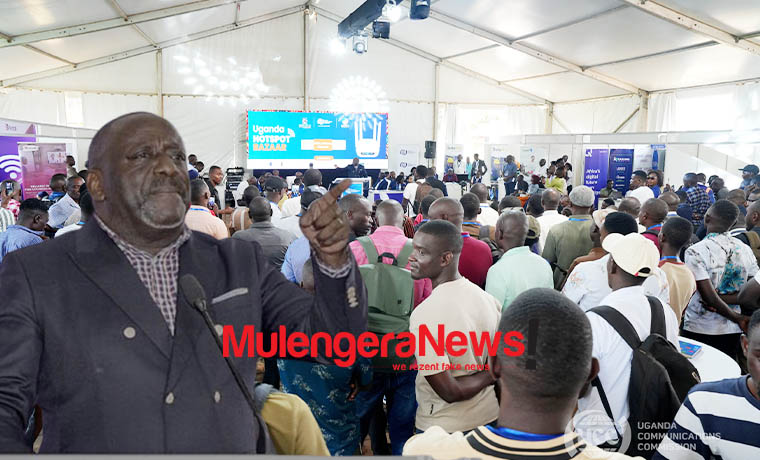
Speaking on Thursday at the UCC-KACITA Wi-Fi Hotspot Bazaar at the Uganda Institute of Information and Communications Technology in Nakawa, Obura said the operators were already reaching customers whom established providers might otherwise struggle to serve.
“At the end of the day these hotspot business owners are reaching people whom we may not normally reach. So we are collaborating in this initiative,” he said.
Obura described the hotspot business as an innovation that allows entrepreneurs to purchase internet capacity in bulk and distribute it to consumers in smaller, more affordable units.
He said this arrangement was very useful for customers who cannot afford conventional fiber connections or larger internet packages but can access connectivity through tokens and vouchers.
“We have to commend them because that’s a good innovation. You’re getting internet in bulk and reselling it,” he said.
He argued that rather than shutting down the businesses because of licensing concerns, established providers should explore ways of working with them to expand their customer base.
Obura said BCC and Fibernet was engaging hotspot operators on affordable internet packages that would take into account the costs they incur while allowing them to make money from distributing the service.
He explained that the agency model was particularly attractive because the hotspot operators would work under the license of an established ISP instead of shouldering the cost of obtaining their own telecommunications licenses.
“The ISP already has a license. So that’s going to reduce your costs. You don’t have to go and pay for a license. You come in and work with an ISP,” he said.
He nevertheless encouraged entrepreneurs with sufficient financial capacity to obtain their own licenses if they wished to operate independently.
Obura warned that operators who ignored the formalization exercise risked losing their equipment and sources of income when UCC begins enforcing compliance requirements.
He said the partnership is not intended to limit the operators’ businesses but to create a system in which both established providers and small-scale distributors can benefit from the expanding demand for internet services.
UCC Executive Director Nyombi Thembo has similarly defended the agency arrangement, estimating that more than 95% of hotspot operators could eventually adopt it.
Thembo said UCC had developed guidelines to facilitate revenue sharing between licensed providers and their agents while ensuring that the smaller businesses meet the legal obligations governing telecom services.
He also cited Uganda’s approximately 20 million smartphone users as evidence of the potential size of the market, arguing that there is enough demand to accommodate different players in the internet distribution chain.
The Thursday Bazaar brought together hotspot operators and several national telecom operators, including MTN, Airtel, Lyca Mobile and UTL, alongside other licensed ISPs.
The engagement provided an opportunity for hotspot operators to compare service providers, discuss internet prices, examine billing systems and explore contractual arrangements.
On the side of the ISPs, the attraction is a ready-made network of entrepreneurs with existing customers and local distribution points. For the hotspot dealers, the arrangement offers an opportunity to retain their businesses without carrying the full financial burden of independent telecommunications licensing.
According to Mr. Obura, the ultimate objective is to ensure that consumers receive affordable internet while businesses across the distribution chain remain commercially viable and compliant with UCC regulations. (For comments on this story, get back to us on 0705579994 [WhatsApp line], 0779411734 & 041 4674611 or email us at mulengeranews@gmail.com).