















By Mulengera Reporters
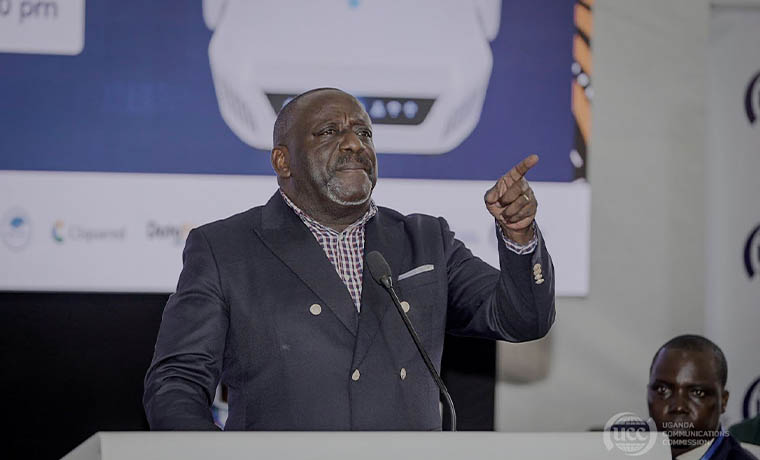
The Uganda Communications Commission (UCC) Executive Director, Nyombi Thembo, has set December 12, 2026, as the deadline for illegal Wi-Fi hotspot operators to formalise their businesses, warning that enforcement against those who fail to comply will begin immediately after the deadline.
Thembo said the Commission was shifting from engagement and negotiations to enforcement, following months of discussions with informal internet data resellers aimed at bringing them into the regulated telecommunications sector.
Speaking while officially opening the two-day Uganda Hotspot Bazaar at the Uganda Institute of Information and Communications Technology (UICT) in Nakawa organized by UCC in conjunction with Kampala City Traders Association Uganda (KACITA-Uganda), Thembo said the Commission had since June been engaging hotspot operators to establish a legal framework that allows them to continue doing business while complying with telecommunications regulations.

“We started engaging these Ugandans in June, and we have been negotiating. In our approach, we created what we called a compliance pathway, which is built on three pillars,” Thembo said.
He explained that the first option requires hotspot operators to acquire the appropriate telecommunications licence, although the Commission recognises that the cost of existing licences may be beyond the reach of many small-scale operators.
To address this challenge, UCC is exploring the creation of a micro-licence category and has also suggested that operators could organise themselves into cooperatives or companies to jointly pursue licensing, with the possibility of support from the Universal Service and Access Fund.
The second and seemingly most attractive option is the agency model, under which hotspot operators will work as agents of already licensed telecommunications companies and Internet Service Providers (ISPs).
Under this arrangement, operators will not need to obtain individual telecommunications licences. Instead, they will be required to register companies and enter into contractual agreements with licensed operators, including the four national network operators and other authorised ISPs.
“This one looked to be more appropriate because it doesn’t require a lot of capital injection on behalf of these hotspotters. You just need to have a company, get a contractual obligation between yourself and the licensed operator, and start operating as their agent,” he explained.
Thembo said UCC had developed guidelines to ensure that hotspot agents receive a share of the revenue generated from the data they sell while meeting the legal, consumer protection and other telecommunications obligations applicable to the sector.
He estimated that more than 95 per cent of the affected hotspot operators would eventually adopt the agency model, comparing the arrangement to mobile money agents and travel agents who provide services on behalf of licensed financial institutions and airlines without having to operate the institutions or airlines themselves.
The Uganda Hotspot Bazaar has brought together hotspot operators and licensed ISPs to facilitate direct engagements, allowing the informal operators to compare business terms, negotiate possible agency arrangements and understand the requirements for joining the regulated telecommunications ecosystem.
According to Thembo, nearly 30 ISPs and the four national network operators — MTN, Lyca Mobile, Airtel and YUtel — are participating in the engagement.
He described the initial discussions as successful, expressing optimism that the agency model would provide a practical solution to the challenge of illegal data reselling.
However, he issued a stern warning to operators who may choose to remain outside the formal system, saying the December 12 deadline would mark the beginning of firm enforcement.
“Government gave them up to 12th December, and that’s when I’ll start to enforce against the illegals. And now I’ll enforce on the illegals with a lot of gusto,” he said.
Thembo added that enforcement would also be necessary to protect the newly registered agents and licensed service providers from unfair competition by operators who continue selling internet data outside the regulatory framework.
Thembo challenges operators to embrace sustainable profits
Beyond compliance, the UCC chief used the engagement to challenge hotspot operators to rethink their expectations about profitability, arguing that the unusually high returns some have been enjoying were largely a result of operating outside the law.
He said some operators had reported monthly earnings of between Shs600,000 and Shs800,000, but cautioned that such returns were not necessarily sustainable because they did not account for applicable taxes, licensing costs, customer identification requirements and cybersecurity obligations.
“Those profits were abnormal profits. Most of that money was government taxes which had not been paid. Most of these were regulatory fees which had not been paid. So that’s not profit. That was profit built on deceit. It can’t be sustainable,” Thembo said.
He explained that the transition to the agency model would likely reduce the amount earned from individual transactions, but operators would benefit from consistent business, increased customer volumes and operational efficiency.
According to him, the model is designed around normal profit margins, where businesses make smaller returns per transaction but build sustainable income by serving large numbers of customers over time.
He cited mobile money agents as an example, noting that their success is based on handling numerous transactions rather than earning unusually high margins from individual customers.
“Now they’ll earn little per transaction, but on scale and efficiency, and consistency for a long time, they’ll make money. That’s how we make money,” he said.
Thembo further expressed confidence that operators who successfully establish themselves as agents could eventually grow their businesses and graduate into applying for independent telecommunications licences.
UCC estimates 4,400 hotspot operators
On the number of operators expected to be affected by the formalisation exercise, Thembo said UCC’s current estimates put the figure at approximately 4,400, significantly lower than earlier claims that the country had as many as 40,000 hotspot operators.
He said the Commission was nevertheless committed to ensuring that every operator willing to comply is accommodated within the regulated ecosystem, regardless of the final number.
Thembo pointed to Uganda’s growing digital market as an opportunity for the operators, revealing that approximately 20 million Ugandans own smartphones, each representing a potential customer for hotspot businesses.
“The telecom sector is serving a very big market. Twenty million people have a smartphone in this country. Every smartphone owner is a potential customer for this agent. There is some food for everybody in this ecosystem. What we are saying is that everybody should operate legally,” he said.
The two-day Uganda Hotspot Bazaar at UICT, Nakawa, is expected to provide a platform for operators to establish business relationships with licensed internet providers and agree on practical arrangements ahead of the December 12 enforcement deadline.
The initiative marks a significant shift in UCC’s approach to informal Wi-Fi businesses, moving away from outright confrontation towards formalisation through partnerships, while maintaining the threat of enforcement against those who fail to comply. (For comments on this story, get back to us on 0705579994 [WhatsApp line], 0779411734 & 041 4674611 or email us at mulengeranews@gmail.com).