








By Aggrey Baba
Kampala Central Division Mayor Salim Saad Uhuru appears to be building a working relationship with Lord Mayor Engineer Ronald Balimwezo that is already producing a different political atmosphere at City Hall, with the two leaders demonstrating that belonging to opposing political parties does not necessarily have to stand in the way of working together for Kampala.
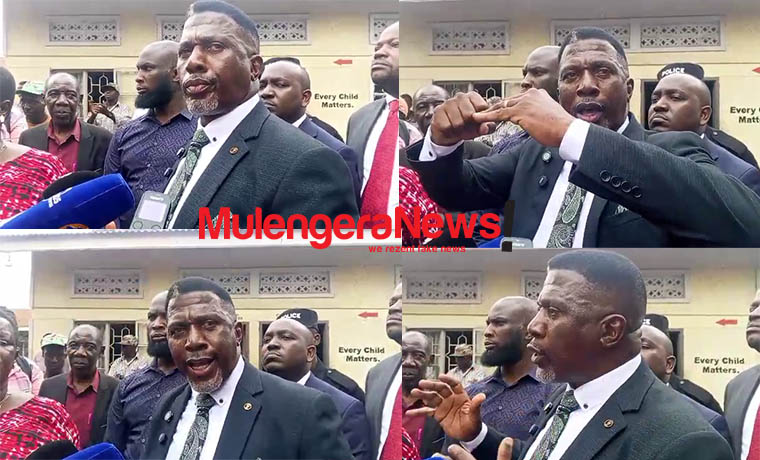
The relationship between the two mayors was on display on Thursday when Balimwezo publicly praised Uhuru for standing up to defend public property at Nakivubo Settlement Primary School, before inviting him to address councillors and other officials who had accompanied them to inspect the nine-acre property.
What made the moment particularly notable was that Uhuru belongs to the National Resistance Movement (NRM), while Balimwezo was elected on the opposition National Unity Platform (NUP) ticket, the party that now controls much of the political leadership at KCCA.
Yet, rather than allowing their political differences to define their relationship, the two appeared comfortable working together on an issue they considered important to the city.
As Balimwezo addressed the gathering over allegations of irregular land titles on the Nakivubo property, he deliberately recognized Uhuru’s contribution to the cause.
“I want to appreciate the mayor for standing up for this cause,” Balimwezo said before inviting Uhuru to say something.
The appreciation was not merely a courtesy extended to a fellow elected leader. It was a public acknowledgement that the Kampala Central Division mayor had taken an active interest in protecting property within his jurisdiction and was prepared to work with the Lord Mayor regardless of their different political affiliations.
When handed the microphone, Uhuru demonstrated that he was not simply accompanying the Lord Mayor for the inspection. He used the opportunity to raise concerns about the management of the school, turning attention to what he described as the questionable renting out of substantial portions of its properties by the school administration and the KCCA technical team.
He also challenged the school’s enrolment figures, saying Nakivubo Settlement Primary School had only 89 pupils, contrary to the head teacher’s claim that it had 139.
The difference of 50 pupils prompted further questions about how the institution was being managed, with Uhuru asking Balimwezo to extend the inspection exercise to all public schools in Kampala.
His intervention was particularly interesting because it showed that the two mayors were not only cooperating on the question of public land but were also prepared to scrutinize the technical officials responsible for managing the city’s institutions and assets.
In fact, both leaders directed attention towards the KCCA technical wing, questioning aspects of how public property and school facilities were being administered.
This is significant when viewed against the history of relations between Kampala’s political leadership and the technical administration, particularly during the 11-year tenure of former Lord Mayor Erias Lukwago.
Lukwago’s tenure was characterized by prolonged confrontations with successive KCCA technical leaders and frequent disagreements with officials appointed by the NRM government.
His political confrontation also extended to the NRM leadership, whose dominance in the council at the time became a major point of contention. Lukwago frequently presented himself as a defender of Kampala against what he considered interference by the central government and its appointees.
The strained relationship between the political and technical wings was so pronounced that, following Musisi’s resignation in 2018, Lukwago publicly spoke about the need to normalize relations and make KCCA operate as an institution rather than a one-person affair.
That history provides an important backdrop to the emerging relationship between Balimwezo and Uhuru.
Unlike the previous political atmosphere, Balimwezo has repeatedly indicated that he wants to work with government institutions and the KCCA technical administration rather than allow political differences to frustrate service delivery.
He has also been seen working with the current KCCA Executive Director, Sharifah Buzeki, during city inspections, signalling a willingness to engage the technical wing even though he belongs to an opposition party.
Thursday’s visit, however, demonstrated that cooperation with technocrats does not mean the political leadership will refrain from demanding accountability.
Balimwezo and Uhuru found common ground in questioning how public property was being managed, with Uhuru openly asking the Lord Mayor to extend the scrutiny to other public schools.
The relationship also presents an interesting political arrangement in Kampala. While Balimwezo provides the overall political leadership of Kampala, Uhuru represents the ruling NRM in Kampala Central Division, one of the city’s important administrative jurisdictions.
Their public interaction suggests that the two are willing to use their respective offices to pursue issues affecting residents without allowing party differences to dominate their working relationship. (For comments on this story, get back to us on 0705579994 [WhatsApp line], 0779411734 & 041 4674611 or email us at mulengeranews@gmail.com).