







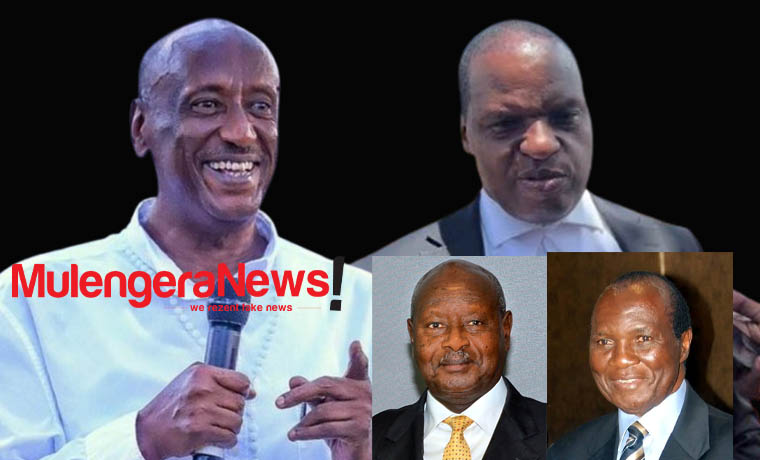
Lawyer Keneth Paul Kakande has questioned the sincerity of President YK Museveni’s proposed consociational dialogue, arguing that the initiative being spearheaded by his brother, Gen Salim Saleh, is another attempt to deceive Ugandans into believing that the president is ready to share power with his opponents.
Kakande, a veteran of the anti-Museveni struggle, says he is not convinced that the proposed arrangement is intended to address Uganda’s longstanding political grievances, particularly the continued detention and prosecution of opposition leaders.
Appearing on the state-owned Star TV during his regular weekly television engagements, Kakande wondered why the architects of the proposed dialogue did not consider inviting the judges handling the cases of PFF leaders Dr Kizza Besigye, Erias Lukwago and other National Unity Platform (NUP) leaders and supporters whose detention has become a major political concern.
Kakande said that if Museveni and his brother Saleh were genuinely interested in finding a permanent solution to the country’s political disagreements, they should have openly confronted the question of political prisoners and involved the judicial officers presiding over their cases in the proposed discussions, given the fact that almost all the opposition political parties have set the same as one of the conditions for them to sit on the same table with the ruling establishment.
He wondered how the government could claim to be searching for a political settlement while leaving out the very judicial decisions that have kept prominent opposition figures behind bars.
“Will the judges who denied Besigye and Lukwago bail also be part of the dialogue? If not, that shows it’s not courts holding them in prison but someone with power. You can’t fool us all the time,” Kakande asked the television discussion.
He says the government should have made it clear that since the proposed dialogue intends to address the grievances of political actors, the judges handling the politically sensitive cases involving Besigye, Lukwago and NUP supporters should also be invited to the table so that a way forward can be found.
For Kakande, the absence of such an arrangement raises serious questions about the real intentions of the initiative and whether the proposed dialogue is intended to resolve Uganda’s political problems or merely provide a new political arrangement through which Museveni can maintain control.
Kakande argues that the continued detention of opposition leaders makes it difficult to accept the argument that the courts are independently responsible for their predicament without asking who ultimately exercises political authority over the country’s institutions.
He contends that the failure to address this question exposes what he described as a family-driven consociational arrangement, with Museveni using his brother to spearhead a political initiative whose ultimate direction remains in the hands of the President.
The lawyer further argued that the people of Uganda should not be distracted by the language of power-sharing when fundamental questions surrounding political freedoms, opposition detentions and the administration of justice remain unresolved.
Kakande said he sees the proposed arrangement as an attempt by a government that has governed Uganda for forty years to calm growing public frustration by presenting itself as willing to accommodate the opposing political forces.
In his view, Museveni has reached a moment when he recognizes that Ugandans are increasingly questioning the political system and that simply promising dialogue and power-sharing may no longer be enough to address their concerns.
He argues that the President is now trying to create the impression that he is prepared to distribute political power among different groups, yet the initiative has not sufficiently addressed the institutions and grievances at the centre of the country’s political disagreements.
Kakande also said that this is not the first time Museveni has used promises of political accommodation to win the confidence of other political actors, only for the commitments to change once he has secured the political advantage he seeks.
To illustrate his argument, the lawyer revisited Museveni’s political engagement with former DP president Paul Kawanga Ssemwogerere during the early years of the NRA/M government.
Kakande recalled that Museveni reached out to Ssemwogerere in the 1980s, assuring him that he only needed one presidential term before retiring and allowing another political arrangement to take shape.
According to Kakande, the initial understanding was that Museveni would serve one term and subsequently leave office, but when that period approached, fresh justifications emerged for extending his stay in power.
He says the President subsequently sought additional time, arguing that he needed to restore the country’s constitutional order, before other explanations emerged that have kept him in office up-to-date.
Kakande argues that what was initially presented as a temporary political arrangement eventually became a prolonged stay in power, with Museveni continuing to govern Uganda for approximately forty years and still counting.
He says this history should make Ugandans cautious about accepting the current consociational proposal without demanding clear commitments, concrete guarantees and an explanation of how the promised sharing of power would actually work.
The central issue, for Kakande, is not simply whether Museveni is prepared to sit with his opponents or other political actors, but whether the proposed dialogue can produce meaningful changes in the way Uganda is governed.
He maintains that a genuine political settlement cannot be built around private family-led initiatives while the grievances of opposition supporters, including those facing criminal proceedings and detention, remain unresolved.
Kakande’s objection adds to the growing debate surrounding the consociational democracy proposal initiated by Gen Salim Saleh and Prof Ogenga Otunnu, which has generated discussion about a possible restructuring of Uganda’s political arrangements to accommodate competing political interests.
The proposal has been presented as an avenue for addressing political divisions through negotiated participation and power-sharing, but questions remain about the participation of key political actors, the proposed institutional safeguards and how such an arrangement would relate to the country’s existing constitutional order.(For comments on this story, get back to us on 0705579994 [WhatsApp line], 0779411734 & 041 4674611 or email us at mulengeranews@gmail.com).