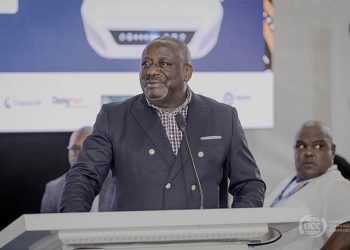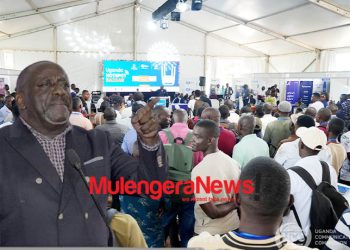








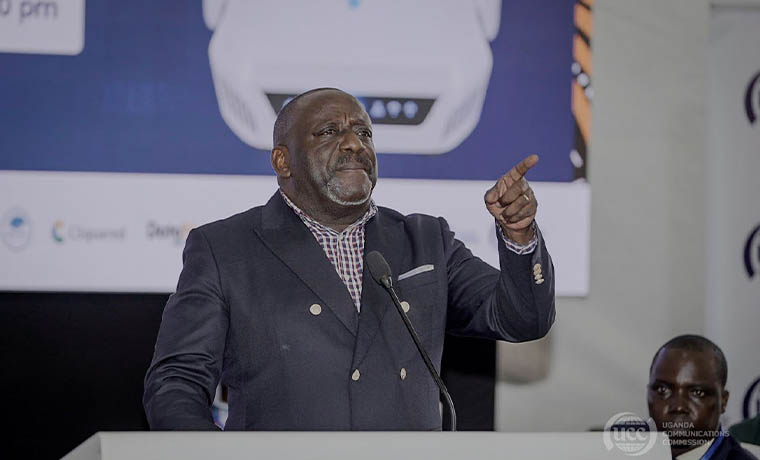
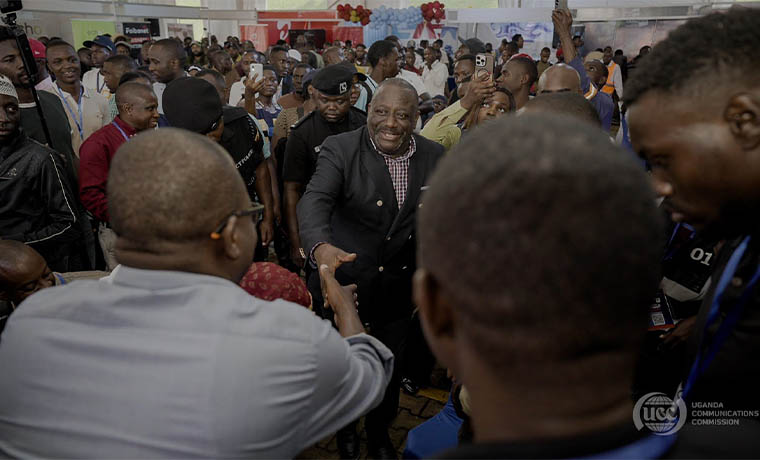
At Thursday’s UCC-KACITA Wi-Fi Hotspot Bazaar held at the Uganda Institute of Information and Communications Technology (UICT) in Nakawa, UCC Executive Director Hon. Nyombi Thembo challenged hotspot operators to rethink what they consider profits, arguing that the UGX600,000 to UGX800,000 some of them previously earned every month was largely an illusion created by operating outside the law and avoiding taxes, regulatory fees and other business obligations.
Thembo said the operators had become accustomed to high earnings from selling internet data, but warned that such returns were neither genuine nor sustainable because they were being generated without meeting the costs and responsibilities that come with running a legitimate internet providing business.
He argued that although the transition to a regulated agency model might initially reduce the profits individual operators earn from each transaction, it would give them a more reliable and sustainable source of income over time.
The UCC boss explained that the uncontrolled profitability of the hotspot business had attracted many people into the market, creating a situation where more operators continued entering the business in pursuit of high returns until competition eventually threatened to eliminate those profits.
“From basic economics, any business with a lot of profits will attract other people. And when there’s no regulation, everybody will come into this business until when those profits disappear,” he said.
He also maintained that the solution was not for operators to continue pursuing unusually high margins but to embrace a business model in which they earn smaller amounts per transaction while building their income through customer numbers, efficiency and consistency.
“The only model that works is where profits are normal. And where profits are normal, you earn little but you earn on scale and efficiency,” he explained.
To illustrate his argument, Hon Nyombi Thembo compared the proposed arrangement to the mobile money business, where individual agents earn relatively small commissions from transactions but generate reasonable incomes by serving many customers.
He also cited travel agencies, explaining that people do not have to own aircraft or operate airlines to benefit commercially from the aviation industry.
Thembo argued that hotspot operators should similarly position themselves as internet distribution agents rather than attempting to operate independently without the necessary telecom licenses.
However, his most pointed remarks concerned the actual source of the profits that hotspot operators had previously reported.
He said the UGX600,000 to UGX800,000 monthly earnings some operators had been making were misleading because the businesses had not accounted for government taxes, regulatory fees and the costs associated with meeting mandatory compliance requirements.
“Most of these were regulatory fees which had not been paid. Most of these were inefficiencies because they didn’t have KYC, all cyber security concerns and everything like that. So that’s not profit. That was profit built on deceit. It can’t be sustainable,” he said.
His words suggest that UCC considers the formalization exercise not merely a licensing campaign but also an attempt to correct a business model in which operators collect money from customers without carrying the full costs and responsibilities borne by licensed Internet providing companies.
Under the new agency model, hotspot providers will enter into contractual arrangements with licensed Internet Service Providers (ISPs), which will supply the internet and allow the smaller businesses to distribute it to customers under their existing licenses.
Hon Thembo said UCC had already developed guidelines to facilitate revenue sharing between the licensed providers and their agents, ensuring that hotspot operators receive a portion of the value generated from the internet services they sell.
He clarified that the specific earnings would be determined by contractual agreements between individual operators and the ISPs they choose to work with.
The model is intended to offer a cheaper alternative to obtaining independent telecom licenses, which many hotspot operators have complained are too expensive for their small businesses.
The UCC boss said his Commission had also explored the possibility of introducing a micro-licensing category for smaller operators who wish to run independent businesses but cannot afford the existing licensing requirements.
He added that operators could also organize themselves into cooperatives or companies and pursue collective licensing arrangements, with the possibility of support from the Universal Service and Access Fund.
However, he said the agency model appeared to be the most practical option because it requires less capital and allows operators to begin working under an established provider without having to obtain individual licenses.
Thembo estimated that more than 95% of the hotspot operators would eventually adopt this arrangement, although he predicted that some would grow their businesses and later acquire independent licenses.
He also dismissed fears that the formalization programme would eliminate the small businesses, arguing that Uganda’s internet market is large enough to accommodate both established telecom companies and independent distribution agents.
He said approximately 20 million Ugandans own smartphones, representing a substantial potential market for the hotspot operators.
The UCC boss said the Commission’s intention was to bring everyone into a legal business ecosystem rather than push entrepreneurs out of the market.
Thursday’s Bazaar brought together hotspot operators and licensed providers, including MTN, Airtel, Lyca Mobile, Roke Telecom and UTeL, alongside other ISPs, to negotiate affordable internet packages, billing systems and possible business partnerships. (For comments on this story, get back to us on 0705579994 [WhatsApp line], 0779411734 & 041 4674611 or email us at mulengeranews@gmail.com).