







By Mulengera Reporters
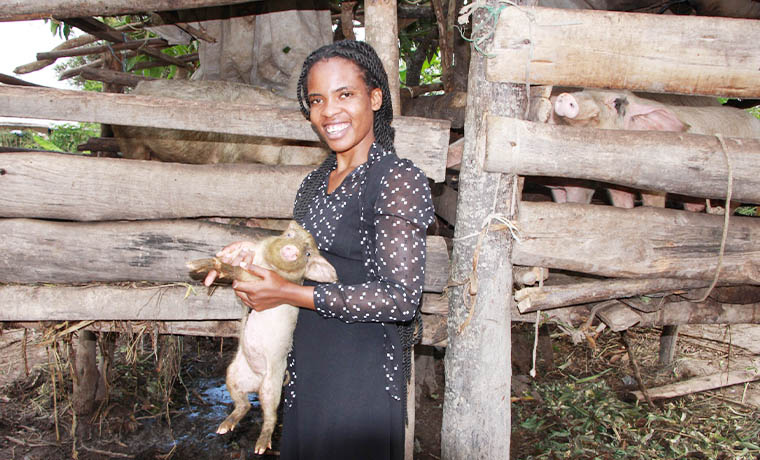
At a young age, Evete Mukeshimana had already experienced the pain of displacement, an abusive marriage and the struggle of raising children without a partner. But rather than surrender to her circumstances, the 26-year-old Congolese refugee has turned to piggery to rebuild her life and provide for her two sons.
Born in 2000 in Masisi, Karegera, Northern Kivu Province in the Democratic Republic of Congo (DRC), Mukeshimana fled to Uganda in 2013 with her mother and brother following insecurity and conflict in her home country.
She recalls that life in Congo had become unbearable, with her family constantly fleeing attacks and struggling to find somewhere safe to sleep.

“We had nowhere to sleep. We had to run away every day and night, so we came to Uganda,” she recalls.

Upon arriving in Uganda, the family found safety and shelter, with humanitarian assistance, including food support from the World Food Programme (WFP), helping them survive for years.
However, as refugee assistance changed and her family gradually moved towards self-reliance, Mukeshimana realised she needed to find ways of earning an income rather than continue depending on humanitarian support.
Today, she lives in Busheka Village, Buyanga Sub-county, Nakivale Refugee Settlement, Isingiro District, where she engages in piggery and hairdressing to provide for her household and meet the educational needs of her two boys.
“I am doing a pig farm where I get what to eat and where I get the school fees for my two boys because now I have children. That’s how we are surviving,” she says.
GROW training introduces her to piggery
Mukeshimana’s journey into piggery began about four years ago, but establishing the business was initially difficult.
With limited resources and practical knowledge, she struggled to grow the enterprise and generate enough income to meet her family’s needs.
Her breakthrough came after she came across an advertisement inviting women entrepreneurs to participate in free business training under the Generating Growth Opportunities and Productivity for Women Enterprises (GROW) Project.
She applied and was selected to attend a one-month practical piggery training programme at Gudi Leisure Farm in Najjera, Kira Municipality, Wakiso District, in April 2024.
The training equipped her with practical knowledge and skills in pig farming, opening a new opportunity for her to strengthen her enterprise.
She also participated in training in bankable financial record-keeping facilitated by the Private Sector Foundation Uganda (PSFU), which helped her appreciate the importance of proper business records and financial management.
Following the training, the GROW Project followed up with her and linked her to financing through UGAFODE Microfinance Limited.
She subsequently accessed a GROW loan of Shs1 million at an interest rate of 10 per cent of the total loan amount, with a repayment period of eight months.
The financing provided an important boost to her struggling piggery enterprise, helping her invest in the business and gradually expand production.
From an initial stock of two pigs, she has grown her enterprise to 12 pigs.
She says piggery has become an important source of income, enabling her to meet household needs and pay school fees for her two children.
Apart from piggery, Mukeshimana also acquired hairdressing skills through the GROW-supported training programme and received start-up equipment to establish a salon.
However, her progress in both enterprises would later be interrupted by challenges in her marriage.
Domestic violence forces her out of marriage
Mukeshimana says one of the biggest challenges she has faced in Uganda has been marriage.
She married a Burundian refugee, hoping to build a family and establish a stable future.
However, she says the relationship became increasingly difficult as her husband allegedly interfered with her efforts to become economically independent.
According to Mukeshimana, after receiving hairdressing training and start-up equipment, she established a salon, but her husband sold the equipment and other items she had acquired for the business.
She says she also had four pigs following her participation in the GROW training, but her husband wanted to sell the assets she had worked hard to acquire.
The situation was compounded by domestic violence, with Mukeshimana alleging that her husband physically assaulted her whenever she questioned his actions or raised concerns about their household affairs.
“I had even four pigs after the GROW training, but he was like everything I have to sell it. On top of it, he used to beat me whenever I complained about my things or certain issues that were not working well,” she recounts.
Faced with the possibility of losing everything she had worked to establish, Mukeshimana decided she could no longer remain in the marriage.
She eventually left and returned to live with her mother, where she continues to raise her two children while rebuilding her enterprises.
Although she was unable to revive her salon after losing its equipment, she chose to continue with piggery, which had remained her most dependable source of income.
Her determination to maintain the business has enabled her to keep providing for her children despite the challenges of single parenthood.
Loan repayment challenges amid family responsibilities
Although piggery has helped Mukeshimana sustain her household, running the business while raising two children has not been without difficulties.
She says proceeds from piggery have enabled her to make repayments on the Shs1 million GROW loan, which carries a 10 per cent interest rate on the total loan amount and an eight-month repayment period.
However, unexpected illnesses and pressing household needs have affected her ability to meet the repayment schedule as planned.
She is still repaying the loan, explaining that balancing business expenses, loan obligations and the responsibility of providing for her two children has placed considerable financial pressure on her.
Nevertheless, she remains committed to keeping her piggery business running, describing it as an important source of income for feeding her family and paying her children’s school fees.
Her experience highlights the challenges refugee women entrepreneurs, particularly single mothers, face in sustaining businesses while managing household responsibilities, health-related expenses and limited financial resources.
Appeals for more support for refugee single mothers
Beyond her personal struggles, Mukeshimana wants the government and organisations supporting women entrepreneurs to pay greater attention to refugee women who leave abusive marriages and find themselves raising children alone.
She argues that while business training and loans provide important opportunities, some women need additional support to sustain their enterprises, particularly when they lack partners or other reliable sources of household income.
She is calling for continued follow-up and possible additional financing for vulnerable refugee women who have already started businesses but struggle to expand them.
“I would like you to follow up the ladies, the refugee women who are suffering. Some of us got married, but we were not able to stay with our husbands because of challenges. We are now single mothers struggling to raise our children,” she appeals.
She believes additional capital and continued business support would help such women strengthen their enterprises, become financially independent and provide better lives for their children.
“If it is possible to add more money to their businesses and support what they are doing, it can be better so that those women can stay and be happy with their children without having to look for other men to take care of their babies,” she says.
For Mukeshimana, the appeal is not simply about receiving more money. It is about ensuring that women who have experienced difficult marriages and other forms of vulnerability are not left without the means to support their families.
GROW Project expands financing opportunities for women
Mukeshimana’s experience illustrates the importance of combining business training, access to finance and continued support in helping women entrepreneurs establish and sustain their enterprises.
Through UGAFODE Microfinance Limited, the GROW Project is extending financing opportunities to women entrepreneurs, including those living in refugee-hosting communities such as Nakivale Refugee Settlement.
The Generating Growth Opportunities and Productivity for Women Enterprises (GROW) Project is implemented by the Private Sector Foundation Uganda (PSFU) in partnership with the Ministry of Gender, Labour and Social Development, with financing from the World Bank.
UGAFODE is among the financial institutions implementing the GROW loan facility to improve women’s access to affordable business financing.
The project seeks to expand women’s access to finance and business support services to enable them to establish, grow and sustain their enterprises.
The GROW loan facility targets micro and small enterprises in which women own at least 51 per cent of the shareholding.
Eligible businesses operate across various sectors, including agriculture, agro-processing, manufacturing, construction, science and technology, services, creative arts, and information and communication technology.
For Mukeshimana, the GROW initiative has provided more than an opportunity to borrow money. Its training helped her acquire practical piggery skills, while the Shs1 million loan gave her business the financial boost it needed to grow.
From struggling with just two pigs to managing a herd of 12, she is gradually building an enterprise that supports her children and gives her renewed hope for the future.
Despite the setbacks in her marriage and the financial difficulties she faces, she remains determined to keep her piggery business running.
Her story demonstrates the importance of ensuring that refugee women, particularly single mothers and survivors of domestic violence, have access to the skills, financing and continued business support needed to rebuild their lives and achieve economic independence. (For comments on this story, get back to us on 0705579994 [WhatsApp line], 0779411734 & 041 4674611 or email us at mulengeranews@gmail.com).