








By Mulengera Reporters
Third Deputy Prime Minister Rukia Nakadama has boldly challenged Uganda’s private sector, entrepreneurs and innovators to take a leading role in transforming the country’s economy, saying government cannot achieve its ambitious target of building a $500 billion economy by 2040 alone.
Nakadama said achieving the target requires increased private investment, innovation, productivity, value addition and the creation of enterprises capable of competing in regional and international markets.
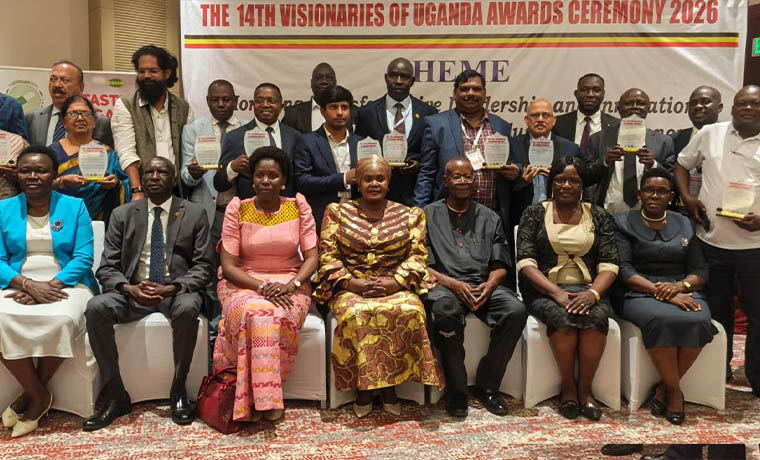
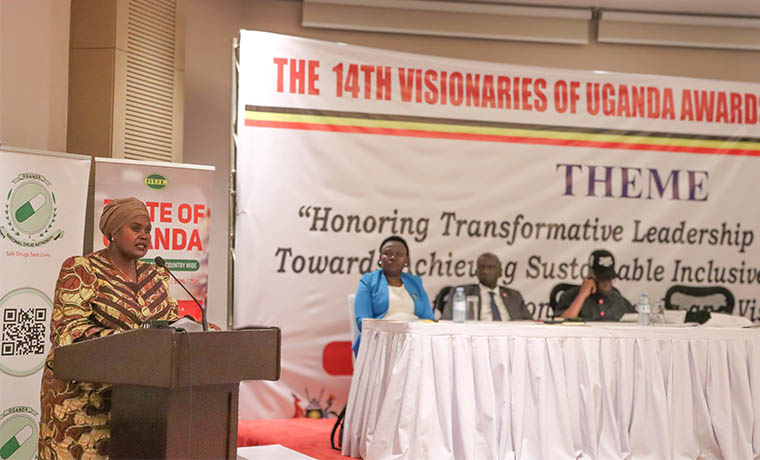
She made the remarks while officiating as Chief Guest at the 14th Visionaries of Uganda Awards 2026 held at Serena Hotel in Kampala on Wednesday night.

The awards, held under the theme, “Promoting Transformative Leadership and Innovation Towards Achieving Sustainable Inclusive Socio-Economic Transformation of Uganda and Vision 2040,” recognise individuals, institutions and initiatives contributing to Uganda’s development.

Nakadama, who also serves as State Minister Without Portfolio in the Office of the Prime Minister, said national transformation could not be delivered by government alone but required coordinated efforts involving businesses, academia, communities and citizens.
“The private sector is not a spectator in Vision 2040, it is a principal implementer of it,” she said.
She noted that Uganda’s Fourth National Development Plan (NDP IV), covering the financial years 2025/26 to 2029/30, provides the implementation framework for the country’s long-term development aspirations.
The plan is the first of six five-year development plans intended to guide the implementation of Uganda Vision 2040, which seeks to transform the country into a modern and prosperous nation.
Nakadama said the plan prioritises increased household incomes, commercialisation of the economy and employment creation as key drivers of sustainable socio-economic transformation.
She added that achieving the $500 billion economic ambition would require deliberate investment in infrastructure, human capital, technology, industrialisation and export competitiveness.
Economy grows by 6.4 per cent
The Deputy Prime Minister pointed to Uganda’s economic performance as evidence of progress, citing Uganda Bureau of Statistics figures indicating that the economy grew by 6.4 per cent in the 2025/26 financial year, compared with 6.3 per cent in the previous year.
She said the economy had reached approximately Shs250.4 trillion, but cautioned that economic growth must translate into productive employment, improved public services and higher household incomes.
Among the sectors registering growth during the financial year, agriculture expanded by 6.5 per cent, manufacturing by 5.5 per cent and construction by 8.2 per cent.
Electricity activities grew by 14.4 per cent, while information and communication expanded by 6.6 per cent.
Nakadama said the performance demonstrated the progress being made across productive sectors, but emphasised the need to strengthen investment and ensure that economic growth benefits ordinary Ugandans.
Oil production must benefit Ugandans
She also highlighted developments in Uganda’s oil and gas sector, describing the unveiling of the country’s crude oil brand, Pearl Sweet, on September 2, 2026, as an important milestone in the country’s journey towards commercial oil production.
She said the Tilenga and Kingfisher oil developments are designed to support combined production of up to 230,000 barrels of oil per day, while the East African Crude Oil Pipeline will extend 1,443 kilometres to the Tanzanian coast.
However, she said the success of the oil sector should not only be measured by production volumes and revenue but also by the opportunities it creates for Ugandans.
She called for increased local procurement, skilled employment, infrastructure development, responsible environmental management and investment in human capital.
“Any oil resource is finite; the opportunities we build from it must endure,” she said.
Government pushes skills development
Nakadama further emphasised the need to equip young people with skills that respond to the demands of a changing economy.
She said education and training institutions should increasingly focus on science, technology, engineering and mathematics, technical skills, digital competencies, entrepreneurship and problem-solving.
She cited institutions such as the petroleum training facilities in Kikuube and the Presidential Industrial Hubs as important interventions aimed at equipping young people with practical skills.
She challenged universities, government and private businesses to strengthen partnerships to prepare young people for emerging industries rather than limiting them to seeking traditional employment opportunities.
“Young Ugandans should not be prepared merely to search for the jobs of yesterday. They must be prepared to design the industries, technologies, services and institutions of tomorrow,” she said.
Awards recognise contributors to national development
Nakadama commended the Visionaries of Uganda Awards for recognising individuals and institutions whose work contributes to national development.
She said the awards provide an opportunity to celebrate organisations and leaders who translate ideas into practical interventions that improve people’s lives.
She particularly highlighted the importance of initiatives such as the Projects for Inclusive Markets for Energy Efficiency in Uganda, implemented by SNV Netherlands Development Organisation with support from the Swiss Government.
She urged award recipients and nominees to maintain ethical leadership, responsible investment and innovation that addresses Uganda’s development challenges.
The Visionaries of Uganda Awards were launched by President Yoweri Museveni in 2013 to recognise impactful personalities, institutions and initiatives contributing to national transformation.
Nakadama said government would continue investing in productive infrastructure, human capital and reforms to improve service delivery, but called for greater private-sector participation in financing and implementing NDP IV.
She challenged businesses to move beyond profit-making and embrace investments that generate employment, improve productivity and contribute to the country’s long-term development.
She congratulated the award recipients and nominees, urging them to use their achievements as inspiration to contribute further to building a competitive, inclusive and prosperous Uganda. (For comments on this story, get back to us on 0705579994 [WhatsApp line], 0779411734 & 041 4674611 or email us at mulengeranews@gmail.com).