









By Aggrey Baba
The students of Makerere University may have elected a new Guild President in the recent elections, but the institution could have missed an opportunity to have one of its most articulate student leaders occupy the Guild leadership seat.
Claver Peter Kyajja, who contested for the Guild presidency on the Democratic Party (DP) ticket, lost to Ms Gracious Kadondi, who contested on the National Unity Platform (NUP) ticket.


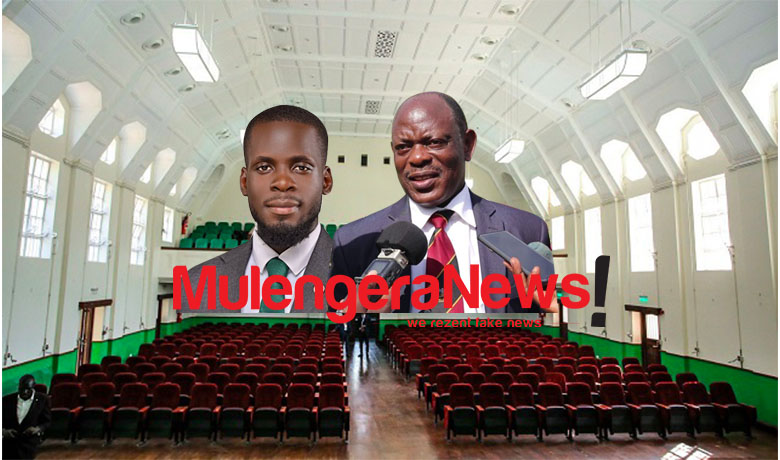
Yet, judging from the ideas he presented during a podcast with Mulengera News on Tuesday, Kyajja’s campaign was not simply about winning an election, but it was an attempt to put some of the university’s long-standing challenges at the center of student leadership. See detailed video interview via this link https://www.youtube.com/watch?v=ofLk9YfVoZY&t=629s&pp=ygUSbXVsZW5nZXJhIG1lZGlhIHR2.
The discussion came against the backdrop of a recent report published by New Vision highlighting concerns over university students reportedly dying from hunger, bringing renewed attention to the increasingly difficult conditions under which many students pursue higher education.

It was against this backdrop that Mulengera News engaged Kyajja, a former Guild presidential candidate, to discuss the situation at Makerere, the challenges students face and what he believes should be done to address them.
During the podcast hosted by Mulengera News journalist Aggrey Baba Buluba, Kyajja spoke extensively about student welfare, the cost of education, accommodation, feeding, government sponsorship and the responsibility of university management.
His arguments presented a student leader with an ideology that went beyond the usual politics of Guild elections, where candidates often compete on popularity, slogans and political party affiliation.
Kyajja instead attempted to approach Makerere’s problems from an economic and institutional perspective, arguing that the university and government must take greater responsibility for creating an environment in which students can actually study and thrive.
One of his strongest concerns was the feeding crisis among students.
Kyajja argued that many students struggle to afford even modest meals, warning that the consequences go beyond hunger because students are in an academic environment that demands higher levels of concentration and intellectual effort.
He cited research suggesting that about 90% of university students in Uganda struggle to afford adequate meals, although he acknowledged that there was no single official statistic he could rely on to conclusively establish the figure.
“We are in an academic institution where the growth of academia is very imperative. You need to help people. The brain consumes a lot of food,” Kyajja said, explaining why he believes feeding should be treated as an academic and institutional concern rather than merely a student’s personal financial problem.
He questioned the decision to replace the provision of meals to government-sponsored students with cash allowances.
According to him, students who reside in university halls receive about UGX 500,000 for feeding over the semester, while non-residents receive about UGX 760,000, with part of the latter amount presumed to cater for accommodation.
He questioned the practicality of such arrangements in the current economic environment.
Using his own calculations, Kyajja said a student spending about UGX 2,000 on breakfast and UGX 4,000 each on lunch and supper would require approximately UGX 10,000 every day to maintain even a modest three-meal routine.
Over roughly 100 days, he calculated that this would amount to about UGX 1.2 million, more than twice the amount allocated to a resident government-sponsored student for feeding.
For Kyajja, this illustrates a fundamental mismatch between the support provided to students and the actual cost of living around Makerere.
“I do not think it was a wise decision for the government to make that resolution, because government students are given money instead of the food,” he said.
He argued that government and university management could achieve better prices through economies of scale by procuring food in bulk instead of leaving students to purchase individual meals from private service providers.
His argument was that the university and government have the purchasing power to secure food at prices that individual students cannot achieve.
“The price at which the government finds rice, the price at which the university management or the government is going to find beans, flour for making posho and all, is not the same price this service provider is going to get,” Kyajja argued.
His criticism extended to accommodation.
Kyajja, who is pursuing a Bachelor of Commerce(BCOM) said privately sponsored students face tuition costs running into millions of shillings while their parents must separately raise money for accommodation and feeding.
He gave the example of students from poor farming families who have to depend on their parents for tuition, accommodation and other necessities.
He argued that accommodation charges should correspond with the quality of facilities students receive, saying some private hostels outside the university offer better accommodation at comparable or even lower prices.
According to Kyajja, the burden placed on parents can become overwhelming when tuition, accommodation, food and other academic expenses are combined.
“For my course, I’m doing Bachelor of Commerce. This semester I paid about UGX 2.2 million. On top of the UGX 2.2 million, my father is supposed to pay at least UGX 600,000” for accommodation, he explained.
For a student from a poor rural family, he argued, the figures quickly become unsustainable.
This is where Kyajja believes student leadership should become more than a political office.
He argued that the Guild should be able to question policies that directly affect students and engage university management and government on practical solutions rather than merely reacting to crises.
His proposals included subsidizing student meals, reviewing accommodation charges and improving the quality of university accommodation.
He also called for greater accountability from lecturers and other university stakeholders, arguing that the welfare of students should remain central to the academic mission of Makerere.
Perhaps what distinguished Kyajja was the way he connected these problems.
Rather than viewing hunger, accommodation, tuition and academic performance as isolated challenges, he presented them as interconnected pressures that can determine whether a student survives university, drops out or completes their studies under enormous financial strain.
He also spoke about the less visible consequences of student hardship, including declining health and, in extreme cases, deaths among students.
While he acknowledged that claims about students dying every week or every month could not be confidently established without reliable statistics, he maintained that the existence of student deaths and serious welfare challenges should itself prompt a serious institutional conversation.
His approach was therefore less about making sensational claims and more about demanding that the university and government confront the conditions under which students are expected to study.
He also challenged students themselves to recognize their responsibility in demanding better conditions rather than remaining silent.
Kyajja’s loss to Kadondi may consequently be viewed as more than the defeat of one candidate by another. It could be argued that Makerere students missed the opportunity to place in the Guild presidency a student leader whose politics was built around questioning systems, interrogating figures and demanding explanations for decisions affecting students.
His DP ticket may have been a disadvantage in a contest where national political loyalties increasingly influence student politics, particularly against a candidate carrying the NUP or NRM ticket.
But beyond party politics, Kyajja’s campaign revealed an ideological position that could have made his Guild presidency markedly different. He appeared determined to use the office not merely as a platform for student representation but as an avenue for challenging the structures that he believes contribute to student hardship.
That may explain why, despite losing the election, Kyajja’s arguments remain relevant, particularly at a time when the question of student hunger has moved from private conversations on university campuses into the national spotlight. (For comments on this story, get back to us on 0705579994 [WhatsApp line], 0779411734 & 041 4674611 or email us at mulengeranews@gmail.com).