







By Atwemereireho Alex (alexatweme@gmail.com)
There comes a moment in the life of a nation when silence becomes complicity and candour becomes patriotism. Uganda is at such a moment. Beneath the rituals of elections, the pageantry of campaigns, and the illusion of popular choice lies a corrosive reality that has steadily hollowed out the soul of our politics: the monetisation of political power. Politics in Uganda has, over time, been transformed from a contest of ideas, character, competence, and conviction into a marketplace where leadership is purchased, loyalty is rented, and public office is treated as a private investment to be recouped with interest once power is secured. This quiet but devastating mutation has cost the country its most precious asset, thoughtful, visionary, principled leadership, and replaced it with transactional politics devoid of ideology, imagination, and national purpose.
The monetisation of politics is not merely about money changing hands during elections; it is a systemic pathology that redefines the very meaning of leadership. It is the reduction of political engagement to cash handouts, vote-buying, patronage, inducements, and the weaponisation of poverty. In such a system, elections are no longer referenda on ideas or competence but auctions in which the highest spender often prevails, regardless of intellectual depth, ethical grounding, or policy vision. As Plato warned in The Republic (c. 380 BCE), “Unless philosophers rule as kings or those who are now called kings and leading men genuinely and adequately philosophize… there can be no rest from evils for the cities.” Uganda’s experience painfully confirms this ancient insight: where wisdom is crowded out by money, governance degenerates into appetite and expediency.

Empirical evidence bears this out with unsettling clarity. Reports by civil society organisations such as the Alliance for Finance Monitoring (ACFIM), ACODE, and Transparency International Uganda consistently indicate that Ugandan elections are among the most expensive in Africa relative to average incomes. Credible monitoring reports from recent electoral cycles show that parliamentary candidates in competitive constituencies routinely spend between UGX 300 million and UGX 2 billion, while presidential campaigns run into hundreds of billions of shillings. This occurs in a country where, according to the Uganda Bureau of Statistics (UBOS), approximately 39–41% of the population lives in multidimensional poverty, and where the average monthly household income remains modest by any global standard. This grotesque mismatch between campaign expenditure and citizens’ living conditions is not accidental; it is structural. Poverty becomes the currency through which political loyalty is bought, while conscience, ideology, and long-term vision are crowded out.

The consequence is brutal but logical: individuals with ideas but without money are systematically excluded from leadership. Teachers, scholars, policy thinkers, young reformers, community intellectuals, and principled professionals, those who might offer Uganda fresh thinking, ethical leadership, and long-term planning are locked out by prohibitive campaign costs. Meanwhile, those with access to wealth, often accumulated through opaque or politically connected means, dominate the political space. Joseph A. Schumpeter, in Capitalism, Socialism and Democracy (1942), warned that democracy risks decay when it is reduced to a competition for votes devoid of substantive choice, noting that political competition can become “a struggle for the people’s vote” rather than a contest of ideas. Uganda today offers a living laboratory of this degeneration.
The legal framework of Uganda, at least on paper, envisages a radically different political culture. Article 1(1) of the Constitution of the Republic of Uganda (1995) provides that “all power belongs to the people,” while Article 1(4) commands that this power “shall be exercised in accordance with this Constitution.” Article 38(1) guarantees every citizen the right “to participate in the affairs of government, individually or through his or her representatives.” Article 59(1) enshrines the principle of free and fair elections, mandating that citizens vote “in regular, free and fair elections.” Yet the spirit and letter of these provisions are steadily suffocated by the reality of monetised politics. When participation is conditioned on one’s ability to distribute cash, buy fuel, sponsor funerals, and bankroll campaigns, the constitutional promise of equal political participation becomes a mirage.

The law does attempt to regulate campaign financing and electoral conduct. The Presidential Elections Act, the Parliamentary Elections Act, and the Political Parties and Organisations Act contain provisions intended to promote fairness, transparency, and accountability. Uganda is also bound by regional and international instruments, notably the African Charter on Democracy, Elections and Governance (Article 3, obliging states to promote democratic principles and transparent governance) and the United Nations Convention Against Corruption (UNCAC) (Articles 7 and 8, requiring transparency in political financing and integrity in public life). Yet enforcement remains weak, selective, or symbolic. Where the law is not enforced with independence and courage, it becomes ornamental, a decorative shield for a broken system.
The predictable outcome of weak enforcement is institutional moral hazard. Leaders who enter office through monetised pathways quickly learn that accountability is negotiable and sanctions are elastic. Oversight institutions are politically pressured, regulatory agencies are underfunded, and whistleblowers are isolated. The state begins to function not as a neutral guarantor of the public good but as an arena of elite bargaining, where access replaces merit and proximity to power outweighs competence. In such a climate, corruption ceases to be deviant behaviour and becomes a rational strategy for political survival.
Beyond legality lies a deeper philosophical injury. Monetisation has collapsed politics into survival economics. Voters, understandably burdened by poverty, begin to assess candidates not by ideas but by immediate material benefit. This is not a moral failure of the poor; it is an indictment of a system that has normalised deprivation while turning elections into rare moments of transactional relief. Frantz Fanon, in The Wretched of the Earth (1961), observed that when political systems fail to deliver structural dignity, politics degenerates into struggle over immediate material survival rather than collective liberation. Uganda’s political economy has perfected this tragic cycle.
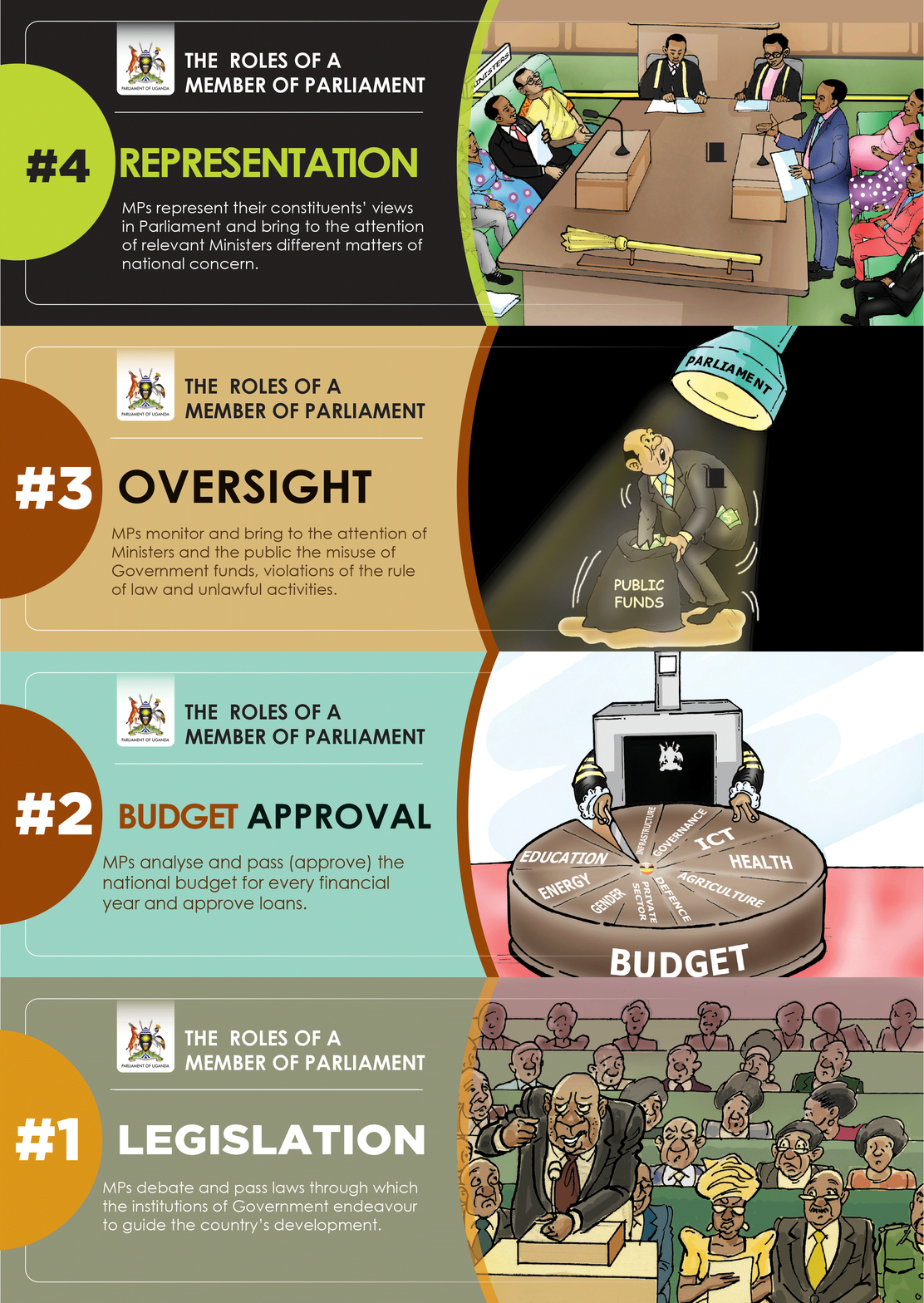
The cost to leadership quality is incalculable. Visionary leadership requires time for thought, ideological grounding, policy literacy, moral courage, and the ability to imagine a future beyond the next election. Monetised politics punishes these attributes. It rewards populism over policy, noise over nuance, loyalty over competence, and wealth over wisdom. Parliament risks becoming a chamber of investors seeking returns rather than statespersons crafting laws for posterity. Edmund Burke, in his 1774 Speech to the Electors of Bristol, warned that “your representative owes you, not his industry only, but his judgment; and he betrays instead of serving you if he sacrifices it to your opinion.” In a monetised system, judgment itself is auctioned.
Uganda’s development challenges – youth unemployment, underfunded education, fragile healthcare systems, poor means of transport, environmental degradation, governance deficits -demand leaders who think in decades, not electoral cycles. Yet monetised politics incentivises short-termism. Leaders who spend extravagantly to acquire office inevitably view public resources as reimbursement. Corruption thus becomes not an aberration but an economic logic. Max Weber, in Politics as a Vocation (1919), distinguished between living for politics and living off politics; Uganda increasingly suffers from the latter, where office is treated as income-generating capital rather than public trust.
This logic of recovery has cascading effects. Policy is captured by financiers, procurement processes are manipulated to reward political creditors, and public debt is normalised to sustain patronage networks. The long-term cost is generational: weakened institutions, eroded public trust, fiscal stress, and a citizenry increasingly alienated from formal politics. When leadership is compelled to prioritise survival over statesmanship, the nation’s future is silently mortgaged to the past.
The implications stretch beyond borders. International observers often praise procedural aspects of elections while ignoring the deeper distortion caused by money politics. Global economic and political powers, keen on stability over transformation, frequently tolerate systems that deliver predictability even if they stifle visionary change. A leadership class produced through monetized politics is often more manageable, less ideologically disruptive, and more amenable to external interests. This is not conjecture but political economy. Samir Amin, in Eurocentrism (1988), argued that peripheral states are often kept in dependent equilibrium through compliant elites rather than empowered citizens.
Yet patriotism demands that critique be accompanied by possibility. Uganda is not condemned to this fate. The way forward lies in a deliberate re-moralization and de-commercialization of politics. This requires strict enforcement of campaign finance laws, transparent and enforceable ceilings on expenditure, public funding of political parties tied to measurable accountability, and civic education that restores dignity to the vote. It requires strengthening independent institutions; especially the Electoral Commission and the judiciary, so that the law is not intimidated by money. It requires cultural renewal, where leadership is once again associated with service, sacrifice, and ideas rather than cash distributions.
Most importantly, it requires citizens to reclaim politics as a collective moral project rather than a transactional event. As Kwame Nkrumah declared in Africa Must Unite (1963), “Political independence is meaningless unless it is accompanied by economic and intellectual liberation.” Uganda’s political renewal will not come from deeper pockets but from deeper thinking, ethical courage, and a recommitment to the constitutional promise that power belongs to the people, not to money.
In the final analysis, the monetization of politics is not just a technical flaw; it is a national emergency. It erodes leadership quality, degrades democratic values, and mortgages the future. If Uganda is to rise to its full potential, it must decisively break with the culture of priced ballots and auctioned leadership. For a nation cannot buy its way to greatness; it must think, choose, and build its way there, with integrity, vision, and unwavering fidelity to the public good. The writer is a lawyer, researcher and governance analyst. (For comments on this story, get back to us on 0705579994 [WhatsApp line], 0779411734 & 041 4674611 or email us at mulengeranews@gmail.com).