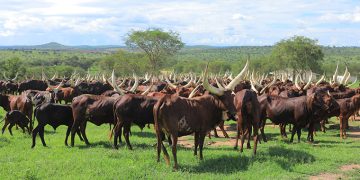








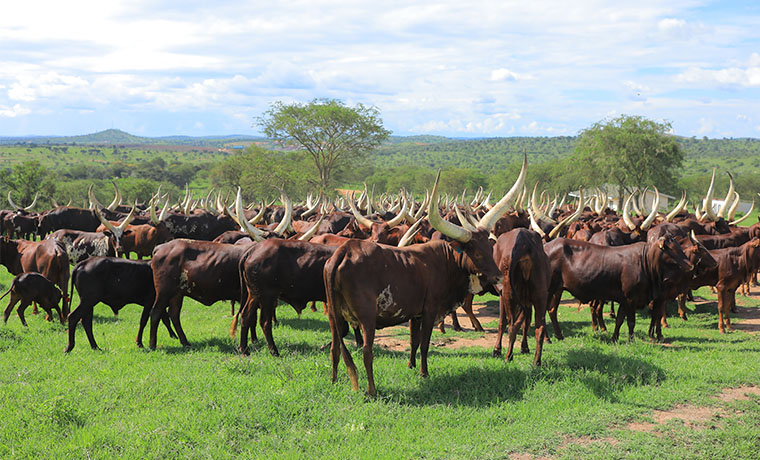
For generations, Uganda’s Ankole Longhorn has been celebrated for its distinctive horns, hardiness and ability to survive under challenging conditions. But new results from a government breeding programme suggest the iconic breed may have another largely untapped strength: milk production.
At Nshaara Conservation Ranch in Kiruhura District, the National Animal Genetic Resources Centre and Data Bank (NAGRC&DB) is selectively breeding pure Ankole cattle to unlock higher milk yields—without crossing them with exotic dairy breeds.
The results are beginning to challenge conventional perceptions of what the indigenous breed can produce.
Average milk productivity at the ranch increased from 5.2 litres per cow per day in 2023 to 8.6 litres in 2025, representing an increase of about 65 percent over the three-year period.

Over the same period, annual recorded milk production rose from approximately 56,040 litres to 168,285 litres, while the number of milking cows increased from 24 at the beginning of 2023 to 60 by December 2025.

At individual level, some selected Ankole cows are now producing between 5 and 10 litres during a single morning milking session, with exceptional animals recording as much as 12 litres. One cow has recorded a peak morning yield of 14 litres.
The figures are emerging from a deliberate effort by NAGRC&DB to establish whether superior milk-producing traits can be developed within the Ankole’s own genetic population.
Unlocking what is already there

The programme, which began about three years ago at Nshaara, focuses on identifying naturally superior Ankole animals and multiplying their desirable characteristics through systematic selection.
Rather than introducing exotic dairy genetics, the programme draws on genetic variation already present within the pure Ankole population. Selected animals have also been sourced from recognised Ankole conservation and improvement herds, including the Kisozi Ankole Longhorn herd.
Dr. Innocent Tuwangye, Manager of Nshaara Conservation Ranch, said the objective is to make the Ankole more productive while preserving the characteristics that make it suited to Uganda’s production environment.
“We are not trying to turn the Ankole into an exotic dairy cow. We are identifying superior dairy traits that already exist within the pure Ankole population and systematically selecting and multiplying those genetics,” he said.
The ultimate goal, he added, is to develop an Ankole that produces more milk while retaining the breed’s adaptability, resilience and genetic identity.
The breeding programme prioritises milk yield, lactation length, udder conformation and calving interval when identifying superior cows.
Replacement heifers are assessed using their mothers’ milk production, growth and fertility records, alongside physical characteristics such as body structure, udder development and temperament.
The same data is increasingly being used to identify breeding bulls capable of passing desirable traits to future generations.
From exceptional cows to a productive population
For NAGRC&DB, the challenge now is moving beyond a handful of exceptional animals and establishing a population in which high milk production can be consistently reproduced.
Candidate bulls are therefore selected from high-performing maternal families, with their mothers’ milk records forming an important part of the selection process. The bulls are also assessed for growth, body size, maturity, reproductive soundness, testicular development, libido and temperament.
The approach is supported by detailed production, reproductive and animal-health records maintained at the ranch and captured through NAGRC&DB’s Integrated Livestock Management Information System (ILMIS).
These records allow the breeding team to track individual animals over successive lactations and identify maternal lines that repeatedly demonstrate desirable production characteristics.
NAGRC&DB officials said the emerging results point to the importance of combining genetic selection with proper animal management.
“Our records are increasingly showing us that breeding and feeding must move together,” they stated.
“Selection identifies the animal with superior genetic potential, but nutrition determines how effectively that potential is expressed.”
Feeding the genetic potential
The programme has consequently gone beyond breeding to improve the nutritional environment in which the selected animals are kept.
Nshaara has supplemented conventional grazing with hay and silage produced at the ranch, with the highest individual yields recorded under the improved feeding regime.
This has demonstrated an important lesson for the programme: identifying an animal with superior genetic potential does not automatically translate into higher milk production unless the animal receives adequate nutrition and management.
The gains recorded at Nshaara therefore reflect the combined effect of selection, feeding, animal health, reproductive management and systematic performance recording.
The Ankole’s untapped potential
The 2025 figures offer a glimpse of what may be possible, but NAGRC&DB officials caution against treating the performance of individual exceptional animals as the final measure of success.
For the breeding programme, the bigger test is whether the gains can be passed on and sustained across generations.
“Our real measure of success will not simply be one exceptional cow,” one of the bosses said.
“The breeding objective is to establish a population in which superior milk production can be consistently reproduced from one generation to another.”
That will require continued pedigree recording, identification of elite cows, selection of replacement heifers from proven maternal families and the use of bulls originating from superior dams.
The approach could eventually offer farmers an alternative pathway to improving milk production while retaining the qualities that have enabled the Ankole to thrive in Uganda’s production systems.
What is emerging at Nshaara is therefore not simply a quest for a high-producing cow. It is an attempt to demonstrate that Uganda’s indigenous cattle may contain more productive potential than previously recognised—and that the key could lie in identifying, selecting and multiplying what is already within the breed. (For comments on this story, get back to us on 0705579994 [WhatsApp line], 0779411734 & 041 4674611 or email us at mulengeranews@gmail.com).