







By Aggrey Baba
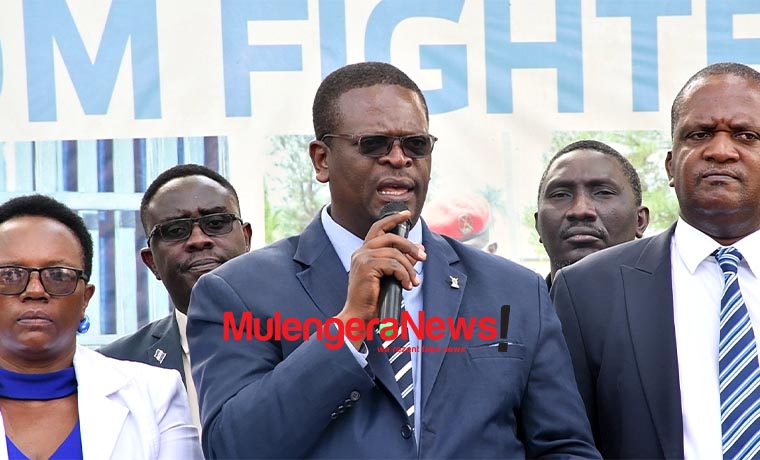
Dr Michael Lulume Bayiga has declared that Uganda is suffering from political constipation after 40 years of President Yoweri Museveni’s rule, warning that the country cannot continue with the same political leadership and expect a different outcome.
The PFF leader made the remarks on Monday at the Party headquarters located at Katonga road in Kampala, while explaining why his party rejects Gen Salim Saleh’s proposed Consociational Democracy Agreement as a possible solution to Uganda’s political mess.
Lulume argued that those promoting the agreement were attempting to persuade Ugandans to embrace another political arrangement without changing the leadership and governance structures responsible for the country’s longstanding problems.
Using a medical analogy, Lulume compared Uganda to a patient suffering from constipation whose doctor has recommended a change of diet, only for the patient to stubbornly continue eating the same food.
“Actually, we have political constipation in Uganda,” he said, further illustrating the situation by describing a patient who has been advised to take a balanced diet, eat yellow bananas and drink water but continues consuming cassava without making the recommended changes.
“The doctor is telling you change your diet. Have a balanced diet and you continue with the same diet, yet you already have constipation,” Lulume said.
He used the analogy to dismiss the possibility of resolving Uganda’s political problems through negotiations that leave Museveni and his family in control of the country’s political affairs.
He went ahead and said that after 40 years, the people of Uganda were looking for a different political direction and could not accept a continuation of the same leadership under the disguise of national reconciliation.
He insisted that genuine dialogue must produce a transition government in which Museveni and members of his family are no longer in power.
Lulume also outlined the changes PFF wants to see, including a new constitution, truth and reconciliation, independent state institutions and federal governance based on the traditional nations that formed Uganda.
He further demanded genuinely free elections at the end of the transition period, arguing that Ugandans should be allowed to choose their leaders without fear or intimidation.
The PFF leader also questioned the logic of inviting opposition politicians into government positions while leaving the existing political leadership untouched.
He argued that such an arrangement would only give selected individuals access to political benefits without delivering meaningful power to the people of Uganda.
Lulume maintained that Uganda’s political problems require a fundamental change of leadership and governance rather than another agreement designed to accommodate a few political actors.
He warned that PFF would not endorse a dialogue process whose outcome is merely to preserve the status quo after forty years of Museveni’s rule.