








By Mulengera Reporters
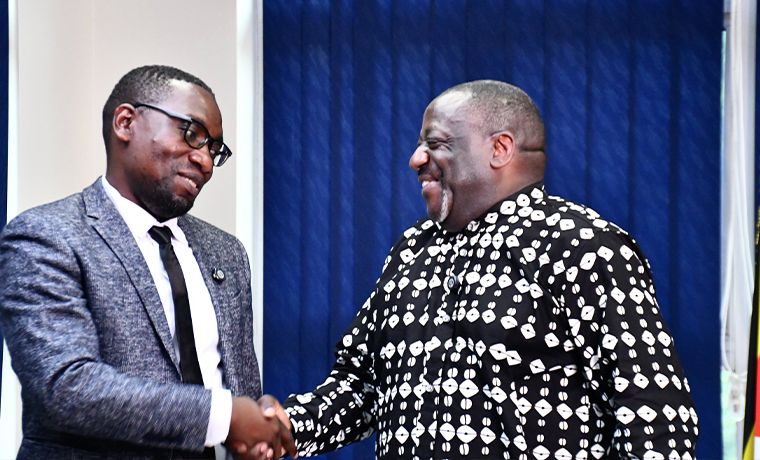
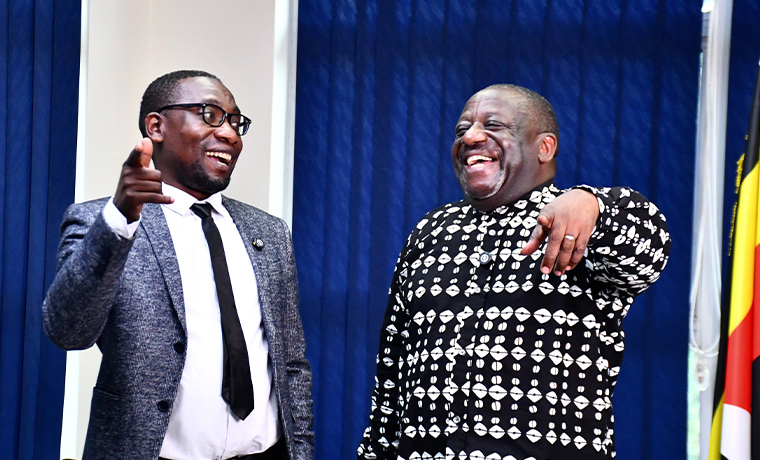
The return of TV10 Gano Mazima to Uganda’s digital media landscape has not been quiet and it was never meant to be. In a defining online broadcast show of ‘The Crossroads’, veteran journalist Dean Lubowa Saava hosted George William Nyombi Thembo, the Executive Director of the Uganda Communications Commission (UCC), in a wide-ranging conversation that laid bare the realities, tensions, and opportunities shaping the country’s fast-evolving digital media space.
Broadcast in Luganda and now rendered into English, the discussion marked more than just another interview. It symbolized a convergence between regulator and broadcaster, between policy and practice, and between a resurgent media platform and the institution mandated to guide it.
From the outset, Lubowa set the tone: this would not be a ceremonial exchange. It would be a candid, fact-driven conversation. Welcoming his guest, he acknowledged both the significance of the moment and the perception once widespread—that such a meeting might never happen. Yet there they were, seated across from each other, ready to engage.

Nyombi Thembo responded with equal candor and warmth. He congratulated TV10 Gano Mazima on securing its operational license, emphasizing that UCC’s role is not to stifle platforms but to support them in fulfilling their mandate. For the Commission, he noted, media outlets are critical partners in reaching citizens and enabling national discourse. The return of the station, therefore, was not just a private success story, it aligned with the broader public interest.
The conversation quickly moved into the heart of the matter: the explosive growth of the digital space in Uganda and the inevitable friction between those who regulate and those who operate within it. Lubowa Saava pointed out a reality many Ugandans recognize—the expansion of digital platforms has been accompanied by tension, with accusations of overreach on one side and irresponsibility on the other.
Nyombi Thembo did not dismiss these concerns. Instead, he contextualized them. Government, he explained, is constitutionally mandated to regulate in the public interest. Just as rules exist to ensure safety on the roads, similar principles must apply in the digital environment. Communication, he stressed, is not an ordinary service—it is what economists call a “merit good,” one that reaches vast numbers of people and has the power to shape society at scale.
The statistics he shared underscored this reality. Uganda has 58 millions of SIM cards in circulation, with roughly 25 million unique subscribers in a population of about 46 million people. Smartphone penetration continues to rise, with millions of users actively engaging on platforms like TikTok and YouTube. In such an environment, the influence of communication tools is unparalleled.

With that influence comes responsibility—and the need for regulation. Yet Nyombi Thembo acknowledged that regulation must evolve alongside the technologies it seeks to govern. This, he admitted, is one of the greatest challenges facing institutions like UCC. The pace of innovation far outstrips the speed of legislative processes. While digital platforms can transform in months, regulatory frameworks may take years to develop and implement.
To address this gap, UCC has adopted a structured approach anchored in four pillars include engagement, technology, enforcement and continuous review. Engagement, he explained, is the first and most critical pillar. The Commission must maintain ongoing dialogue with all stakeholders—licensed broadcasters, online content creators, and the consuming public. Through these interactions, regulators can identify areas of friction, understand emerging trends, and refine their policies accordingly.
This emphasis on engagement directly addressed one of Lubowa’s key concerns: the perception that regulators have not done enough to connect with the growing community of digital content creators. Today, journalism is no longer confined to those with formal training or institutional backing. Anyone with a smartphone can record, publish, and distribute content to potentially vast audiences.
Nyombi Thembo embraced this reality rather than resisting it. Citizen journalism, he noted, is now a defining feature of the digital age. In Uganda, some individual content creators command audiences that far exceed those of traditional media houses. A single influencer may reach tens of millions of viewers, while some licensed broadcasters operate with comparatively modest audiences.
This shift raises complex questions about classification, accountability, and fairness. Should highly influential individuals be treated as broadcasters? Should they be subject to the same regulations? These are not abstract debates—they are pressing issues that regulators must confront.
For UCC, the answer lies not in exclusion but in inclusion. Engagement must extend to everyone participating in the digital ecosystem. Feedback from these diverse actors helps the Commission determine where adjustments are needed—whether to strengthen oversight, ease restrictions, or introduce new frameworks altogether.
One such adjustment is already underway. While online media has been indirectly regulated under existing laws, Nyombi Thembo acknowledged that this is no longer sufficient. The Commission is now working to explicitly incorporate digital platforms into its legal framework, ensuring clarity and consistency for all stakeholders.
Alongside legal reforms, technology is emerging as a critical tool in modern regulation. Rather than relying solely on enforcement actions, UCC is exploring ways to use automated systems—such as content filters—to detect and manage harmful material. These technologies, already deployed in various parts of the world, offer a more efficient and less confrontational approach to oversight.
Of course, no system is foolproof. As Nyombi Thembo pointed out, some users will always attempt to bypass safeguards. But the overall effectiveness of such tools makes them an essential component of contemporary regulation.
Beyond systems and structures, however, the conversation turned to a more fundamental issue: integrity. Lubowa raised concerns about the influence of powerful individuals and interest groups—a recurring theme in discussions about regulation.
Nyombi Thembo’s response was unequivocal. Independence, he said, is non-negotiable. The moment a regulator is captured—whether by political pressure, financial incentives, or personal relationships—their authority is compromised. Trust, once lost, cannot easily be regained.
To illustrate this principle, he shared a striking example involving Starlink, the satellite internet service associated with Elon Musk. Upon discovering that Starlink equipment was operating in Uganda without the necessary license, UCC took decisive action. A directive was issued demanding the immediate cessation of operations.
The response from the company was swift and compliant. Operations were halted, and only resumed after all regulatory requirements had been met—a process that took over a year. For Nyombi Thembo, the episode demonstrated that firm, principled regulation can command respect, even from the most powerful global actors.
The same approach, he emphasized, applies across the board. Whether dealing with major telecommunications companies like MTN or smaller emerging players, UCC is committed to ensuring a level playing field. Fairness, after all, is a cornerstone of credible regulation.
As the discussion shifted toward accessibility, Lubowa highlighted a concern shared by many Ugandans: the cost of data. In a country where digital connectivity is increasingly essential, affordability remains a critical barrier.
Nyombi Thembo offered cautious optimism. Studies have been conducted, and measures are being developed to reduce data costs. While implementation depends on broader fiscal decisions—such as the national budget—there is a clear commitment to making connectivity more affordable in the near future.
At the same time, significant progress has been made in expanding network coverage. Fourth-generation (4G) services now reach a substantial portion of the country, while fifth-generation (5G) networks are already operational in key urban areas like Kampala. These advancements lay the foundation for a more connected and digitally empowered society.
Yet infrastructure alone is not enough. As Nyombi Thembo pointed out, the real challenge lies in how people use these technologies. Research conducted by UCC reveals a striking gap between access and utilization. Even among educated users, smartphones are often used at only a fraction of their potential.
Digital literacy, therefore, has become a central focus. Without the skills to navigate online platforms, create content, or conduct transactions, users remain excluded from the full benefits of the digital economy. The issue is particularly acute in rural areas, where basic tools—such as email—are not widely adopted.
For Nyombi Thembo, this is more than a technical problem; it is a structural one. An individual without an email address, he argued, is effectively invisible in the digital world. Email is the gateway to countless services and opportunities, from communication to commerce. Without it, participation is severely limited.
Addressing this gap requires sustained effort—from government, from industry, and from media platforms themselves. Initiatives to promote digital literacy must go hand in hand with investments in infrastructure and regulatory reform.
As the broadcast drew to a close, one thing was clear: ‘The Crossroads’ had lived up to its name. It had brought together different perspectives, confronted difficult questions, and illuminated the path forward for Uganda’s digital media landscape.
For Dean Lubowa Saava, the program marked a powerful return—not just to broadcasting, but to meaningful public engagement. For UCC Boss George William Nyombi Thembo, it was an opportunity to articulate a vision of regulation grounded in fairness, innovation, and trust.
And for viewers, it offered something increasingly rare: a conversation that did not shy away from complexity, but embraced it—openly, directly, and with purpose. (For comments on this story, get back to us on 0705579994 [WhatsApp line], 0779411734 & 041 4674611 or email us at mulengeranews@gmail.com).