







By Aggrey Baba
Namanve – The Minister of Trade, Industry and Cooperatives, Hon. Sanjay Tanna, has commended the Uganda Industrial Research Institute (UIRI) for its impressive work in advancing locally developed technologies, urging the institute to move more of its innovations from laboratories and prototypes into the market.
Tanna made the remarks on Thursday when he visited UIRI’s Machining, Manufacturing and Industrial Skills Development Centre (MMISDC) at Namanve Industrial Park as part of his programme to acquaint himself with institutions and entities under his docket.
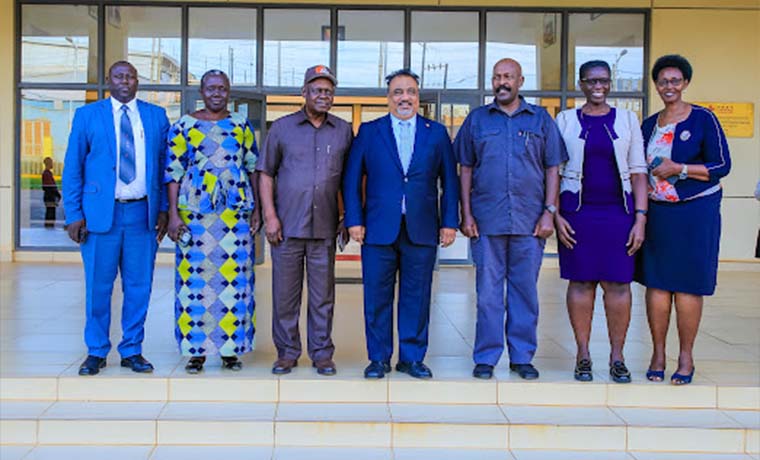
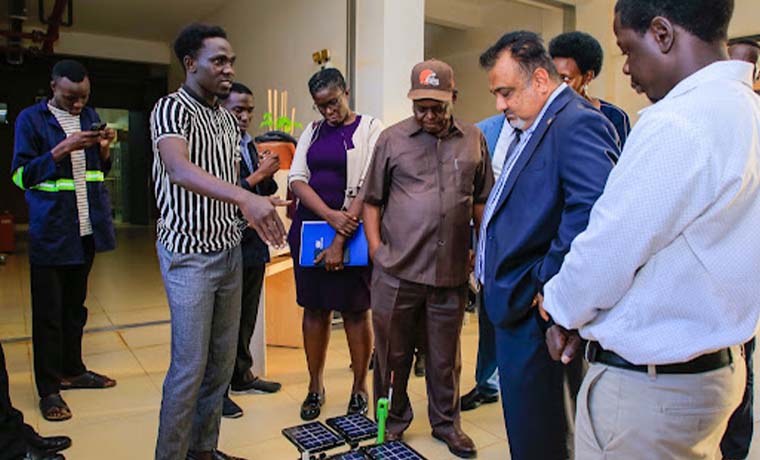
The Minister, who arrived at the 15-acre facility at about 3:00pm accompanied by a team from the Ministry, first held a closed-door meeting with the UIRI Board members, led by the Chairman, General (rtd) Ivan Koreta, before embarking on a tour of the institute’s laboratories, workshops and innovation facilities.
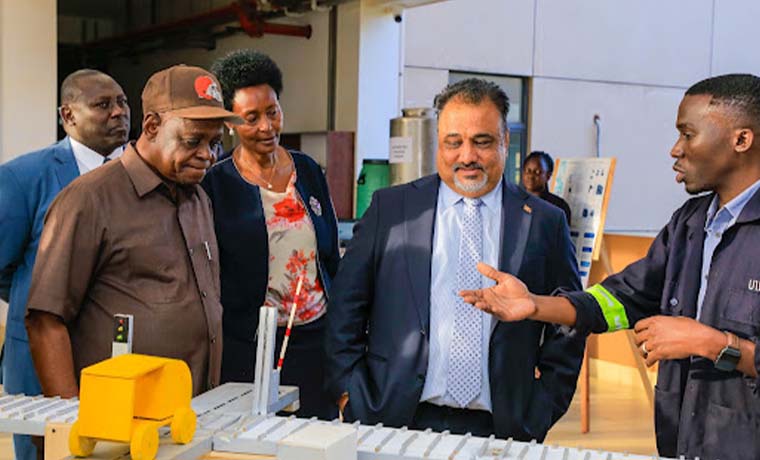
Throughout the tour, Tanna was visibly impressed by the range of technologies being developed by Ugandan engineers and innovators, repeatedly commending UIRI Executive Director Prof. Charles Kwesiga and his team for the work being done.
UIRI is a government parastatal under the Ministry of Trade, Industry and Cooperatives whose mandate is to undertake applied research and related activities aimed at accelerating Uganda’s industrialization. Its work includes value addition, product development, process design, machinery fabrication, technology transfer, business incubation, skills development and support to small and medium enterprises.
At Namanve, the Minister was taken through laboratories and production facilities where UIRI engineers demonstrated technologies developed locally, in some cases starting with raw materials and components before turning them into functional products.
Among the innovations showcased was cotton wool produced from fibre extracted from pineapple leaves, and the same locally developed material is being used in the production of medical protective equipment, including PPEs, face masks, and surgical gowns, demonstrating how agricultural waste can be converted into products with industrial and medical applications.
Tanna also viewed an automated gate system operated through magnetic sensors, an automated irrigation system using artificial intelligence sensors and remote control technology, and a prepaid water metering system designed on a model similar to the prepaid electricity systems used by UEDCL (Yaka).
In the medical technology laboratories, he was shown a diabetes testing machine incorporating an AI model to assist in determining results.
Another innovation that attracted the minister’s attention was AGRIKBOT, a smart agricultural intelligent rover built for African conditions and engineered to operate in challenging environments, which can do electronic irrigation and it can be controlled using a smart phone as per its programming.
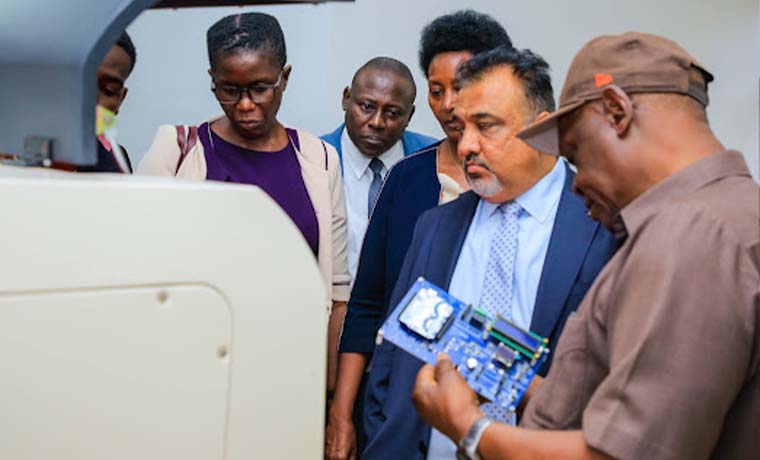
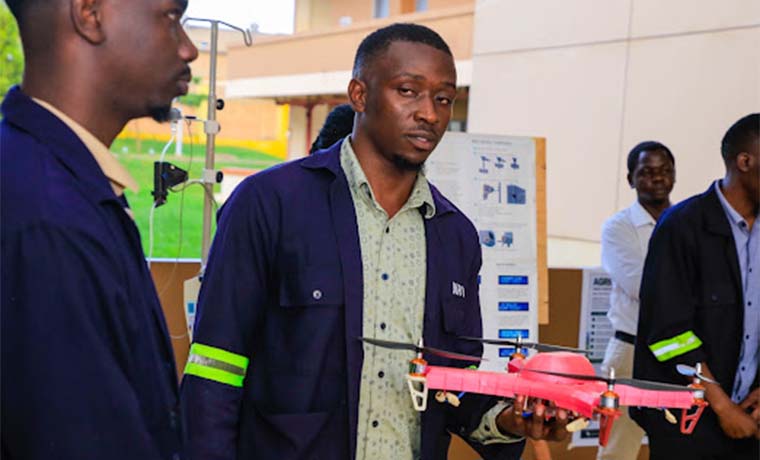
The Minister also inspected UIRI’s locally manufactured drone technology and the remote-control systems used to operate the drones. When he asked how the electronic boards powering the drones and radio equipment were produced, engineers showed him raw copper boards from which the circuit boards are manufactured within the institute’s laboratories.
He was further taken through a laboratory where automatic street-lighting systems are developed. The systems are designed to detect darkness and switch lights on, then automatically switch them off when daylight returns.
What appeared to particularly impress the Minister was the explanation that the technologies he was seeing were not simply imported finished products, but were being designed, assembled and developed by Ugandan engineers working at UIRI.
Hon. Tanna, however, challenged UIRI to ensure that such innovations do not remain prototypes indefinitely, but are developed to a level where they can be produced commercially and accessed by Ugandans or even be exported.
The challenge touches one of the biggest issues facing Uganda’s innovation ecosystem: translating research and prototypes into commercially viable products capable of creating jobs, reducing imports and generating wealth.
Prof. Kwesiga told the Minister that Uganda now has engineers and innovators capable of designing and producing technologies locally, but that increased government investment in UIRI would be necessary to take many of the innovations through the final stages of development, testing, certification and commercialization, futher indicating that turning the institute’s innovations into market-ready products remains a major aspiration for UIRI.
The visit also offered the minister an opportunity to appreciate the transformation UIRI has undergone over the years under Prof. Kwesiga’s leadership.
UIRI traces its institutional roots to regional research structures of the 1970s and was legally established by Uganda in 2002 before undergoing major restructuring from 2006. Prof. Kwesiga, an industrial engineer, with versed expirience, has served as its Executive Director and oversees technology transfer, product and process development, business incubation, contract engineering services and applied research.
The institute has grown from its Nakawa base to include the state-of-the-art MMISDC facility at Namanve, established with support from the Government of China in 2018. The Namanve centre was designed both to produce technology-based products and develop industry-relevant technical skills.
Under professor Kwesiga’s leadership, UIRI has also been recognized as an East African Community Centre of Excellence in Research and Development. The institute’s official history describes its present role as connecting applied research, technology development, value addition and enterprise support to Uganda’s industrialisation agenda.
Hon. Tanna’s visit therefore comes at a time when the Government is seeking to strengthen industrialization, local manufacturing and value addition. The Ministry’s stated goal is to increase the range and scale of manufactured and traded goods and expand markets for Ugandan products.
Before leaving Namanve at just a few minutes to 7:00pm, thebminister promised to return to UIRI’s Nakawa facility within ten days to continue familiarizing himself with the institute’s operations and innovations.