







Hon Babirye Milly Babalanda, the minister in Charge of the Presidency has challenged government institutions, development partners and civil society organizations to address persistent governance and accountability gaps, warning that Uganda’s development ambitions depend on translating policy commitments and institutional reforms into tangible results for citizens.
In a message delivered by Kampala Metropolitan Affairs Minister Minsa Kabanda, who represented her as chief guest at the 5th Annual Governance and Security Programme (GSP) Review for the financial year 2025/2026, Babalanda said the country must measure progress by the improvements citizens experience in security, access to justice, accountability and public service delivery.
“The real test is whether these solutions produce lasting improvements in governance, security, justice, and welfare for our people.”
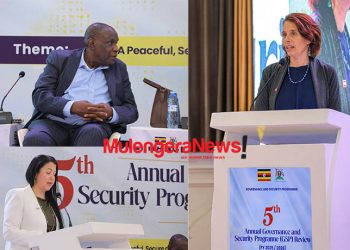
The review, held at Imperial Royale Hotel in Kampala on Friday, brought together government officials, development partners and other stakeholders to assess the programme’s performance, share lessons and identify priorities for improving governance and security service delivery.
Minister Babalanda said Uganda had registered progress in maintaining peace and stability during the financial year under review, creating an environment in which citizens could pursue their livelihoods while businesses and investors operated with confidence.
She cited a decline in the reported crime rate and 93% coverage under the sub-county policing model as some of the achievements recorded during the year.
She also pointed to improvements in the institutional infrastructure supporting justice and law enforcement, including efforts to strengthen forensic investigations through the National DNA database.
On accountability, Babalanda said the Inspectorate of Government reported recovering UGX14.9 billion through corruption-related interventions, alongside savings of UGX17.8 million.
The Office of the Auditor General (AG), she added, achieved 94.4% of its planned financial audits, demonstrating the contribution of accountability institutions to protecting public resources.
However, she cautioned against allowing these achievements to overshadow persistent weaknesses in governance, implementation of audit recommendations, gender and equity compliance, refugee resilience and international cooperation.
Babalanda cited Uganda’s performance on the Ibrahim Index of African Governance at 49.1% against a target of 60%. Refugee resilience stood at 39% against an expected 53, with declining financing identified as a major constraint.
She called for coordinated action to address the gaps, urging institutions to strengthen oversight mechanisms, improve implementation and ensure public resources are efficiently deployed.
“In particular, we must close the gap between identified constraints and taking corrective action,” she said.
The minister further emphasized the need to translate policy commitments into effective implementation, insisting that gender and equity considerations must be reflected in public expenditure and service delivery outcomes.
Babalanda also called for greater citizen participation in governance, saying patriotism should be demonstrated through respect for the law, protection of public resources, national unity and integrity in public service.
She urged government officials to prioritize the public interest over personal gain, while calling on development partners to align their support with national priorities and strengthen institutional capacity.
Civil society organizations, she said, should contribute to national development through civic engagement, independent oversight, service delivery and evidence-based dialogue.
Babalanda warned against duplication of interventions and called for stronger coordination among institutions and partners, saying partnerships should be assessed not merely by the resources mobilized or activities undertaken, but by the results achieved and institutional capacity strengthened.
She outlined five strategic priorities for the programme: consolidating peace and security; strengthening governance and accountability; improving access to justice and protecting human rights; advancing inclusive governance and resilience; and strengthening coordination through results-based planning.
She said these priorities must be supported by clear institutional responsibilities, measurable indicators, reliable data and regular follow-up to ensure commitments made during review meetings translate into action.
Babalanda urged participants to engage openly, share evidence and acknowledge implementation challenges, noting that Uganda’s development aspirations require trust, effective coordination and shared responsibility among government institutions and their partners.
“Our success is not measured simply by the resources mobilized, but by the results achieved, by citizens’ experience in their security, access to justice, participation in decision-making and quality of life,” she said.
The fifth annual review assessed the Governance and Security Programme’s performance during the 2025/2026 financial year, with a focus on improving adherence to the rule of law and strengthening the country’s capacity to contain prevailing and emerging security threats. (For comments on this story, get back to us on 0705579994 [WhatsApp line], 0779411734 & 041 4674611 or email us at mulengeranews@gmail.com).