






By Ben Musanje
Uganda’s education system is showing a widening mismatch between early childhood education and primary school intake, with new data revealing significantly higher enrolment in Primary One compared to the number of children completing pre-primary education.
The findings were presented by Johnstone Galande UBOS Principal Statistician and Head of the Demography and Gender Section during the dissemination of the Baseline Education Census 2025 Report at Statistics House in Kampala.
Johnstone Galande emphasized the importance of early childhood development, noting that ages 3 to 5 are critical for brain development and lifelong learning outcomes.

“We are told that pre-primary is very fundamental. This is the age where the brain grows faster than any other time in a child’s life. What happens at this stage determines what the child becomes,” Galande said.

Despite this importance, the census reveals a system heavily dominated by private providers, limited public attachment, and weak progression tracking into primary education.
Pre-Primary Sector Dominated by Private Providers
The report shows that Uganda has 38,347 pre-primary schools, the majority of which are privately owned. Only 3,193 schools, representing about 8.3 percent, are attached to public primary schools.

Galande explained that some public primary schools failed to disclose their pre-primary sections, meaning they were still counted under primary education.
“In some schools, we found hidden classes such as P1 Smart, P1 Junior, or P1 Zero, which suggests some institutions are disguising pre-primary sections,” he said.
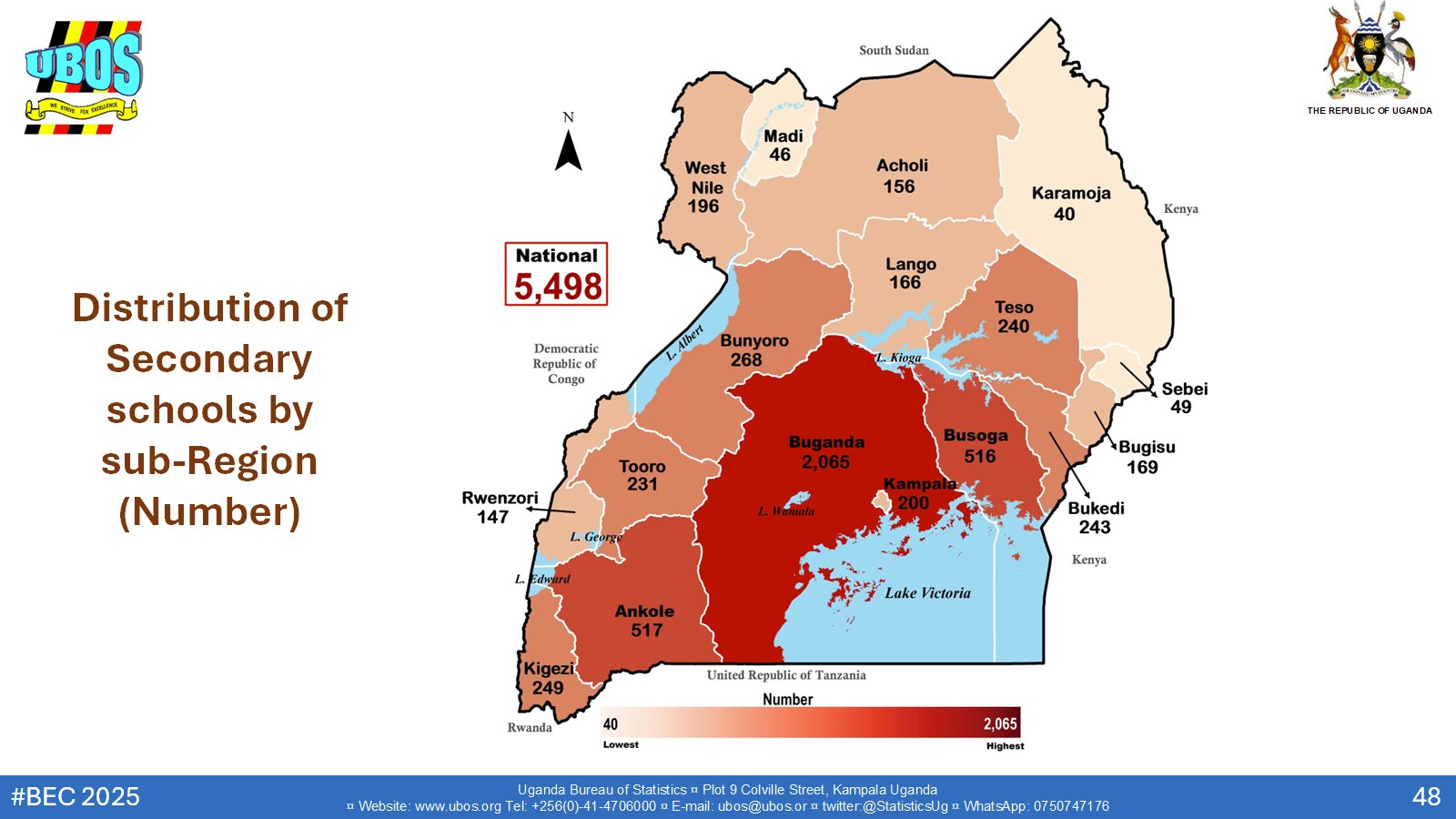
Regionally, Buganda sub-region accounts for the highest number of pre-primary schools at 15,846, while Karamoja has the lowest.
In terms of learners, Uganda has 2,374,674 children in pre-primary education, with males slightly more than females at 1,207,966 boys and 1,166,708 girls, representing 49 percent female participation.
However, the age structure reveals a major challenge. Although pre-primary is intended for children aged 3 to 5 years, the report found that 534,306 learners (22.5 percent) are aged 6 years and above, while 32,682 children are below 3 years, indicating significant age misalignment.
Pre-Primary Class Imbalances and Early Entry Issues
The distribution across classes shows that Baby Class and Top Class have slightly higher enrolment than Middle Class. Galande noted that this reflects irregular entry and progression patterns.
“We see learners who are too young in Baby Class and others who are too old in Top Class. The system is not fully aligned,” he said.
The report further indicates that Top Class enrolment is significantly lower than expected when compared to Primary One intake, suggesting that many children transition into primary school without completing pre-primary education.
Primary One Enrolment Far Exceeds Pre-Primary Output
One of the most striking findings is the sharp rise in Primary One enrolment compared to pre-primary completion levels.
Uganda has 43,567 primary schools, with 31,010 private schools and 12,557 public schools. Total primary enrolment stands at 9,118,314 learners, with females slightly higher at 4,586,970 (50.3 percent) compared to males.
However, class distribution reveals a major imbalance.
Galande observed that if all children transitioned from pre-primary to Primary One, enrolment would roughly match the number of Top Class learners. Instead, Primary One alone has over 1.7 million learners, compared to far fewer in pre-primary completion classes.
“If we had a smooth transition, we would expect similar numbers from Top Class to Primary One. Instead, we see about 1.7 million in Primary One alone,” Galande said.
This suggests that many children enter Primary One directly from home, bypassing pre-primary education entirely.
Transition Bottlenecks and Classroom Congestion
The report also highlights irregular progression through primary education. While Primary One has the highest intake, a “traffic jam” is observed in Primary Four, where enrolment peaks at 1,534,993 learners before dropping to 1,186,629 in subsequent grades.
Galande said this pattern raises concerns about retention, repetition, or dropout causes that require further investigation.
“We see congestion in Primary Four and Primary Two. Something is happening in the system, but our questionnaire did not capture the cause,” he said.
Age Mismatch in Primary Education
The census also found that 2,433,566 learners (26.7 percent) in primary school are aged 13 years and above, while 35,312 learners are below 6 years, indicating continued age-inappropriate enrolment.
Galande linked the older cohort partly to COVID-19 disruptions, where some learners interrupted schooling or repeated classes.
Infrastructure and Teacher Pressure
Quality indicators also show strain on the system. The national pupil-to-teacher ratio stands at 34:1, below the UNESCO benchmark of 40:1. However, government schools face much higher pressure at 48 pupils per teacher, compared to 24 pupils per teacher in private schools.
Classroom congestion is also evident, with an average of 31 pupils per classroom nationally, but up to 50 pupils per classroom in government schools.
Sanitation facilities are similarly stretched, with 42 pupils per stance nationally, rising to 61 in public schools compared to 30 in private schools.
Uneven Access to Schools Across Parishes
The report highlights structural inequalities in access to education. Out of 10,860 parishes, 9,487 have at least one school, while 1,373 parishes (12.6 percent) have no school at all.
Additionally, 3,087 parishes lack a government primary school, representing 28.4 percent, underscoring gaps in public education provision.
Policy Implications
Galande stressed the need for improved tracking systems to monitor learner progression from pre-primary through primary.
“We need to follow learners individually so we can understand where they are and where they go. Without that, planning becomes difficult,” he said.
The report also calls for better registration systems after discovering inconsistencies in school identification numbers, with some schools having multiple or missing NIMS identifiers.
The Baseline Education Census 2025 concludes that while Uganda has made progress in expanding access to education, significant gaps remain in early childhood education, transition to primary school, and equitable distribution of services. (For comments on this story, get back to us on 0705579994 [WhatsApp line], 0779411734 & 041 4674611 or email us at mulengeranews@gmail.com).