






By Atwemereireho Alex (alexatweme@gmail.com)
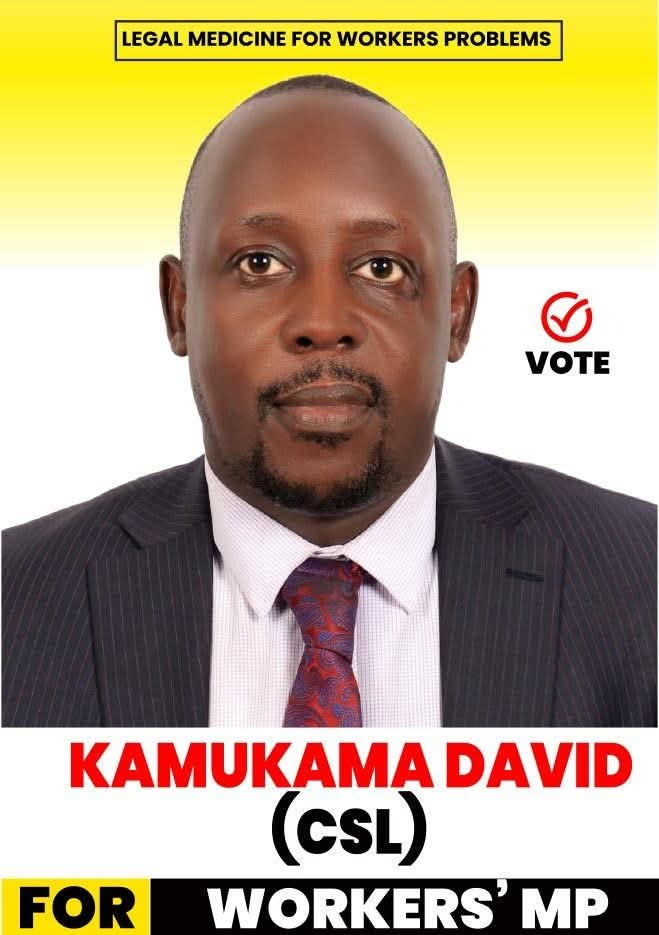
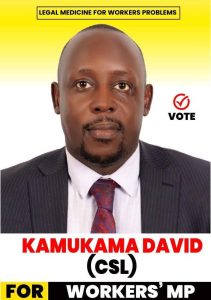
In medicine, a good doctor does not guess; he diagnoses. He studies symptoms, understands root causes, and prescribes treatment that heals rather than masks pain. Uganda’s workers have for decades suffered from a chronic condition, systemic exploitation, weak enforcement of labour laws, inaccessible justice, and economic vulnerability yet they have largely been attended to by political rhetoric rather than professional remedies. What the workers need today is not sympathy, but legal medicine: precise diagnosis, sound prescription, and consistent follow-up. It is this philosophy that defines Counsel Kamukama David, whose slogan and guiding creed- “The Legal Medicine for Workers’ Problems” – is not a catchphrase, but a method.
Across Uganda, millions of workers dedicate their lives to sustaining the economy, yet their rights, welfare, and dignity often remain precariously unprotected. From formal institutions to the sprawling informal sector, challenges such as wage arrears, unsafe working conditions, lack of social protection, and limited opportunities for advancement persist. According to the Uganda Bureau of Statistics (UBOS), more than 80 percent of the workforce operates within the informal economy, where legal enforcement is weak, exploitation is rampant, and voices are too often ignored. In such a context, leadership for workers cannot be ceremonial; it must be legal, practical, and unwaveringly committed.


This is precisely what Counsel Kamukama David offers. He is not merely a politician; he is a legal mind trained to diagnose labour problems with clinical precision and prescribe solutions grounded in law and policy. The 1995 Constitution, under Article 40, guarantees fair labour practices, while Article 41 protects the right to join trade unions and enjoy just working conditions. Section 6 of the Employment Act, 2006 outlaw’s discrimination; Section 25 prohibits forced labour; Section 50 guarantees written contracts for employment exceeding six months; and Section 66 provides protection against unfair dismissal. Yet millions of workers, especially those in informal or casual employment, remain outside these protections, left vulnerable to exploitation, wage theft, and unsafe working conditions. He understands that these rights are only as meaningful as their enforcement and implementation, and he is uniquely positioned to ensure they are upheld.
His approach treats labour injustice as a systemic disease, not a collection of isolated complaints. Wage theft is a symptom. Unsafe workplaces are symptoms. Arbitrary dismissal is a symptom. The real illness lies in weak enforcement, inaccessible justice, and the absence of worker-centred legal infrastructure. His leadership seeks to treat the disease, not merely manage the pain.
His journey exemplifies the qualities required for this mission. Born in Kanekye Kashozi, Sheema District, he excelled academically, ranking third nationally at A-levels, before earning a Bachelor of Laws at Makerere University and a Postgraduate Diploma in Legal Practice at the Law Development Centre. Today, as the Managing Partner at Byamugisha Gabriel & Co. Advocates, he brings unparalleled legal expertise, practical advocacy experience, and a history of service that directly benefits workers. He has consistently provided pro bono legal services, organized vocational and educational initiatives, and spearheaded programs to enhance social cohesion and skill development.
A notable initiative is the Bikwase Kamukama Foundation, which he founded to skill youth and women in entrepreneurship, trades, and technical skills. Through this foundation, he has already provided thousands with practical skills, mentoring, and start-up support, directly tackling unemployment and underemployment. His vision is to scale these interventions nationally, ensuring that both formal and informal workers access opportunities for economic empowerment.
Central to his legislative agenda is the establishment of Workers’ Legal Aid Clinics across the country. He recognises that most workers are paid meagre wages and cannot afford legal fees when their rights are violated. Justice that depends on one’s wallet is not justice at all.
These clinics will provide pro bono legal advice, representation, mediation, and rights education, ensuring that workers can seek redress without choosing between legal fees and family survival. To guarantee sustainability and professionalism, he will liaise with development partners such as the International Labour Organization (ILO), government agencies, philanthropic foundations, and other funding partners, aligning Uganda’s labour justice system with international best practices.
Equally critical is his commitment to decentralising labour justice. Today, the architecture of industrial justice remains dangerously centralised. Expecting a worker from deep in Obongi District, Karamoja, or remote parts of West Nile to travel to Kampala to lodge a complaint is not only impractical; it is a denial of justice. Counsel Kamukama David will advocate for regional industrial court circuits, mobile labour tribunals, and strengthened district labour offices, bringing justice closer to where workers live and toil. Justice delayed by distance is justice denied; justice delivered locally is justice restored.
He has articulated a clear, actionable vision for workers. For the informal sector, which accounts for the majority of Uganda’s labour force, he plans to formalize businesses and artisanal enterprises through legal recognition, certification, and access to affordable financing, ensuring workers enjoy the protections and benefits they deserve. Understanding the challenges faced by Uganda’s Jua Kali sector, which employs over 2.5 million people, he will provide legal, financial, and structural support to empower these workers, increasing income, improving working conditions, and contributing meaningfully to national economic growth.
Youth and women are central to his agenda. With youth unemployment at 13 percent and rural women disproportionately affected by economic marginalisation, he intends to implement targeted strategies that expand entrepreneurship, create sustainable employment, and strengthen household incomes. These initiatives will combine mentorship programs, vocational training, access to capital, and legal empowerment.
He is also committed to protecting vulnerable workers by advocating for reforms that close enforcement loopholes in the Employment Act, particularly for casual, contract, and part-time workers who are often denied pensions, health benefits, and job security. In Parliament, he will demand compliance with occupational safety standards, strengthen labour inspections, and ensure that government agencies and private employers are held accountable. His interventions will be informed by both national law and international standards, including ILO Conventions Nos. 87 and 98, guaranteeing freedom of association and collective bargaining.
Recognizing that empowerment begins with awareness, he will initiate nationwide workers’ legal literacy programs, equipping workers with knowledge on contracts, dispute resolution, and lawful negotiation. In doing so, the law ceases to be an elite instrument and becomes a tool of daily survival and dignity.
What sets him apart is not merely knowledge of law but an unyielding fidelity to the principle that the worker is the backbone of national development. The factories, schools, banks, farms, and offices that sustain Uganda’s economy are animated by human effort, men and women whose labour fertilizes the soil of prosperity. Representing them requires more than slogans; it requires legal medicine administered with courage, intelligence, and consistency.
Electing him as Workers’ Member of Parliament is more than a choice; it is a commitment to treatment rather than temporary relief. He will not merely echo grievances; he will diagnose, prescribe, and follow through. His leadership promises measurable outcomes: accessible justice, enforceable rights, empowered workers, and restored dignity especially for those long neglected by conventional labour structures.
History favours those who heal nations by fixing systems. For Uganda’s workers, the choice is clear. When they seek legal medicine for their problems, they will find not a quack, but a professional; not a politician of noise, but a lawyer of solutions.
Counsel Kamukama David is that professional, the rare advocate whose legal intellect, moral clarity, and fidelity to justice will cure the long-standing ailments of Uganda’s workforce. The writer is a lawyer, researcher and governance analyst. (For comments on this story, get back to us on 0705579994 [WhatsApp line], 0779411734 & 041 4674611 or email us at mulengeranews@gmail.com).