







By Aggrey Baba
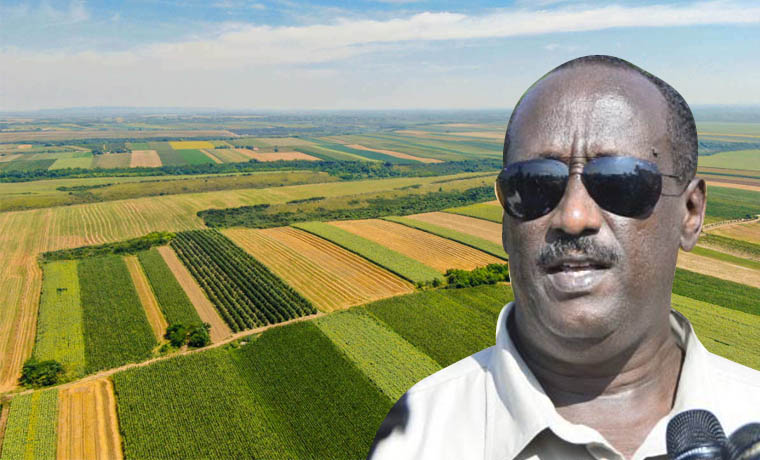
Uganda could soon need a different way of looking at the value of its land, with Gen. Caleb Akandwanaho (Salim Saleh) arguing that the country’s economic planners should pay greater attention to what land produces, the jobs it creates and the wealth it generates rather than concentrating mainly on ownership and acreage.
Saleh is pushing for an expanded economic assessment of land through a framework he calls the Expanded Land Use Balance Sheet (ELUBS), which he presents in the book, Organizing Land for National Economic Transformation. The proposed framework seeks to establish the actual economic contribution of land and how effectively it supports Uganda’s development ambitions.
His argument is that knowing who owns land, how many acres it covers and its estimated market price does not necessarily tell government how useful that land is to the economy. A large piece of land could be registered in someone’s name but remain idle for years, while a smaller parcel elsewhere could be supporting commercial agriculture, employing workers and supplying raw materials to processing industries.
Under the ELUBS framework, land would be examined through several dimensions, including its legal status, actual utilization, productivity, institutional support and connection to markets, which would allow government to assess not only the physical resource but also the economic activities taking place on it and the conditions determining its performance.
Slaeh’s proposed system would help distinguish between land that is actively productive, underutilized, completely idle, affected by ownership disputes or suitable for agricultural and industrial investment.
Saleh believes such an assessment would expose the difference between land that merely exists as a registered property asset and land that is actually contributing to national wealth creation.
For instance, land suitable for commercial farming may fail to generate meaningful returns because its owners lack financing, machinery, reliable roads or access to buyers. Similarly, land located in potentially strategic industrial areas could remain unproductive because of unresolved wrangles, inadequate infrastructure or the absence of organized investment.
By identifying these limitations, the proposed system would give government a clearer picture of why certain areas are failing to realize their economic potential and what interventions could unlock production.
It would also help planners identify locations where agricultural production can be expanded, processing industries established and industrial clusters developed around available land resources.
The proposal carries implications for Uganda’s broader industrialization agenda because factories require more than buildings, machinery and investment capital. They also depend on organized production systems, reliable raw material supplies and land that is being put to productive use.
Gen Saleh’s thinking is that government cannot effectively plan an economic transformation programme without first understanding the productive capacity of the land available to support it.
He therefore proposes incorporating the Expanded Land Use Balance Sheet into national planning, potentially giving policymakers another tool for directing public investment, identifying underperforming areas and measuring the economic returns from land utilization.
The framework also introduces a different way of thinking about land development. Instead of treating ownership and market valuation as the only important measures, it places production, employment, investment and economic contribution alongside them.
In practical terms, Akandwanaho wants Uganda to begin asking not only how much land the country owns, who owns it and what it is worth, but also how much wealth it generates and what more it could contribute if properly organized.
He says land should be treated as a strategic economic resource whose performance matters to national development, rather than merely as property to be registered, transferred, inherited or even sold. (For comments on this story, get back to us on 0705579994 [WhatsApp line], 0779411734 & 041 4674611 or email us at mulengeranews@gmail.com).