



By BM
The National Resistance Movement (NRM) has placed education and human capital at the centre of its new five-year plan, with a bold pledge to recruit 49,406 teachers and reform the school curriculum to produce job creators rather than job seekers.
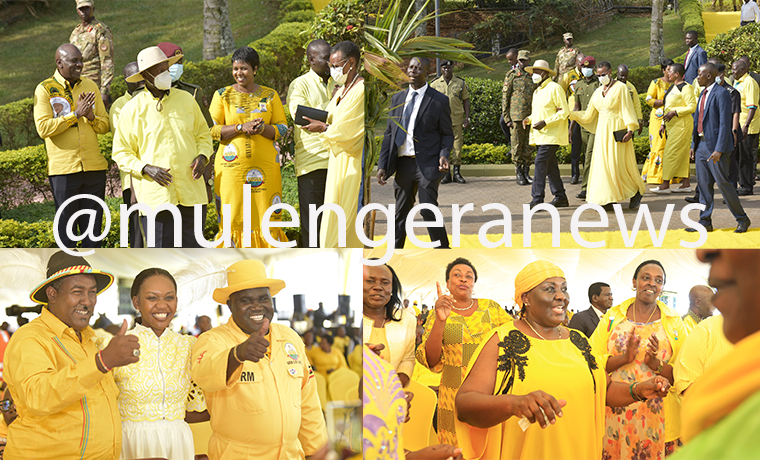
This was announced by NRM Secretary General Richard Todwong during his maiden address at the launch of President Yoweri Museveni’s campaign manifesto at Speke Resort Munyonyo on Monday.
In a speech that laid out the party’s comprehensive vision for Uganda’s development, Todwong declared that education would be a top priority in the government’s efforts to build a skilled, science-oriented Labor force.
He stated that the NRM government would continue implementing curriculum reforms across all levels to ensure the education system aligns with the demands of the modern job market.
He added that the government planned to recruit 49,406 teachers to address staffing gaps and improve the quality of education nationwide.
The NRM would also commit to constructing more schools and hospitals, while progressively increasing salaries for civil servants, including arts teachers—a category that has frequently protested over unequal pay.
Todwong noted that civil servants, especially arts teachers, should not be striking, given that the party was already making plans to enhance their remuneration.
He also emphasized the need to invest in young people, saying the party’s focus would be on equipping the youth with skills relevant to manufacturing and innovation as part of a broader commitment to human capital development.
The manifesto, structured along five core themes, includes: growing the economy and creating wealth; infrastructural development; investment in human capital; democracy, good governance and security; and regional integration and political federation.
On the economy, Todwong said the NRM’s strategy would be guided by its principles of socio-economic transformation.
He outlined the party’s focus on fully monetizing the economy, increasing agricultural production and productivity, and adding value to raw materials.
The party also intends to intensify its wealth creation campaigns, with pledges to increase Parish Development Model (PDM) funding to UGX 300 million per ward in Greater Kampala Metropolitan Area.
In addition, households headed by persons with disabilities would receive an extra UGX 500,000 in addition to the existing UGX 1 million provided under the PDM.
Elected leaders at the village level are also set to receive UGX 15 million, with a separate fund earmarked for religious leaders.
Todwong revealed that the government would establish a fertilizer fund to support farmers in accessing agricultural inputs and increasing productivity.
He stated that these measures would encourage all Ugandans to become producers of goods or services, contributing to job creation and wealth generation.
In terms of infrastructure, Todwong said the NRM was committed to large-scale investments in roads, railways, energy, and water transport systems.
Among the planned projects are new ferry services for Busi Island in Wakiso, Kome to Damba in Mukono, Nangoma to Kasensero, Albert Nile, Lake Kwania, and Amuru’s Rhinocamp, as well as procurement of a ferry for Kyamuswa in Kalangala.
He explained that these infrastructure investments would help reduce the cost of doing business through affordable electricity, transport, and internet access, thereby enabling entrepreneurs to generate higher profits and reinvest more.
Todwong also addressed the NRM’s commitment to democracy and good governance, asserting that the party’s democratic track record was strong.
He said the NRM would continue efforts to deepen decentralization, fight corruption, and secure the lives and property of Ugandans.
The manifesto also outlines continued support for initiatives such as NUSAF, PRDP, cattle restocking and compensation programs, and reforms in land governance.
He said the government would uphold the rule of law, equality, and zero tolerance to corruption, while also promoting justice, labour rights, employment, and affirmative action policies.
On regional integration, Todwong reaffirmed the NRM’s commitment to Pan-Africanism.
He indicated that in the next term, the party would support ongoing initiatives aimed at forming a political federation within the East African Community (EAC).
This would include participation in the drafting of an East African Constitution, the establishment of a single regional currency, and cooperation with member states to remove non-tariff barriers within the region.
He concluded by encouraging all Ugandans to read and understand the manifesto, which he described as a comprehensive guide to the NRM’s vision, values, and development strategy.