







By Mulengera Reporters
For years, Florence Nabutsebi’s daily routine revolved around smoke-filled kitchens, expensive charcoal purchases, and the constant search for firewood.
A mother of five and grandmother of seven living in Busamaga West Constituency in Mbale District, Nabutsebi spent much of her household income on cooking fuel while enduring the health effects of traditional cooking methods.
Today, her kitchen tells a different story.

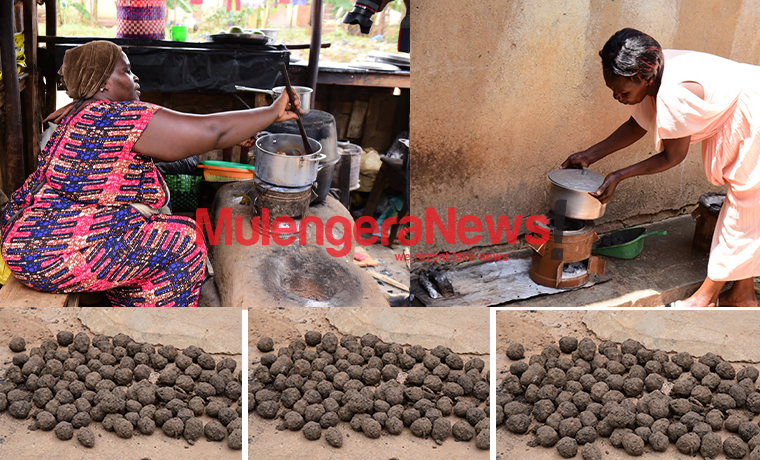
Thanks to a fuel-efficient eco-stove introduced through a local community initiative, she now uses significantly less charcoal and firewood, spends less time cooking, and saves money for other household needs.

“In the past, I used a sack of charcoal for one month, but with this stove it lasts about two and a half months,” she says. “We now use very little firewood, just a few sticks, and cooking takes less time.”
Her experience reflects a growing transformation taking place across rural Uganda, where thousands of households are embracing eco-stoves as a cleaner, cheaper and healthier alternative to traditional cooking methods.
Uganda continues to face a major household energy challenge. Nearly 96 percent of rural households depend on biomass fuels such as firewood and charcoal, while close to 90 percent lack access to clean cooking technologies. Most families continue to cook using traditional three-stone fires or rudimentary charcoal stoves, exposing themselves to harmful smoke and accelerating environmental degradation.

The consequences are severe. Indoor air pollution linked to traditional cooking methods contributes to an estimated 19,700 deaths annually in Uganda, while increasing demand for firewood continues to drive deforestation in many parts of the country.
For women and girls, who bear the greatest responsibility for cooking and collecting fuel, the burden is particularly heavy.
However, the growing adoption of eco-stoves is beginning to change that reality.
The improved stoves require less fuel, produce less smoke and reduce cooking time. The savings generated from lower fuel consumption are helping families meet other pressing needs such as education, healthcare and food.
The benefits are also extending to small businesses.
In Namatala, Mbale City, restaurant owner Fatimah Nanfuma says she previously spent between Shs85,000 and Shs100,000 on charcoal every three weeks. Since switching to an eco-stove, the same amount of charcoal now lasts up to three months.
“This is a truly cost-effective initiative,” she says.
The reduction in fuel expenses has significantly improved her business profitability while reducing exposure to smoke in her workplace.
Beyond household savings, some beneficiaries have begun producing fuel briquettes made from sawdust, charcoal dust and organic waste. The briquettes are used for cooking and sold within communities, creating an additional source of income while reducing pressure on forests.
Health experts say the shift to cleaner cooking technologies is equally important. Traditional cooking methods expose women and children to dangerous levels of smoke for prolonged periods, increasing the risk of respiratory illnesses, eye problems and burns.
Eco-stoves significantly reduce these risks by producing fewer emissions and creating safer cooking environments.
The technology is also helping women reclaim valuable time. With less fuel required, families spend fewer hours collecting firewood, allowing women and girls to focus on farming, education, childcare and other income-generating activities.
The rapid growth in adoption has been supported by initiatives such as the Results-Based Financing (RBF) Programme, a partnership between Equity Bank Uganda and GIZ Energising Development (EnDev) Uganda.
The programme provides incentives to suppliers, helping reduce costs and expand the availability of clean cooking solutions in underserved communities.
As a result, some eco-stove models are now available for as little as Shs10,000, making them affordable even for low-income households.
Community influence has also played a major role in accelerating uptake.
Nabutsebi says many of her neighbours decided to purchase eco-stoves after witnessing the savings and benefits in her own home.
“I have convinced many of my neighbours to buy these eco-stoves because they can see the difference,” she says.
Recent initiatives have distributed more than 600,000 improved cookstoves across Uganda, with demand continuing to rise as fuel prices increase and awareness about environmental conservation grows.
Through its environmental sustainability programmes, Equity Bank Uganda continues to support clean energy solutions that improve livelihoods while protecting natural resources.
For many rural families, eco-stoves may appear to be a simple household appliance. Yet their impact reaches far beyond the kitchen.
They are helping families spend less, breathe cleaner air, protect forests, grow businesses and improve household incomes.
For women like Florence Nabutsebi, the transition is not simply about cooking differently. It is about living better. (For comments on this story, get back to us on 0705579994 [WhatsApp line], 0779411734 & 041 4674611 or email us at mulengeranews@gmail.com).