








 56
By Ben Musanje
The National Water and Sewerage Corporation (NWSC) is intensifying efforts to optimize Kampala’s water distribution network, targeting pipeline bottlenecks, pressure imbalances, leakages and inefficient water transfers that have contributed to intermittent supply in several communities.
The interventions form part of the six-month Kampala Water Forward-Looking and Optimisation of Water Supply (K-FLOWS) programme, which aims to ensure that available treated water is distributed more efficiently to customers.
Although Kampala’s Ggaba and Katosi treatment plants have adequate production capacity, NWSC says weaknesses in the transmission and distribution infrastructure have limited the amount of water reaching some consumers.

The Corporation is therefore shifting attention towards maximising the performance of existing infrastructure while undertaking targeted improvements to local networks.

Under the distribution network optimisation component, NWSC plans to reinforce undersized pipelines, reorganise supply zones, manage water pressure, repair faulty valves and reduce leakages.
The interventions are expected to make approximately 9,370 cubic metres of water available for distribution every day.
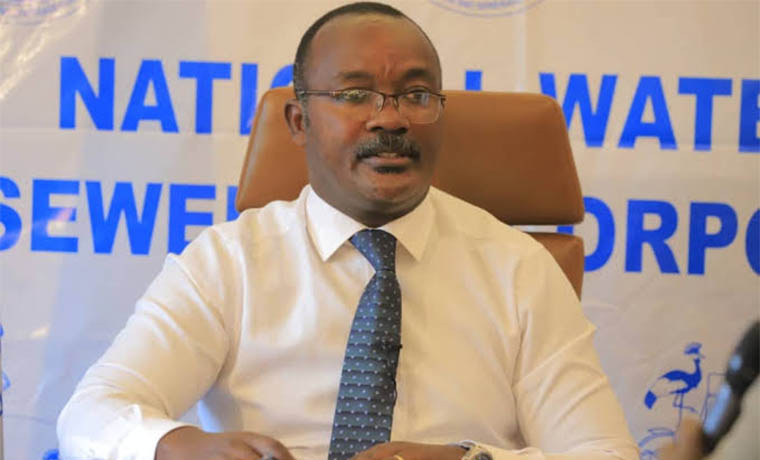
Speaking during the programme launch, NWSC Managing Director Eng. Dr Silver Mugisha said the Corporation was adopting an optimisation approach to address inefficiencies within the existing water supply system.
He explained that improving supply requires more than increasing production, noting that additional water must be supported by an efficient network capable of moving it to different service areas.
One of the major interventions involves improving connections between supply systems to redistribute water to areas experiencing shortages.
Mugisha cited north-eastern Kampala as one of the areas expected to benefit from increased water transfers from Katosi, which would also improve water availability within the Ggaba and Muyenga systems.
He noted that once more water is transferred into the affected zones, supply levels could improve across several parts of south-western Kampala.
The programme will also address the challenge of groundwater availability through new boreholes and local supply schemes in selected communities.
However, Mugisha acknowledged that laying new pipelines can be complicated by the absence of designated utility corridors, particularly in areas where roads have already been constructed or buildings have encroached on road reserves.
He said the Corporation must balance the need to extend water infrastructure with the responsibility to minimise disruption to existing roads and ensure proper restoration whenever excavation is necessary.
“Wherever they are cutting roads, they must be reinstated on time and with quality equal to or even better than what was there,” he said.
The network optimisation works will be implemented alongside NWSC’s larger Package 2B infrastructure investment, which includes new transmission mains, reservoirs and booster stations.
The Corporation says the combination of immediate network repairs and long-term infrastructure expansion will help improve the movement of water across the supply system.
To strengthen accountability, every K-FLOWS intervention will have a designated officer, a specific target supply area and measurable performance indicators.
NWSC will also use field inspections and customer feedback to establish whether network improvements are resulting in better pressure, longer supply hours and more reliable access to water. (For comments on this story, get back to us on 0705579994 [WhatsApp line], 0779411734 & 041 4674611 or email us at mulengeranews@gmail.com).