







By Mulengera Reporters
In the dry fields of Omoro District, Acholi Sub-Region in Northern Uganda, Richard Ocheng Akena’s story is one of resilience and transformation. Once a security guard, Akena’s journey to becoming an ambitious farmer is nothing short of extraordinary.
Akena, now a resident of Lagwe Dola Village in Lujorongole Parish, Lakwana Sub County, Omoro District, spent years guarding property and securing lives as a private security officer.
His career, which spanned the hustle of Iraq to the quiet streets of Omoro, was marked by long shifts and challenging environments. But over time, a quiet longing began to grow within him.

“I always wanted something more—something that would be mine, where I could see the results of my hard work,” Akena reflects.

In 2011, Akena made a bold decision. He left his security job, bought land in his home village, and ventured into farming. At first, the work was unfamiliar, but he believed in the potential of the land.
He planted bananas and tried growing gonja (plantains), only to see his crops wither under the harsh dry season. Water was scarce, and the nearest water source was miles away. The challenge of farming without reliable resources became clear, and yet, Akena refused to give up.
“I couldn’t let go of the dream,” Akena says, gazing over the now flourishing fields of his farm. The once barren land has been transformed into a vibrant space of growth, a testament to his perseverance.


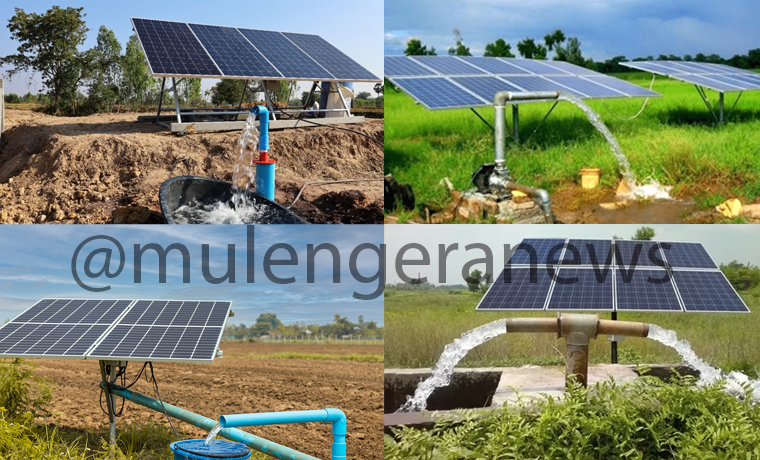
In 2023, a significant breakthrough came when Akena’s farm was selected by Nexus Green to receive a solar-powered irrigation system as part of a government initiative led by the Ministry of Water and Environment (MWE) under President Yoweri Museveni’s directive. The impact was immediate. With water now easily accessible, his crops began to thrive, and Akena saw the tangible rewards of his hard work.
“Now, I feel like I’m a human being again on this farm,” Akena says, his face lighting up with gratitude. In his first year with the new irrigation system, he earned over 8 million shillings from tomatoes, onions, and green peppers. He hired two full-time workers, ensuring that his farm was not only productive but also creating jobs in the community.
But Akena’s vision extends beyond his own success. Inspired by his farm’s transformation, he plans to rent out five acres of land to local farmers, giving them access to the irrigation system that changed his life. While none have yet approached him, Akena remains committed to helping his neighbors.
“My goal is to help my community. This technology has changed my life, and I want others to experience the same growth,” he says with conviction. “The money is good, but the real reward is seeing people work together to build something meaningful.”
Looking to the future, Akena has big plans. He’s already working on expanding his farm with new greenhouses and better marketing strategies. He dreams of creating a farmers’ cooperative to ensure the sustainability of the irrigation system and even hopes to partner with Busitema University to turn his farm into a demonstration site for agro students.
A Broader Impact: The Ripple Effect of Solar-Powered Irrigation
Akena’s farm isn’t the only one benefiting from the Ministry of Water and Environment’s solar-powered irrigation projects in Northern Uganda.
Over 100 kilometers away in the village of Apitopat Cell, Kayago Ward, Namasale Town Council in Amolatar District, Lango –Sub region, another story of transformation is unfolding.
Bosco Olum, chairperson of the Apitopat Solar-Powered Irrigation Scheme, is witnessing firsthand how the same technology is helping local farmers overcome water scarcity and improve their livelihoods.
“We were struggling,” Olum recalls. “Before the system, we had no reliable water source. We were using watering cans, and it was tiring and inefficient. But now, we have water on demand, thanks to solar-powered irrigation.”
Olum’s group of 22 farmers, which started with just 15 members in 2019, faced poor harvests due to unreliable water sources. But their persistence paid off when their application for the solar-powered irrigation system was approved in 2021. The results have been remarkable. In the first season, Olum earned 2.8 million shillings from watermelons, and in the second season, over 3 million shillings from cabbage and green peppers.
“This is more money than I ever made growing maize and cassava,” Olum shares, smiling. He’s not only focused on his personal success but also on the long-term sustainability of the project. The group has started a savings fund to maintain the irrigation system, ensuring it benefits the community for years to come.
A Mother’s New Hope: Jessica Abulo’s Journey with Irrigation
On the same farm in Apitopat village, Jessica Abulo, a mother of nine, has found hope in farming thanks to the solar-powered irrigation system introduced by the Ministry of Water and Environment.
Before joining the irrigation scheme, Abulo was a fishmonger struggling to support her large family. When the market for fish dwindled, she turned to farming, inspired by the government’s new irrigation initiative.
“At first, we used watering cans, and it was hard,” Abulo recalls. “But when the irrigation system arrived, it changed everything.”
In her first season, Abulo earned 1.5 million shillings from tomatoes, and in the second season, 1 million shillings from cabbage. “That money has made a big difference,” she says, grateful for the financial relief it has brought her family. With her earnings, she has paid school fees for her children and even bought a cow.
But despite her success, Abulo faces a challenge familiar to many farmers in the area: a lack of reliable markets for her produce. “If we had better markets, we could grow even more,” she says, frustration evident in her voice.
Still, she remains optimistic. “At least now, I know I can feed my children and build a future for them,” Abulo says with pride. Her story is a testament to the transformative power of irrigation, not only in improving livelihoods but also in providing hope for a brighter future.
A Shared Vision for Sustainable Growth: The Role of Irrigation Support Officers
Behind these success stories is the crucial role played by irrigation support officers like Engineer John Allan Obukulem and Adam Ssennyunja, who provide vital guidance to farmers in implementing and maintaining the solar-powered irrigation systems.
Engineer John Allan Obukulem, from the Water for Production Department at the Ministry of Water and Environment in Northern Uganda, highlighted the importance of support for the farmers using these systems. He explained that irrigation support officers are vital in helping farmers improve their skills, particularly in agronomy.
Obukulem emphasized that the role of these officers extends beyond just providing irrigation—they also support farmers in improving their crop yields and helping them access markets for their produce.
“The Ministry signs agreements with beneficiaries to ensure that if a farmer has no capacity to fully utilize their land, they can rent it out to other farmers. This ensures the irrigation system is not rendered redundant,” Obukulem said.
Adam Ssennyunja, Community Liaison Officer for West Nile, Acholi, and Lango at Nexus Green Limited, explained that the project’s success also involves market assessments. “We are conducting a market baseline survey to better understand where these products can be sold,” Ssennyunja explained. “The irrigation systems have helped farmers increase their yields, but now we need to ensure they can access reliable markets for their produce.”
He also noted that the government’s focus on sustainable farming includes creating a pathway for farmers to work together, share resources, and thrive collectively. “Irrigation support officers help ensures that the system continues to be effective, and by renting out land, farmers can maximize the use of these irrigation systems,” Ssennyunja added.
A Vision for a Brighter Future
The stories of Richard Akena, Bosco Olum, Jessica Abulo, and many others are a testament to the power of technology and community in transforming lives.
With continued support from the Government through the Minisrtry of Water and Environement and with the guidance of experts like Obukulem and Ssennyunja, these farmers are not only improving their own futures but also paving the way for others in their communities.
The government’s solar-powered irrigation project is having a ripple effect across Northern Uganda, helping families, building local economies, and fostering a sense of collective growth and shared prosperity. (For comments on this story, get back to us on 0705579994 [WhatsApp line], 0779411734 & 041 4674611 or email us at mulengeranews@gmail.com).