



By Mulengera Reporters
In an insightful newspaper article this week, John Fisher Sekabira who serves as the manager marketing & digital communications at National Water & Sewerage Corporation (NWSC) illustrated the GoU’s broader efforts to invest in the infrastructure required to sustainably increase all Ugandans’ access to clean and safe water.
The same access is proclaimed to be a universal human right at the UN level under the arrangement of Sustainable Development Goals (SDGs). Being the effective communicator he is, Sekabira makes it clear that access to clean and safe water isn’t just a basic need but a fundamental human right and cornerstone of public health, economic development and a matter of social dignity too.

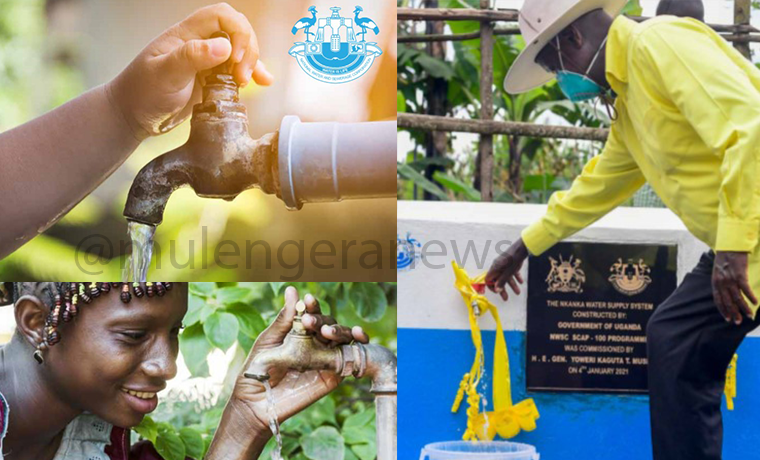
Sekabira aptly makes reference to the fact that, for decades, rural Ugandan communities have faced extreme constraints that have made the enjoyment of that fundamental right to have access to reliable and predictable source of clean and safe water, impossible. He talks about rural communities improvising through relying on natural water streams and ponds, which is regrettable.
Absence of the much-needed access to clean and safe water has, over the years, increased vulnerable rural Ugandan communities to being susceptible to waterborne diseases, while hindering education and public health-related progress.
GOV’T MITIGATING THE SITUATION:
Sekabira, in the same newspaper article, creates optimism for a better tomorrow by breaking and detailing life-changing interventions the GoU, under the prudent leadership of Gen YK Museveni, is taking to gradually alleviate the problem, amidst all the resource constraints.
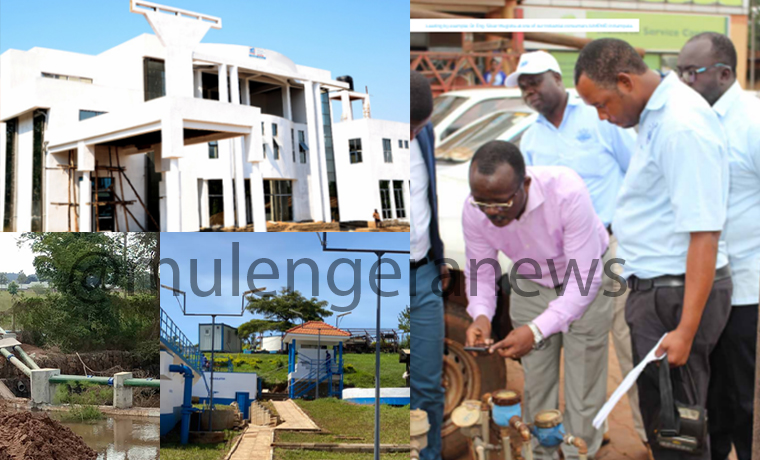
He creates awareness about the ongoing Kagera Water Works project, which the GoU is implementing using funding from the French Development Agency, with NWSC being at the forefront of the project. Sekabira asserts that this huge infrastructure project clearly demonstrates the GoU’s resolve to achieve universal access to safe and clean water.
He explains that the French-funded Kagera project will soon end water access-related constraints for more than 600,000 people living and working in Mbarara City and the entire rural Isingiro district. By 2040, more than 900,000 Ugandans will be benefiting from this same Kagera Water Project.
The project will support and sustain the newly-constructed intake on River Kagera and the new NWSC modern water treatment plant at Kakamba. The Kakamba plant has to have capacity to avail 30,000 cubic metres of water per day for the benefit of urban and rural populations in Mbarara City and Isingiro. Of the 30,000 cubic meters; 12,000 is for Mbarara City and the remaining 18,000 for rural Isingiro. The refugees at settlements of Nakivale and Oruchinga too will benefit from this intervention.
Yet that isn’t all. The resultant water supply infrastructure will also comprise of a 58km transmission main, a high-capacity pumping station at Kabingo and the strategically very important water reservoirs such as the one at Bihunya. This is designed to sit at a higher elevation point so as to be able to serve areas that previously were beyond supply limits.
This improvement in community members’ access to water will impact the quality of life for the people in a multiplicity of ways. Sekabira rightly points out that access to clean water implies fewer cholera and typhoid cases, children being generally healthier and being able to effectively attend school.
It also translates into housewives and generally other women in the community saving their time and energy that would have been expended on walking long distances to go fetch water. Predictable availability of reliable water supply also positively impacts agricultural productivity, resulting from water for production being abundantly available.
The GoU is planning to leverage the Kagera Water infrastructure to boost availability of water for production in a comprehensive way. All this will provide opportunity and generally improve the quality of life for millions of Ugandans living and operating from that part of the country.
Yet that isn’t all that the GoU is doing to improve the water situation in that densely- populated part of the country; the Mbarara-Isingiro stretch. Through the Isingiro Rural Water Supply Project, which is now 50% complete, the GoU also intends to extend water supply and access to even remoter rural communities.
Under this £58m intervention, the following deliverables are to be accomplished: 21 water distribution tanks, 10 water pumping stations and over 767kms of transmission and distribution pipelines. Effective harnessing of the Kagera water systems will result into communities not having to continue detrimentally depending on seasonal water streams.
There are also ongoing efforts by the Corporation to rehabilitate and expand on the old water supply or distribution infrastructure for Mbarara City population. This is badly needed to revitalize that City’s water treatment plants, many of which were first established more than 30 years ago and have therefore become broken, dilapidated and inefficient. These systems can no longer be relied upon to effectively serve and respond to the demands of the rapidly-growing urban population.
The new water tank at Bihunya will ensure abundant water supply to hitherto underserved areas such as Katete. And gratefully, the NWSC is already laying new pipes to operationalize that endeavour by the GoU.
The GoU, funds permitting, also intends to prioritize the rehabilitation of waste water systems besides construction of new faecal sludge treatment facilities. This is all aimed at improving sanitation and generally the environmental health.
Sekabira makes it clear that, because access to safe and clean water is increasingly getting accepted to be a universal human right, it’s in the interest of the Ugandan government to ensure that emancipating water supply/access to rural communities and population is equally prioritized. “Access to clean water,” he submits, “should not be a privilege but a guarantee for every Uganda.”
The NWSC marketing & digital manager goes on to illustrate optimism that, with the Kagera Water Works Project getting completed, there is certainty that the realization of the GoU’s “water for all” goal is achievable and is within reach.
He also admits that a lot will have to be done to ensure that the ongoing progress in the country’s water supply and access journey is sustained.
In conclusion, Sekabira asserts that for the current momentum to be sustained, climate change will have to continue being mitigated in order to safeguard water resources besides ensuring timely completion of ongoing infrastructure projects.
“But for now,” Sekabira stresses, “Uganda has taken a decisive step towards a future where every citizen, regardless of location, can turn on a tap and drink water without fear.” (For comments on this story, get back to us on 0705579994 [WhatsApp line], 0779411734 & 041 4674611 or email us at mulengeranews@gmail.com).