





By Mulengera Reporters
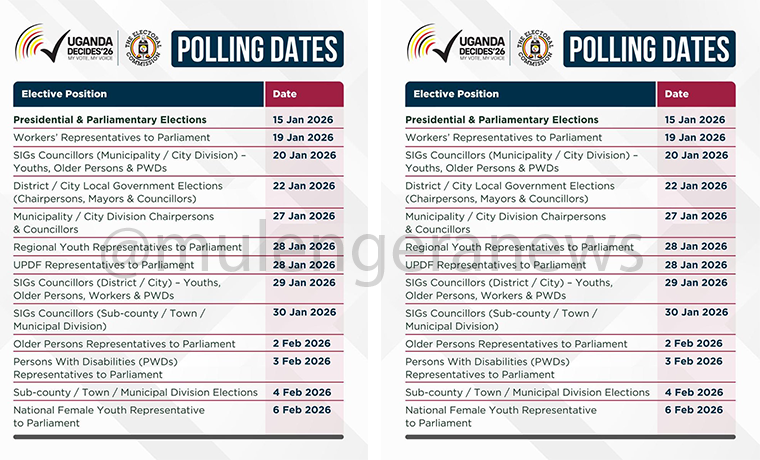
The Electoral Commission created strong public interest after staging a live and detailed voting demonstration using ten Ugandans to show how ballots will be cast on January 15, 2026.
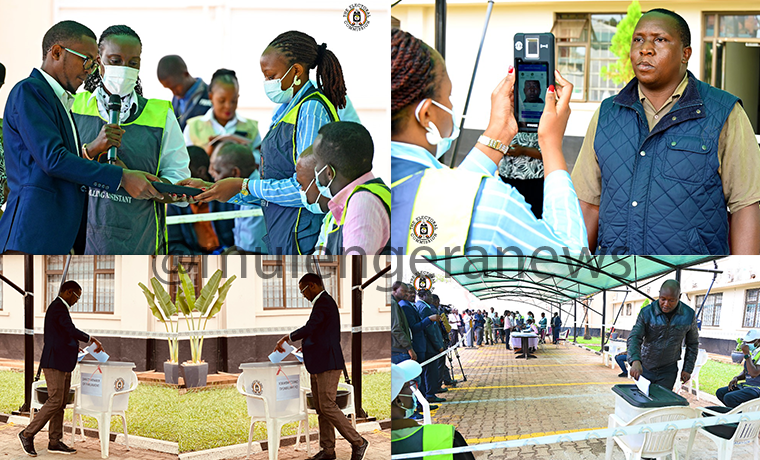
The exercise took place at the Electoral Commission headquarters and was presented as a true reflection of what voters across the country will experience when they go to vote for the President and Members of Parliament. Officials stressed that the process shown was exactly what will happen on polling day and not a rehearsal meant to impress but one meant to educate and warn the public.
The demonstration opened with introductions from key officials involved in the exercise. Yvette Naturinda, an information technology officer, explained the technical side of the system, while Vincent Byamukama, who was designated as the presiding officer for the demonstration, took charge of the polling process. Jackson Matsiko acted as the polling assistant, and Malda Kamoga Rutegatira supervised the entire polling station to ensure that every step followed the law and electoral guidelines.

The officials explained that a mock polling station had been created using real Electoral Commission systems. They made it clear that the ten people involved were not randomly picked on the day but were individuals who had earlier submitted their personal details for the purpose of developing a voters’ register for the demonstration polling station.
The Commission emphasized that a strict cutoff had been enforced and that anyone who failed to submit their particulars on time would not appear on the register, just as it would happen during the real election.
As the process unfolded, it became clear that the demonstration was meant to send a strong message. Some participants were stopped when their names could not be found on the register, showing how unforgiving the system would be on polling day.
The officials explained that this was a real-life example of what voters should expect on January 15, 2026, when Ugandans will vote for the President and Members of Parliament.
Public Relations Officer Julius Muchunguzi explained that the polling station had three ballot boxes, one for the presidential vote, another for the direct Member of Parliament, and the last for the district woman Member of Parliament. Voters were shown that they would receive three ballot papers at once before proceeding to cast their votes in the respective boxes.
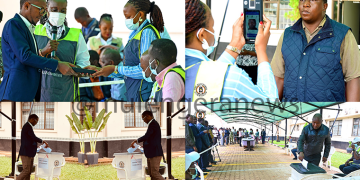
Before voting could begin, the law-required first ten witnesses were processed. The Biometric Voter Verification Kit was introduced as the main tool for identifying voters. Naturinda demonstrated that before a voter could be verified on the kit, their name had to appear on the register. The kit was assigned to the polling station by scanning the polling station details, after which the operator’s ID and fingerprints were scanned.
The presiding officer, Vincent Byamukama, also had his credentials and biometrics scanned, with the system confirming successful verification through an audible signal. Yvette Naturinda explained that these success signals showed that the system was properly assigned and secured.
The process continued with the scanning of ballot booklets. Only the top pages of the presidential and parliamentary ballot booklets were scanned, and officials explained that only ballots from the assigned booklets would be valid at that polling station. This step was highlighted as an important security measure to prevent fraud and misuse of ballots.
The witnesses were then called forward one by one. Patrick Perepetua Monji Kato was the first witness. His name was found on the register, his identification was scanned, and his fingerprint was successfully verified, with assistance from Sam, who was acknowledged during the process. This confirmed him as a valid voter for the demonstration.
Davis Mbabazi followed, but his case caused tension when it was discovered that his name did not appear on the register. Although his identification was on his phone, officials explained that IDs on phones could not be scanned. His name was checked using the register and QR code, but it was still missing, leading to his exclusion from the voting process for the demonstration. Officials clarified that if he were registered in another area, the system could direct him to the correct polling station.
Sheila Kyasiimire was next, and her details were confirmed after it was established that she had submitted her particulars earlier. Bernard Ngobi was also mentioned but was found not to have submitted his details in time. The process then moved on to George Ngobi, with officials reminding participants that appearing on the register was a must.
Vincent Byamukama, acting in his role as presiding officer, explained a situation involving a voter who presented a driving license instead of a national identity card. After checking the register, the officials confirmed that the driving license details were found, allowing the voter to proceed. This was used to show that voters without national IDs or voter registration slips could still vote as long as their names appeared on the register.
Yvette Naturinda later advised those who knew they had not submitted their names to step aside so that only verified witnesses could continue. The verification process went on with Simon Kabayo, who did not have an ID. His details were successfully verified using the register, and his biometrics were captured. Mubiru Bashir followed, with officials again demonstrating that voters without IDs could be verified using a voter locator slip or the QR code on the register.
By the end of the demonstration, the Electoral Commission had delivered a powerful and clear message using real names, real people, and real systems. The process showed that voting on January 15, 2026, will be strict, highly organized, and driven by technology. The Commission’s decision to use ten Ugandans and openly exclude those not on the register served as a strong warning that preparation is critical. At the same time, it reassured the public that the system is designed to be transparent, secure, and fair for all registered voters who follow the rules. (For comments on this story, get back to us on 0705579994 [WhatsApp line], 0779411734 & 041 4674611 or email us at mulengeranews@gmail.com).