









By Ben Musanje
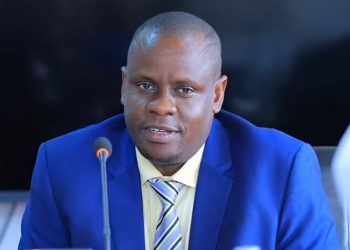
Outgoing Minister for ICT and National Guidance, Dr. Chris Baryomunsi, has used his farewell address to urge government to increase funding for the sector, warning that Uganda’s digital transformation agenda risks slowing down without stronger financial backing.
Speaking during a handover ceremony at the Ministry of ICT and National Guidance, Baryomunsi reflected on what he described as five years of steady progress in building government communication systems, expanding digital infrastructure, and strengthening coordination across state agencies. However, he emphasized that the achievements could only be sustained and scaled up if the ministry receives increased budgetary allocation in the coming financial years.
He noted that ICT had become a backbone sector for government operations rather than a luxury area, stressing that emerging technologies such as artificial intelligence, data systems, and digital platforms required consistent investment. He added that if government was to fully digitize service delivery, it needed to adequately fund the systems that enable such transformation.

The outgoing minister observed that the ministry’s mandate had evolved significantly, combining government communication, national guidance, and digital transformation responsibilities. He explained that this dual role placed heavy demands on staff and agencies responsible for ensuring both accurate public information dissemination and technological advancement across government.

Baryomunsi commended the technical teams within the ministry and affiliated agencies for what he described as outstanding professionalism, noting that political leaders depend heavily on experts to translate policy into workable systems. He also highlighted collaboration between ministers of state and senior leadership, describing teamwork within the ministry as a model for government coordination.
In a light-hearted remark, he referred to his transition to the Ministry of Health, saying he would now be handling complex medical conditions and disease control after years of working with digital systems. He maintained, however, that ICT would remain central to his work, arguing that health services increasingly depend on digital tools such as telemedicine, electronic records, and artificial intelligence-assisted diagnostics.
He further emphasized that the future of governance and service delivery was digital and intelligent, adding that even in the health sector, outcomes would depend on how well ICT is integrated into operations.

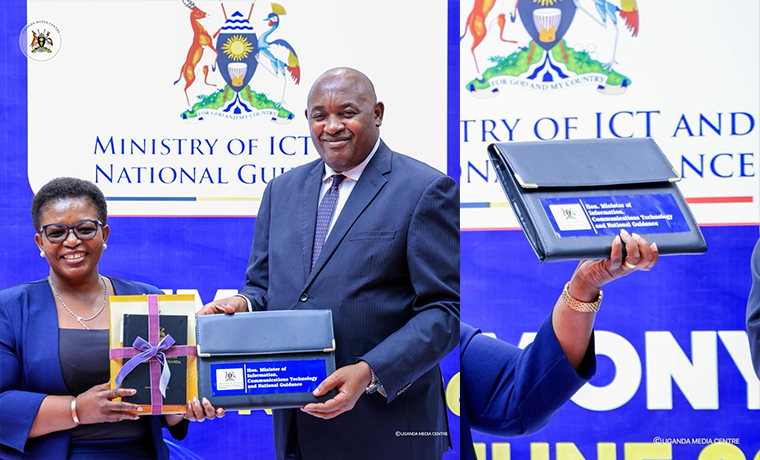
During the handover, he welcomed his successor, Justine Kasule Lumumba, and commended her long experience in public service and party leadership. He expressed confidence that she would build on the foundation laid by the outgoing team and accelerate ongoing reforms in digital governance and public communication.
He observed that she was a tested leader with extensive experience in government, adding that continuity would be essential in sustaining momentum in key ICT programs such as national backbone infrastructure, government communications systems, and e-governance platforms.
He also appealed for continued cooperation between political leaders and technical officers, warning that the ministry’s success depended on close coordination between policymakers and experts. According to him, Uganda’s ICT ecosystem had benefited from strong partnerships between agencies, regulators, and communication units across government.
Baryomunsi further called on Cabinet colleagues and Parliament to prioritize ICT funding, arguing that every sector including health, education, security, and agriculture now depended on digital systems. He warned that inadequate funding could slow down service delivery reforms and weaken government communication structures.
He maintained that ICT remained the engine of all sectors and stressed that it therefore required proportionate investment if Uganda was to remain competitive and efficient.
He concluded by assuring the new leadership of his continued support from within Cabinet and Parliament, pledging to remain an active advocate for ICT development even after leaving the docket. He also encouraged staff at the ministry to maintain teamwork and discipline, describing the sector as one of the most strategically important in government.
The handover marks a leadership transition at a ministry central to Uganda’s digital transformation agenda, with expectations that the new team will accelerate ongoing reforms while navigating persistent budget constraints and rising demand for digital public services. (For comments on this story, get back to us on 0705579994 [WhatsApp line], 0779411734 & 041 4674611 or email us at mulengeranews@gmail.com).