






By Asuman Kiyingi
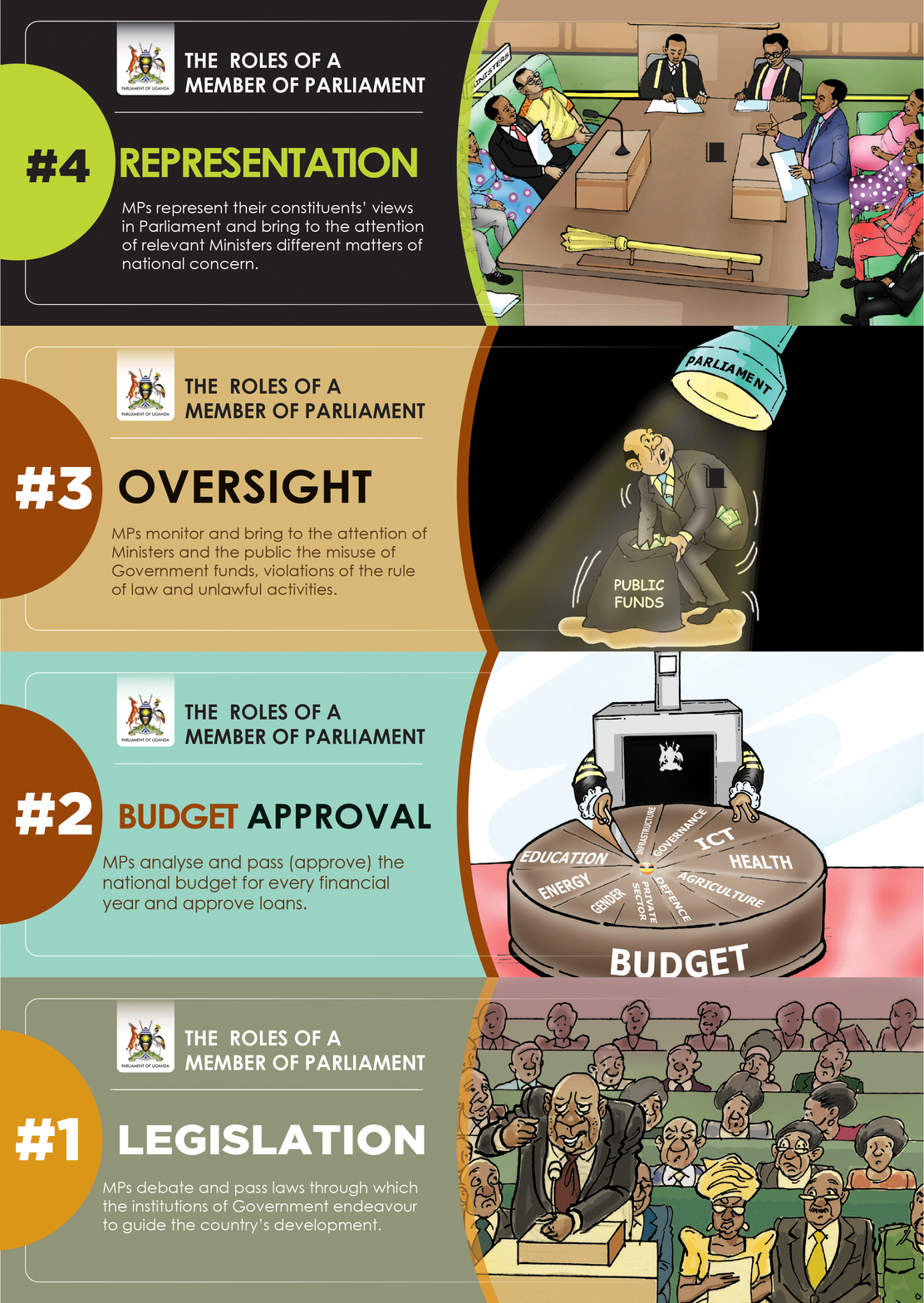
The high-stakes political crisis unfolding as the 12th Parliament takes shape—marked by citizen petitions under the Leadership Code Act, high-profile asset investigations, cash seizures, and the sudden withdrawal of political endorsements for the outgoing Speaker, Anita Annet Among, and her deputy, Thomas Tayebwa—has left the Ugandan public locked in a state of shock and anxiety. From the ostentatious displays of multi-billion-shilling luxury vehicles amidst widespread economic distress to the current dramatic security operations on Anita Among’s residences in Nakasero and Kigo, the balance of power is shifting rapidly.
Yet, as the state security apparatus and ruling party factions scramble to manage this fallout, the most damning indictment is not directed solely at the beleaguered outgoing leadership of the August House. It should be shared with the formal Opposition, whose silence and strategic paralysis have reduced them to passive spectators of their country’s destiny.
The Costs of Safe Cynicism: The Opposition’s Abdication of Duty
Faced with this seismic rift within the National Resistance Movement (NRM) coalition, the main opposition parties have offered neither a unified institutional statement nor hinted at a consensus candidate for the Speakership. Instead, the opposition’s response has been outsourced to individual outbursts of safe cynicism and sharp wit. While theatrical advice urging the embattled Speaker to “use her resources and fight on,” or mocking the executive’s hypocrisy, makes for engaging political satire, it is a poor substitute for a robust counter-narrative and strategy.

By retreating into silence, the opposition has effectively conceded that the Speakership of the 12th Parliament is an “internal NRM affair.” This passive stance permits President Yoweri Museveni and the leadership of the Patriotic League of Uganda (PLU) to project themselves as anti-corruption crusaders.

Yet this posture is a profound historical distortion. The current enforcement is deeply duplicitous; it is a half-hearted commitment to anti-corruption operating strictly on the calculus of a “use-and-dump” strategy.
The historical timeline exposes this acute duplicity:
- The Trigger: Digital Exposure and Institutional Shielding
The current crisis traces its most recent origins directly to February and March 2024, when Agora Discourse—whose leading public figures included investigative journalist Agather Atuhaire, lawyer Godwin Toko, and Dr. Jimmy Spire Ssentongo—launched the #UgandaParliamentExhibition on X. The exhibition unmasked Speaker Anita Among’s massive per diem allocations, multi-billion-shilling “Corporate Social Responsibility” (CSR) funds routed through private staff accounts, nepotism, and the controversial 500-million-shilling “Service Award.”

Following these explosive revelations, public interest lawyers formally petitioned the Inspectorate of Government (IGG) to investigate. Rather than launching an immediate probe, the IGG deployed an administrative delaying tactic, advising that the office could not act because the Auditor General was handling a routine financial audit of Parliament. Frustrated, activist lawyers bypassed the IGG and directly petitioned the Leadership Code Tribunal (LCT). The LCT flatly rejected the petition on jurisdictional grounds, clarifying that under the statutory command of the Leadership Code Act, it cannot receive direct complaints from citizens; it can only adjudicate cases exclusively investigated and referred to it by the IGG.
- The Street Mobilization and State Repression
While the formal avenues of accountability were blocked by this bureaucratic game of legal “ping-pong,” public anger boiled over. Inspired by youth movements across the region, a decentralized coalition organized the #March2Parliament anti-corruption demonstrations between July 22 and July 25, 2024.
Instead of listening to the citizens, the executive stood firmly behind Anita Among, shielding her from scrutiny. President Museveni issued televised warnings that protesters were “playing with fire.” Security forces responded with iron-fisted repression. Over 104 individuals were arrested. High-profile figures at the National Unity Platform (NUP) headquarters, including Deputy President Dr. Lina Zedriga Waru and Members of Parliament Francis Zaake, Charles Tebandeke, and Hassan Kirumira, were targeted. On the streets, prominent youth leaders like former Makerere University Guild President Salim Papa Were and activist Praise Aloikin were dragged into police vans.
The state deployed a tactical legal shortcut to break the movement’s momentum: approximately 100 peaceful citizens were hurried through magistrates’ courts, charged with the colonial-era misdemeanor of “Common Nuisance” under the Penal Code Act, and systematically denied bail—remanding them to facilities such as Luzira Prison and Kitalya Prison for weeks.
To allow the executive to now rewrite history, activating the IGG and deploying security agencies in highly publicized searches and operations only when it becomes politically convenient to neutralize Among as a front-runner for the 12th Parliament, is a catastrophic failure of opposition leadership. It validates a system where accountability is never structural, but merely a weapon of selective enforcement used to discard loyalists who have outgrown their political utility.
The Constitutional Overreach: The Shadow of Military Dictation
Compounding this institutional vacuum is the deeply troubling, unconstitutional behavior of external political and military actors seeking to dictate the leadership of Parliament, a co-equal branch of government. The aggressive posturing by the Chief of Defence Forces (CDF) and the leadership of the PLU represents a serious encroachment on the constitutional order.
This overreach was plainly on display during a thanksgiving party held in Kyungu, Mukono District, for outgoing Defence Minister Jacob Oboth-Oboth. At the event, PLU Secretary General and Kasambya County MP David Kabanda went as far as to explicitly proclaim Oboth-Oboth the “next Speaker of Parliament.” Kabanda openly stated that he was executing direct instructions from the Chairman of the PLU, CDF Gen. Muhoozi Kainerugaba, and that the choice had been formally endorsed by President Museveni.
To have the leadership of Parliament decreed at a private celebratory function by a military command structure is not only a violation of basic democratic tenets but a direct affront to Uganda’s Constitution:
- Article 208(2) of the Constitution explicitly mandates that the Uganda People’s Defence Forces (UPDF) must be non-partisan, national in character, and subordinate to civilian authority. When the choice of the next Speaker is openly dictated by the CDF through a political pressure group, the constitutional wall separating the military from civilian politics collapses.
- Article 82 provides that the election of the Speaker is the exclusive, sovereign prerogative of elected Members of Parliament. This mandate is executed through a secret ballot free from external coercion, as required under Rule 5 of the Rules of Procedure of the Parliament of Uganda.
When military and factional entities treat the Speakership as a fait accompli to be settled via executive fiat or military decrees before the House even convenes, they reduce Parliament to a mere department of State House. The opposition’s failure to forcefully denounce and voice a constitutional objection to this overreach is an abdication of its duty to defend democratic governance.
A Strategic Path Forward: Exploiting Fractures and Building a National Consensus
The opposition must immediately abandon its current positioning as an audience to NRM theater and recognize that public anger across Uganda has created a rare opening for genuine structural change. Even from a position of numerical minority in the House, a sophisticated, proactive strategy can fundamentally alter the dynamics of the 12th Parliament.
- Court Courageous NRM Independents and Reformers
The heavy-handed tactics used to neutralize the incumbent Speaker, combined with the overt military dictation of her successor witnessed in Mukono, have sent shockwaves through the backbenches of the ruling party. Many NRM and independent legislators are quietly terrified, realizing that the executive and military apparatus can completely bypass party organs and parliamentary rules to impose leaders.
The opposition need not field a purely partisan candidate destined for certain defeat. Instead, they can actively court, endorse, and build a coalition around a courageous, independent-minded NRM candidate or a respected legal institutionalist willing to contest as an independent in the Speaker race. By exploiting internal anxieties through the constitutional and procedural guarantee of a secret ballot in the election of the Speaker, the opposition can galvanize a cross-party alliance of legislators eager to reclaim parliamentary independence from military and executive dictation.
- Make Universal Prosecution the Clarion Call
The opposition must shift the national narrative from the vulnerabilities of an individual to a systemic demand for uniform rule of law. The clarion call must be unambiguous: the full, transparent prosecution of all implicated culprits.
The recovery of massive, unmapped cash reserves from a leader’s residence triggers immediate public outrage. While establishing strict criminal convictions for illicit enrichment under Section 31 of the Anti-Corruption Act or money laundering under the Anti-Money Laundering Act (AMLA) requires proving the underlying offense and navigating shifting evidentiary burdens, the state has shown it can move swiftly when motivated.
The opposition must demand that this standard be universally applied. If the state is genuinely fighting corruption, lifestyle audits, asset tracing, wealth declarations, residential searches, and forensic audits currently deployed against the outgoing Speaker must be extended to all. Demanding equal enforcement exposes the selective nature of the current crackdown and prevents the regime from using anti-corruption rhetoric as a tool for selective political containment and fixing the Speaker race.
- Champion Legislative Decoupling
The current crisis provides the ultimate justification for a comprehensive Parliamentary Reform Bill. The opposition must lead the charge to strip the Office of the Speaker of the immense, unilateral financial patronage and budgetary discretion that has turned the position into a toxic prize and an executive target. By tabling structural reforms to insulate oversight committees such as COSASE and PAC, and demanding total transparency in parliamentary expenditure, the opposition can channel public outrage into lasting institutional safeguards.
Conclusion
Ugandans are weary of a political landscape where accountability is only delivered as a byproduct of elite betrayal and “use-and-dump” calculations. The national anger generated by the exposure of systemic rot in the 11th Parliament must not be squandered or allowed to be co-opted by those who tolerated, built, or maintained the patronage network in the first place.
The current crisis presents an opportunity that transcends the woes of any individual politician. If the opposition can rise above its paralyzing cynicism, stand firmly behind the constitutional independence of the legislature, and construct a broad anti-corruption consensus with courageous independent reformers, a new path becomes possible. The battle for the 12th Parliament must not be about which faction of the ruling establishment has the upper hand; it must be about dismantling the parchment barriers that protect the corrupt and beginning the arduous work of building a truly accountable, corruption-free Uganda. The writer is a Senior Advocate and former Minister.