




By Mulengera Reporters
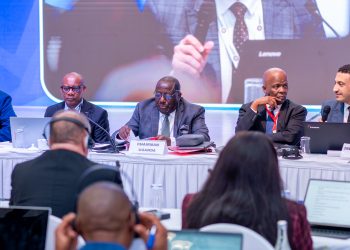
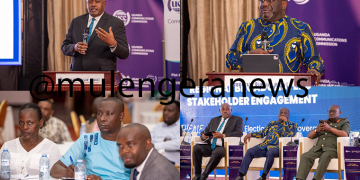
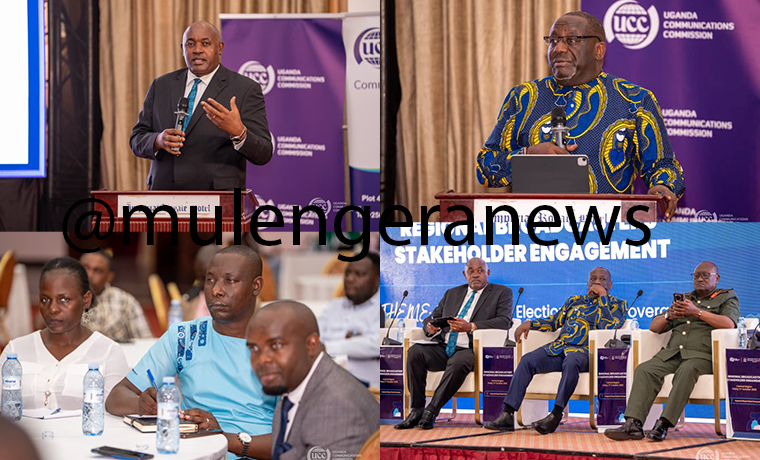
On Friday, hundreds of broadcasters and relevant stakeholders from security and other government agencies converged at Imperial Royale Hotel in Kampala to discuss the conduct of media practice in the ongoing campaigns for the 2026 general elections.
The meeting was convened by Uganda Communications Commission (UCC), which is the regulator of all communications in Uganda, and was among others addressed by Executive Director Nyombi Thembo, who spoke about the role the President’s Office has to play (in sanitizing the media ecosystem) through the Resident District Commissioners (RDCs) who are deployed, operate and live in each of the Ugandan Cities and districts.
Nyombi Thembo thanked Presidency Minister Milly Babalanda for leading the RDCs in such a way that they have been good allies and partners of UCC in monitoring and ensuring that all radio broadcasters (Uganda currently has more than 317 fm radio stations) operate in a manner that complies with the minimum broadcasting standards, as was put in place by the regulator (UCC).

Nyombi Thembo said that, much as UCC now has tracking technology which enables them to detect, keep recordings for 90 days and to subsequently deal with broadcasters who breach these standards, the RDCs do a great job helping the Commission identify and move in to render the appropriate regulatory sanctions in case of any breaches to the minimum broadcasting standards.
Information & National Guidance Minister Dr. Chris Baryomunsi opened the Friday stakeholders engagement meeting and responded to claims that in some districts and regions of Uganda, RDCs demand to dominate the utilization of the mandatory one hour of prime time that each of the radio stations is mandated to make available for government social services delivery programs and business to be communicated to the general public. This hour is given weekly.
Baryomunsi explained that his Ministry worked with her Presidency counterpart Milly Babalanda Babirye and agreed that the government’s one hour per week be utilized by all government officials in the district or region-and not only the RDC.
“The RDC’s role is that of being the contact person and of coordinating with the CAO to determine the relevant officers to appear on which radio program and for which week. That airtime is for the government as per the UCC licensing conditions, and not just for the RDC. So, it should be used by all government officials in the district without restriction or being excluded by the RDC.”
As Babalanda, who was present too nodded in approval, Baryomunsi explained that in consultation with the CAO and other local government officials, the relevant officers from the different departments of the local government, can even make a joint appearance, which the RDC is mandated to coordinate and ensure that this happens every week.
“It could be the district engineer appearing to explain why a certain road or bridge is in a certain state. It could be staff from the health department appearing to sensitize the public about the state of health or outbreak of a disease. The CAO and RDC can determine if there is need for them to appear jointly.”
Baryomunsi also rebuked media owners who employ broadcasters and moderators who they don’t pay-which pushes them into becoming extortionists, who end up demanding for money from the government officials appearing to feature on the radio program yet that one hour is allocated to government every week without having to pay even a penny.
Babalanda, who gets frequent reports and updates from the field through the network of RDCs and DISOs, told the Friday meeting that these extortionist tendences by some moderators explain why many government officials especially in the upcountry local governments shun appearing for such radio talk shows.
Baryomunsi, just like Nyombi Thembo, warned media houses against tolerating anti-government moderators who sabotage government by hosting officials from NGOs and haters from opposition parties, to feature and make use of the time that is allocated and meant for exclusive use to propagate government messages.
Nyombi Thembo reminded broadcasters that omitting to avail the government’s one hour per week amounts to breaching licensing conditions and it’s something that can even lead to a broadcaster’s license being revoked.
The broadcasters and media owners present (led by Dr. Kin Karisa & Innocent Nahabwe of NAB plus Julius Tumusime who heads RUBA, which unites radio owners of upcountry in rural Uganda) were asked to work towards improving journalistic staff’s welfare including paying them on time so as to diminish on extortion cases.
Karisa had complained of government officials not being keen to positively respond to invitations to appear to be hosted for talk shows but government officials present quickly responded to him by making it clear that many such would-be government spokespersons and defenders shy away because most of the moderators and producers tend to extort and harass them by demanding for a lot of money per appearance. That this is very common especially at radio and TV stations around the Greater Kampala Metropolitan Area districts.
Milly Babalanda was the most emphatic on this point, which Nyombi Thembo and Media Council Chairman Paul Ekochu described as an affront to media ethics and professionalism. (For comments on this story, get back to us on 0705579994 [WhatsApp line], 0779411734 & 041 4674611 or email us at mulengeranews@gmail.com).