







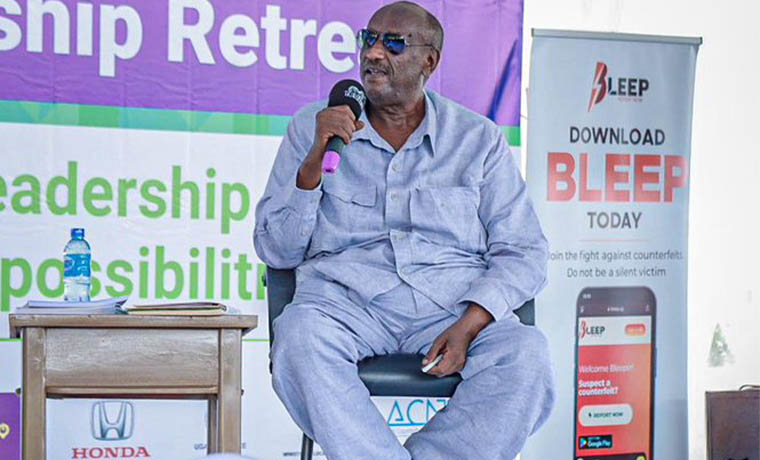
By Aggrey Baba
A field mission that brought together more than 180 cooperative and savings-group leaders across Greater Nebbi exposed the difficulties of turning agricultural financing into large-scale commercial production, Gen. Salim Saleh has revealed.
The mission, conducted between October 25 and 29, 2021, followed an ambitious UGX20 billion agricultural financing initiative that had brought banks, farmers, processors and government institutions together in an attempt to transform smallholder farming into organised commercial production.
In ‘Organizing Land for National Economic Transformation’, a book he coauthored with a friend, Saleh revisits the initiative and the obstacles that prevented its intended production partnerships from taking off, particularly unresolved land challenges that undermined farmers’ ability to supply processors in the required quantities.

The financing arrangement had been launched earlier in 2021 through a partnership involving Stanbic Bank, Afro-Kai Limited, the Uganda Grain Council, Padyere County Farmers’ Cooperative Union and other stakeholders.
Saleh, who was then serving as Chief Coordinator of Operation Wealth Creation, was among the senior officials involved in the initiative, which sought to address several problems that had long limited smallholder farmers’ participation in commercial agriculture.
The idea was to move farmers beyond subsistence production by linking them to financing, processing facilities and dependable markets. Rather than leaving individual farmers to struggle with credit, production and selling their harvests, the partnership sought to bring the different players together under an organised agricultural arrangement.
One of the planned interventions involved an agreement between Operation Wealth Creation and Uganda Breweries to promote commercial crop production in Purongo, Nwoya District, with farmers expected to produce for an identified industrial market.
But the arrangement encountered a fundamental obstacle, where the land on which the production targets depended had not been adequately organized.
According to Saleh’s account, fragmented landholdings and unresolved ownership disputes made it difficult to coordinate farmers and achieve the scale of production required by processors. The financing and market arrangements could not deliver their full promise when the production base itself remained uncertain.
This experience prompted further engagement with local leaders and farmer organizations in Greater Nebbi, where the field mission assessed the conditions affecting agricultural organization and commercial production.
The team visited Pakwach, Nebbi and Zombo, engaging 110 cooperative leaders and 70 savings-group leaders, as well as district and sub-county officials.
The consultations were intended to establish the challenges facing farmer organizations and understand what was needed to make agricultural financing and production partnerships work at community level.
Saleh uses the experience to make a wider point about the limitations of financing farmers without first addressing the conditions under which they are expected to produce.
Access to credit alone, he argues, cannot guarantee commercial agricultural success where farmers lack organised land arrangements, coordinated production plans and reliable connections to processors and buyers.
The initiative had attempted to bring together the essential players in the agricultural value chain, but the experience demonstrated that partnerships involving banks, government, cooperatives and processors also depend on resolving the practical challenges confronting production at farm level.
Gen Saleh thinks land organization must therefore become part of agricultural financing and investment planning. Farmers need arrangements that allow them to coordinate production, meet agreed supply volumes and fulfil commitments to processors without being paralysed by competing land claims.
The UGX20 billion initiative remains an important example in his book of the gap between designing agricultural financing programmes and creating the conditions that allow them to succeed, and he argues that Uganda will struggle to turn small-scale agriculture into a reliable industrial supply base unless financing, land organization, production and markets are planned as connected parts of the same system.