







By Ben Musanje
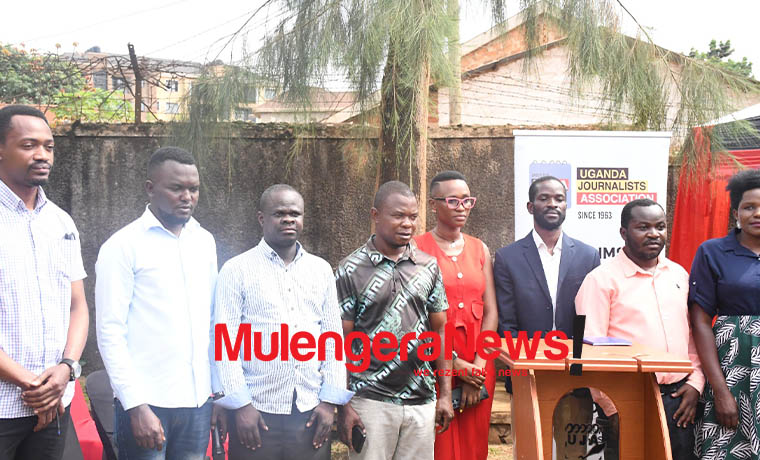
There was drama, heated debate and last-minute political maneuvering at the Uganda Journalists Association (UJA) Annual General Meeting held at the association’s offices in Keti Falawo, Kawempe, as journalists gathered to elect new leaders and chart the organisation’s future.
The meeting saw Emmanuel Kirunda emerge as the new UJA President, replacing outgoing president Mathias Rukundo, while Vision Group journalist Jay Rizik Kalungi was declared Vice President after stepping down from the presidential race.
However, the electoral proceedings were not without controversy, with Bukedde TV journalists Josephat Sseguya and Tera Kaaya separately pushing for the creation of additional positions on the association’s executive to accommodate experienced and older journalists.

Sseguya, Kaaya push for additional positions

One of the notable moments came when Bukedde TV’s Josephat Sseguya rose to propose the creation of a new executive position of All-Time Experienced Journalist, arguing for representation of veteran journalists within the association’s leadership.
His proposal appeared to be aimed at securing a place for himself in the proposed position.
UJA Secretary General-designate Ronald Kabuye, who was serving as the master of ceremonies in his capacity as the outgoing Publicity Secretary, seconded the motion and enthusiastically presented it to members.
However, the proceedings took an unexpected turn when a senior journalist from Mulengera Media intervened, advising the enthusiastic colleagues to allow the Returning Officer, Advocate Albert Mbonye, to guide the meeting on matters concerning the electoral process and proposed changes to the executive structure.
When Counsel Mbonye took the floor, he explained that the proposed position was not among the executive positions previously presented and gazetted for the election. Consequently, it could not be introduced and considered during the ongoing electoral exercise.
He advised the incoming leadership to make a formal application for the proposed position to be considered through the appropriate constitutional procedures after assuming office.
Despite the guidance, Sseguya who presents a celebrity gossip show at Bukedde TV commonly known as ‘Olugambo’ made further submissions in support of his proposal, but his efforts did not yield immediate success.
Before Sseguya’s intervention, another Bukedde TV journalist, Tera Kaaya, had also proposed the creation of an Elderly Persons’ position on the UJA executive to provide representation for older journalists.
Like Sseguya’s proposal, Kaaya’s idea was not adopted during the AGM, although members were assured that the matter could be considered through the appropriate procedures at a later stage.
The proposals sparked discussions about the representation of veteran journalists and the need to accommodate different generations within the association’s leadership.
Kalungi, Kirunda present competing manifestos
Before the presidential election, the two candidates, Emmanuel Kirunda, the outgoing Secretary General, and Jay Rizik Kalungi of Vision Group, presented their manifestos to members, outlining their priorities for the association.
Kalungi placed considerable emphasis on journalists’ economic welfare, financial security, unity and inclusion.
She proposed establishing a savings and credit arrangement, commonly referred to as a SACCO, to enable journalists to access affordable loans at lower interest rates.
She argued that journalists deserved an organised financial support system, just like professionals in other sectors, and noted that such an arrangement would help members address their financial challenges.
Kalungi also promised to develop a support mechanism for journalists facing medical emergencies, particularly those who struggle to raise money for treatment and operations.
She further pledged to advocate for scholarships and educational opportunities for female journalists while promoting mentorship programmes for young and upcoming journalists.
On unity, Kalungi expressed concern about what she described as divisions within UJA, arguing that the association should operate as a family rather than a political organisation.
She cited the exclusion of some prominent journalists, including Abubaker Lubowa of Daily Monitor, Isaac Katende alias Kasuku (former Dembe FM Talk and Talk Show Presenter who turned a Tik Toker) and Zambali Blasio Mukasa (Nansana Municipality Legislature), whom she described as former members who had become disconnected from the association.
Kalungi argued that UJA needed to reconcile with such members and create an environment where every journalist felt welcome and valued.
“As a female in journalism, I understand the unique challenges we face,” Kalungi told members, adding that she would bring resilience, innovation and strategic leadership if elected.
She appealed to members to support her candidacy, promising not to disappoint them.
Kirunda promises to redefine journalism
Kirunda, on the other hand, campaigned on a platform of institutional reorganisation, press freedom, journalists’ safety, economic rights, unity and professional development.
Introducing himself as a journalist and outgoing UJA Secretary General, he said he was seeking the presidency to redefine journalism and give the association a renewed sense of direction.
He outlined seven key priorities that he said would guide his leadership.
First, he promised to reorganise UJA and revitalise its existing initiatives, arguing that the association needed stronger structures and more effective leadership to fulfil its mandate.
He also placed considerable emphasis on press freedom and the protection of journalists, citing his previous involvement in legal efforts to challenge attacks against media practitioners.
Kirunda recalled the 2022 court petition filed following the beating of journalists at the United Nations offices in Kololo. He said he was among those who challenged the Attorney General and eight individual military officers over the attacks.
He described the resulting court decision, which he said declared the beating of journalists in the course of their professional duties unconstitutional, as an important achievement in the struggle for press freedom.
He also highlighted his involvement in securing the release of journalist Remmy Asiteza, whom he said had spent more than two months in detention before his intervention helped secure his freedom.
Kirunda promised to continue defending journalists facing arrest, detention, intimidation and other forms of harassment.
He further argued that press freedom should go beyond the right to publish stories and include journalists’ economic rights, particularly fair remuneration and better working conditions.
His other priorities included empowering journalists to occupy online spaces and challenge imposters, promoting unity through initiatives such as the World Press Freedom Day Media Football Sports Gala, expanding partnerships and strengthening professional development.
He pledged to extend the sports gala to other regions of the country to bring journalists together and promote solidarity across media houses.
Kirunda also promised to attract more development partners to support UJA’s programmes and institutional growth.
Kalungi steps down after five-minute meeting
Following the campaign presentations, Returning Officer Albert Mbonye asked the two presidential candidates to hold a brief meeting lasting approximately five minutes to agree on the way forward.
The candidates retreated into the offices alongside their respective campaign agents before returning to the meeting.
It was upon their return that Counsel Mbonye announced that Kalungi had agreed to step down from the presidential contest.
Her decision paved the way for Kirunda to take the presidency, while Kalungi was declared Vice President, a position that had remained unfilled in the election process.
According to the Returning Officer, nine of the ten executive positions had already been taken by candidates who had been admitted unopposed, leaving only the presidency to be contested.
Mbonye subsequently declared Emmanuel Kirunda President of UJA and Jay Rizik Kalungi Vice President.
The development brought the presidential contest to an end, with Kalungi joining the incoming leadership after initially campaigning for the top position.
Kirunda promises an inclusive leadership
In his acceptance remarks, Kirunda thanked the Returning Officer, members who participated in the AGM and journalists who had entrusted him with the responsibility of leading the association.
He promised not to spend his tenure blaming previous leaders but instead to concentrate on finding solutions and establishing a new direction for UJA.
“I am here to assure you, I am a servant of God. I bring solutions,” he told members.
Kirunda said his administration would embark on reorganising the association and reaching out to media houses and other stakeholders to ensure that journalists across the country were represented.
He also promised to consider proposals raised by members during the AGM, including the suggestions for additional representation of experienced and elderly journalists.
He emphasised that such proposals would be examined in accordance with the association’s constitution and the appropriate procedures.
“We are going to sit and see what the constitution says. And we include all players in this,” he said, adding that the ultimate objective should be ensuring that journalism and UJA emerge stronger.
He further assured members that the new leadership would not operate as an exclusive club, promising to bring different stakeholders on board.
Special hotline for journalists facing threats
One of the immediate commitments Kirunda made was to establish a dedicated mobile telephone line to receive complaints and reports from journalists facing threats, arrests, detention and other professional challenges.
He said the line would provide a mechanism through which journalists could quickly alert the association whenever their safety or freedom was threatened.
The incoming president asked members to give the new administration time to organise itself and establish effective mechanisms for responding to such challenges.
He also promised that the leadership would keep members informed about its activities and progress.
New leadership yet to take oath
Although the election exercise concluded with Kirunda declared President and Kalungi Vice President, the new leadership had not yet taken its oath of office at the time of the AGM proceedings.
The proposed positions for experienced and elderly journalists also remained unresolved, with the incoming leadership expected to consider them through the appropriate constitutional processes.
The AGM therefore ended with a new leadership mandate, renewed calls for journalists’ welfare and a challenge to the incoming executive to bridge divisions within the profession.
For Kirunda, the task ahead will be to translate his campaign promises into practical programmes, particularly on journalists’ safety, financial welfare, professional development and institutional reorganisation.
For Kalungi, her transition from presidential contender to Vice President presents an opportunity to advance the welfare, inclusion and unity agenda she championed during her campaign.
And for Sseguya and Kaaya, the debate over the representation of experienced and elderly journalists is not yet over, with the proposed positions awaiting consideration by the new executive.
Ultimately, the incoming leadership faces the responsibility of demonstrating that UJA can become a stronger, more inclusive and more responsive professional body for journalists across Uganda. (For comments on this story, get back to us on 0705579994 [WhatsApp line], 0779411734 & 041 4674611 or email us at mulengeranews@gmail.com).