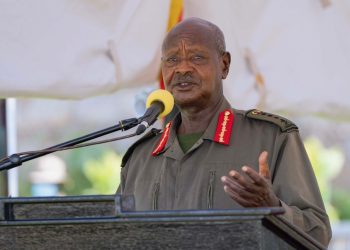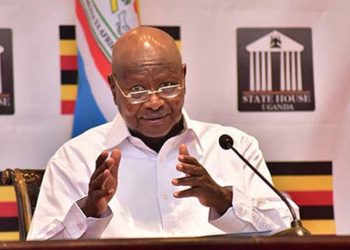







President Yoweri Museveni has praised Tanzania’s founding President Julius Nyerere as a rare example of an African leader who exercised power without resorting to extrajudicial political killings, using his 24-year record in office to challenge the younger generation to rethink what principled Pan-African leadership should look like.
The remarks were made while Museveni revisited some of the most defining moments of Nyerere’s presidency, including the 1964 mutiny by soldiers of the Tanganyika Rifles. In an address read by Hon Crispus Kiyonga at Makerere University on Wednesday, he explained how Nyerere responded to the military revolt and rebuilt the country’s army.
The address was delivered during the Nyerere–Museveni Generation Dialogue, held st Makerere University’s Freedom Square.
Reflecting on Nyerere’s political philosophy, Museveni said the Tanzanian leader understood that African nationalist movements were fundamentally broad coalitions formed to liberate their countries from foreign rule rather than narrow political organizations built around competing domestic interests.
He argued that this understanding helped Nyerere appreciate the need for political arrangements that could accommodate differences while maintaining national unity.
Museveni acknowledged that Tanzania operated under a one-party political framework for much of Nyerere’s presidency. However, he said the system retained competition between candidates within the ruling party and that Nyerere eventually led the country’s transition back to multiparty politics as circumstances changed.
The president further asserted that during Nyerere’s 24 years in leadership, there was not a single case of extrajudicial political killing by the state, presenting this as evidence of the former leader’s moral restraint.
Museveni also recalled the 1964 mutiny by soldiers of the Tanganyika Rifles, describing Nyerere’s response as an important demonstration of decisive leadership.
According to Museveni, Nyerere dissolved the mutinous military force and established a new Tanzania People’s Force, initially drawing recruits from the TANU Youth League while retaining selected experienced personnel from the former King’s African Rifles.
Museveni argued that the move helped prevent the military crisis from becoming an opportunity for forces opposed to African independence to destabilize Tanzania’s government.
He also recalled Nyerere’s backing for armed liberation movements in southern Africa and his support for the struggle against Idi Amin’s government in Uganda.
Museveni said Nyerere remained steadfast despite pressure from powerful foreign interests that opposed his support for liberation movements. He singled out the Tanzanian leader’s solidarity with Uganda during its struggle against Amin as one of the reasons he became a lifelong follower and admirer of Nyerere.
The president said Africa’s liberation generation had secured political independence through sacrifice and collective action, but challenged contemporary leaders to protect those achievements through economic transformation, political integration and stronger security institutions.
He urged young people, mostly Ugandan youths, not to take sovereignty for granted, arguing that political freedom without economic empowerment and dependable security remained incomplete.
The address was delivered at Makerere University’s Freedom Square during the 2026 commemoration of Nyerere, attended by students from different universities, scholars, young leaders and four of the former Tanzanian president’s grandchildren who travelled from Tanzania for the event. (For comments on this story, get back to us on 0705579994 [WhatsApp line], 0779411734 & 041 4674611 or email us at mulengeranews@gmail.com).