






By Ben Musanje
Nineteen years after her father drowned in Lake Victoria, Maria Gorreti Mukandutiye still struggles to hold back tears when recounting the tragedy that left her orphaned and without close family.
Mukandutiye, a resident of Siriba in Buvuma District, was only seven years old in 2007 when her father left home for fishing with her younger brother. The family had lost their mother a few years earlier, leaving her father as the main caregiver and provider.
He never returned alive.

Instead, the family was handed his body for burial, bringing another devastating loss to children who had already lost their mother.

Mukandutiye said she knows very little about her family background and understands that her father originally came from Rwanda. She said she has no relatives she can turn to, making the loss even more painful.
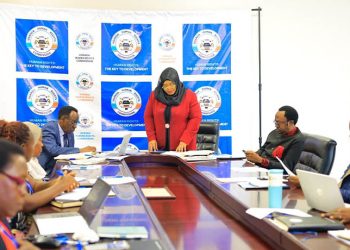
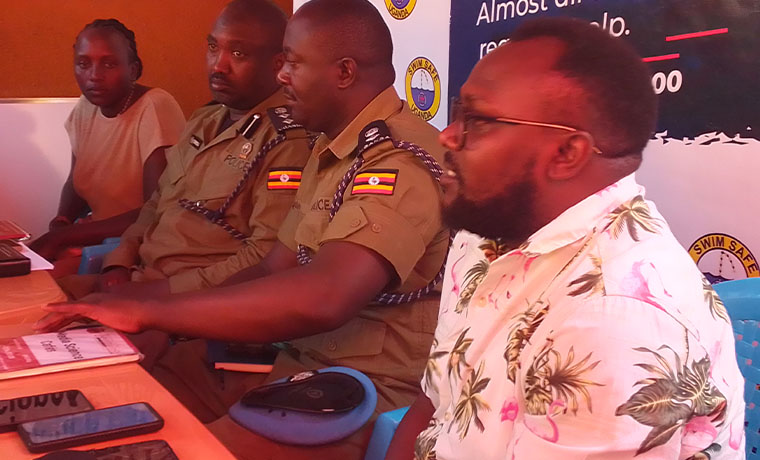
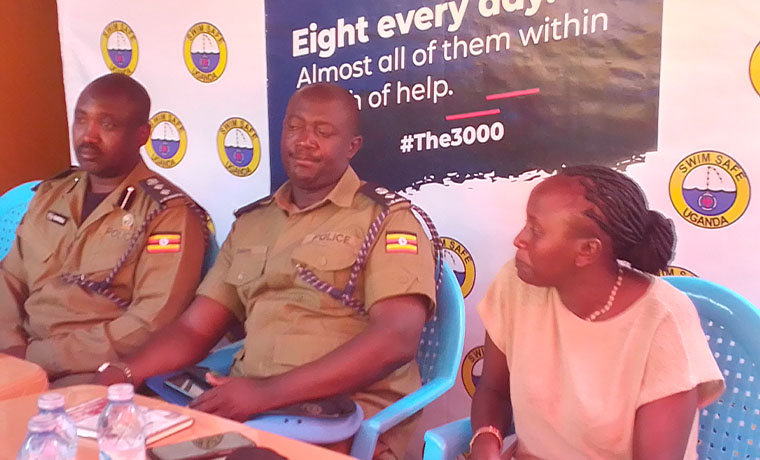
Her emotional account was shared during the Anti-Drowning Media Café held on Friday at the Health Journalists Network in Uganda (HEJNU) offices in Kamwokya, where journalists, researchers, police and other stakeholders discussed Uganda’s drowning crisis under The 3000 campaign, spearheaded by Swim Safe Uganda.
Uganda is estimated to lose about 3,000 people to drowning every year, although researchers caution that the actual number could be higher because many cases go unreported or are never captured in official records.

For some families, the statistics represent years of grief, lost breadwinners and children growing up without parents.
For Moses Nsubuga, popularly known as Kawonawo, the statistics represent a tragedy he narrowly escaped.
The Buvuma Islands resident survived a boat accident on Lake Victoria in April 2007 while travelling from Galamu landing site towards Kenya to transport timber.
He recalled that the journey became dangerous when the wind intensified and a powerful storm struck the boat. The storm affected the engine and water began entering the vessel, forcing those aboard to remove it as the boat started taking on more water.
The vessel eventually capsized.
Although Nsubuga and his two colleagues were wearing life jackets, he found himself struggling in the water. At one point, he felt another person attempting to hold onto him and, in his desperate fight to survive, pushed the person away with his elbow.
When he resurfaced, he managed to hold onto pieces of wood that had broken away from the boat. The floating debris helped keep him above water as the waves carried him through the night.
He was eventually pushed towards a landing site that he later learnt was Kama on the Kenyan side of Lake Victoria. He arrived at about 4am and, exhausted after spending the entire night in the water, fell asleep.
When he woke up, he found himself surrounded by large snakes locally known as enswaswa.
Despite his injuries, Nsubuga attempted to move but could not walk properly. He resorted to crawling towards land, where he spotted people.
Because it was still dark, the people initially mistook him for a ghost and ran away.
Nsubuga continued trying to convince them that he was human. He removed the life jacket he was still wearing and waved it to attract their attention and seek help.
The people eventually returned and helped him.
He discovered that they were members of the Jaluo community in Kenya and managed to communicate with them using the little Swahili he knew. They eventually took him to an area where Ugandan boats were parked.
There, he recognised a former schoolmate who had turned a fisherman.
It was through him that Nsubuga learnt that his two colleagues had not survived the accident. One of their bodies was eventually recovered and buried in Kenya, while the other has never been found.
His survival, experts say, illustrates the importance of life jackets, survival swimming skills and access to objects that can keep drowning victims afloat until rescue teams arrive.
Marine Police Safety Officer SP Manisul Isabirye identified negligence among both passengers and boat operators as one of the major factors contributing to drowning in Uganda.
He said some water users acquire life jackets but fail to wear them, instead leaving them on boats or using them as seats.
Police, he said, have therefore intensified monitoring and surprise operations on water bodies to ensure that safety regulations are followed.
Isabirye also pointed to the continued use of unseaworthy boats and overloading as major risks.
Although the Ministry of Works and Transport licenses boats operating on Ugandan waters, he said some operators still circumvent the regulations and use boats that are not fit for travel.
Overloading remains particularly dangerous, with some boats carrying several times the number of passengers they are designed to accommodate.
The Marine Police officer also said inadequate survival swimming skills expose water users to greater danger, arguing that people who regularly travel or work on water should have at least basic swimming and survival skills.
Otto Busingye, a Research Associate at Makerere University School of Public Health, said research into drowning had revealed that the problem extends far beyond the major lakes.
Researchers conducted a study covering 60 districts, including lakeside and non-lakeside areas, and examined police, hospital, mortuary and community records.
The research found that people drown in lakes, rivers, wells, flooded areas and even water-filled pits left behind by activities such as brick-making.
Children are particularly vulnerable in some communities where they are sent to wells to fetch water or encounter abandoned pits that fill with rainwater.
Busingye said the estimated 3,000 deaths should not be viewed simply as a statistic because they represent parents, children, breadwinners and entire families whose lives are permanently changed.
He also warned that the number of drowning deaths does not capture the full burden of the problem because many people survive drowning but are left with permanent brain injuries, psychological trauma and other complications.
He explained that drowning should also be treated as an injury because a person can be rescued and recover physically while continuing to suffer the consequences of the incident.
Busingye said Uganda’s drowning figures remain estimates because data collection is still developing and some cases, particularly where bodies are not recovered, never enter official records.
Researchers are working with the Ministry of Health to strengthen routine drowning surveillance, including the use of Village Health Teams to collect information from communities.
He said many of the people most exposed to drowning depend on water for their livelihoods, making it difficult to simply advise them to avoid water.
Fishermen, boat operators, traders and passengers use lakes and other water bodies to work, travel and earn a living.
Busingye therefore called for a comprehensive approach that combines safe and properly regulated boats, quality life jackets, swimming and survival skills, weather information, community preparedness and effective emergency response.
The discussions during the Anti-Drowning Media Café underscored that Uganda’s drowning crisis is not only about the thousands of people estimated to die each year, but also about the families left behind.
For Mukandutiye, the loss of her father has remained a painful reminder of the human cost of drowning.
She was only seven when her father left for the lake.
He came back as a body.
Nineteen years later, she is still living with the consequences of that loss, without her parents and with little knowledge of the family she came from.
Her story, stakeholders said, is a reminder that behind every drowning statistic is a family forced to live with a loss that could potentially have been prevented. (For comments on this story, get back to us on 0705579994 [WhatsApp line], 0779411734 & 041 4674611 or email us at mulengeranews@gmail.com).