






By Aggrey Baba
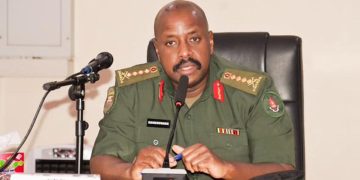
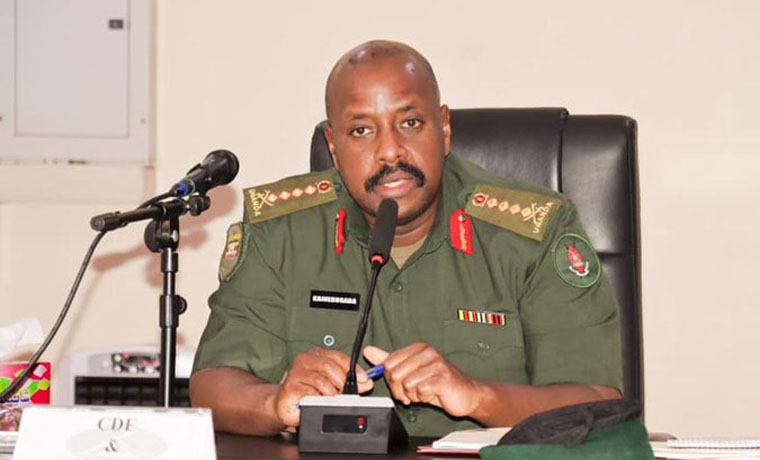
For years now, Gen Muhoozi Kainerugaba’s tweets have often been treated with a generous dose of caution, with the CDF repeatedly sending many people into political speculation with declarations, threats and predictions that sometimes appeared to be part of his trademark social-media style. But his latest 2031 declaration may be one post the country can’t afford to dismiss as another episode from the Tweeting General.
On Tuesday night and Wednesday, Gen Muhoozi, who is also the chairman of the Patriotic League of Uganda (PLU), made perhaps his clearest declaration yet that he intends to succeed his father, President Yoweri Museveni, in 2031.
In a series of posts on X, Muhoozi said: “I will stand for the highest office in the land in 2031. And we will win by the grace of Almighty God.”
The army commander went further, announcing that the man who has ruled Uganda since 1986 will personally manage his campaign.
“Mzee will be my campaign manager,” Muhoozi posted, before adding adding that “with my great father, Mzee’s, support I will get 90% in the elections in 2031.”
These remarks have since been reported internationally as an explicit presidential declaration, with Reuters describing Muhoozi as a long-touted potential successor to his 82-year-old father.
What makes the declaration particularly significant is not simply that Gen MK has mentioned 2031. He has done that before. What is different this time is the political infrastructure that has been developing around him while he has continued to occupy one of the most powerful positions in the Ugandan state.
His PLU, which presents itself as a pressure group rather than a political party, has over the past year developed structures extending beyond Kampala and accumulated an impressive network of political, business, religious and government figures. The group has also built a substantial Legislative presence.
In June, the Daily Monitor reported that more than 15 ministers and more than 200 MPs had pledged allegiance to PLU, demonstrating the extent to which the organization has penetrated the NRM, a development which has produced two competing interpretations.
To some, PLU is increasingly looking like an NRM branch operating within the ruling establishment, particularly because many of its prominent members simultaneously hold positions in the Museveni government or Parliament. Others see a political organization being quietly assembled around the man who could eventually inherit the NRM and, with it, the presidency.
The latest developments give the second interpretation fresh ammunition. PLU has even adopted a system of numbered Patriotic Officers, a feature that has attracted considerable attention because of its resemblance to the numerical structures associated with his father’s historical NRA.
Muhoozi was designated PO 001, while influential figures around him were assigned successive numbers. Andrew Mwenda became PO 002, Michael Nuwagira PO 003, Edwin Karugire PO 004, Daudi Kabanda PO 005, Balaam Barugahara PO 006, Michael Mawanda PO 007, Lillian Aber PO 008, the late Cedric Babu PO 009, Frank Gashumba PO 010, Henry Basaliza PO 011 and Fadil Twalla PO 012.
The list has since grown considerably, and its composition makes the project even more politically interesting.
Among those drawn into the PLU structure are senior figures from Museveni’s government. Agriculture Minister Frank Tumwebaze was assigned PO 013, Governm Chief Whip Jane Ruth Aceng received PO 015. Haruna Kasolo was given PO 014, while several MPs and political figures received numbers 016 to 020.
The recruitment did not stop there.
State Minister for Sports Peter Ogwang was assigned PO 041, Pastor Aloysius Bugingo PO 043 and Rakai Woman MP Juliet Kinyamatama PO 044.
In June, the PLU numbering system moved further into the heart of the government and Parliament. Speaker of Parliament Jacob Oboth-Oboth was assigned PO 059, Deputy Speaker Thomas Tayebwa PO 060, while Defence Minister Kiryowa Kiwanuka was given PO 061. State Minister for Health Anifa Bangirana Kawooya received PO 062, State Minister for Health Charles Ayume PO 063, State Minister for Energy Phiona Nyamutooro PO 064, State Minister for Northern Uganda Beatrice Akello Akori PO 065, State Minister for Public Service Lydia Wanyoto PO 066 and Hon Denis Obua PO 069.
Then came another politically loaded batch.
In July, UPDF Chief Political Commissar Maj Gen Henry Masiko was given PO 085, Vision Group boss Don Wanyama PO 086, while former minister Mike Mukula received PO 087.
And as Muhoozi’s political network continued expanding, Foreign Affairs Minister Adonai Ayebare was assigned PO 102, Internal Affairs State Minister Juma Witonze PO 108, while former Finance Minister Matia Kasaija was assigned PO 119. President Museveni’s younger brother Shedrack Nzaire was given PO 100, while presidential assistant for press and mobilization Faruk Kirunda became PO 132.
Taken individually, each appointment could be explained away as recognition of a person’s contribution to PLU. Collectively, however, the picture is harder to ignore.
This is a network that now touches Parliament, Cabinet, the military, business, religious circles and grassroots politics.
Indeed, Muhoozi has not merely been assigning numbers to prominent people in Kampala. The PLU structure has been presented as a growing countrywide organization, with political mobilization extending to different parts of the country and even chapters abroad. Its leadership has repeatedly spoken about strengthening grassroots structures and mobilization.
It is against this background that Muhoozi’s latest declaration deserves to be treated differently from some of his previous X pronouncements.
His social-media history is filled with controversial statements, some of which have triggered political storms at home and abroad. Reuters notes that he is well known for his fiery social-media presence.
That history has made it easy for many to regard almost every new Muhoozi post as another provocation or political teaser. But this time the message is unusually specific.
He has named the election (2031). He has named the office (the highest office in the land), and he has named his principal political backer (the president). That combination gives the statement a political weight that can’t easily be dismissed.
Hon Michael Mawanda, one of the prominent figures associated with PLU and a senior politician, immediately interpreted the declaration as a call to mobilization, telling Muhoozi that his announcement had electrified PLU and assuring him that the structures are ready, the cadres are fired up, and the masses are waiting.
That response is perhaps as revealing as Muhoozi’s original declaration, suggesting that within the PLU ecosystem, the 2031 question is not being treated merely as an abstract discussion about succession. There are already people presenting themselves as part of a machinery that believes it can take Muhoozi to Entebbe.
The irony is that PLU remains a pressure group rather than a formally registered political party, yet it has managed to establish a presence that many conventional political parties would envy. Its influence in Parliament has become so visible that Muhoozi has previously directed PLU-aligned MPs to support NRM-endorsed candidates for parliamentary leadership.
In June, Muhoozi also appointed Speaker Oboth-Oboth and Deputy Speaker Tayebwa to the PLU Central Committee as special envoys to Parliament, a move which was perceived by many as part of an organization whose influence had spread into the different arms of government.
This is where the succession debate becomes more complicated. If Muhoozi’s 2031 declaration is taken seriously, then the question is no longer simply whether Museveni’s son wants to become president. The bigger question becomes whether the political structures that have been developing around him are already preparing for that eventuality. (For comments on this story, get back to us on 0705579994 [WhatsApp line], 0779411734 & 041 4674611 or email us at mulengeranews@gmail.com).