

![NO ONE HAS THE POWER TO FIRE HIM! Ex-Omuhikirwa [Who Fought M7 in 2016] Dares Tooro Clan Leaders Over Rwomiire Sacking, Says Only King Oyo Could Fire Him](https://mulengeranews.com/wp-content/uploads/2026/09/Steven-Kaliba-Ateenyi-75x75.jpg)






By Ben Musanje
The Government of Uganda has announced the immediate temporary closure of its border with the Democratic Republic of Congo (DRC), in a decisive move aimed at containing the spread of the Ebola Virus Disease (EVD) caused by the Bundibugyo strain, as cross-border transmission risks intensify.
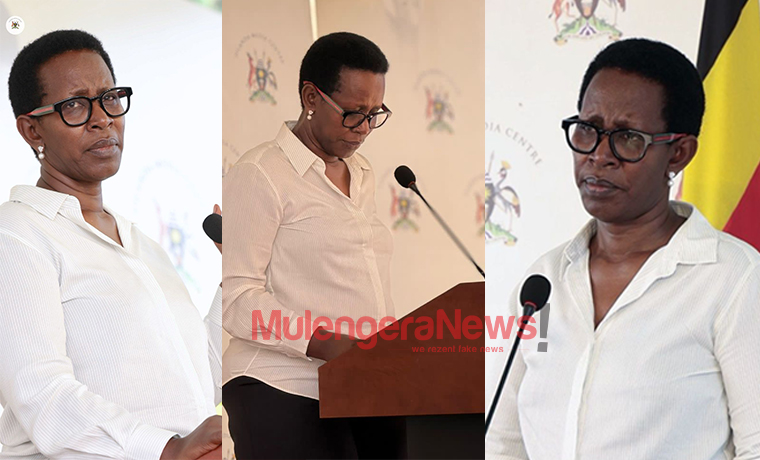
The announcement was made on Wednesday evening by Dr Diana Atwine, Permanent Secretary at the Ministry of Health, during an urgent press briefing at the Uganda Media Centre in Kampala. The briefing followed a meeting of the National Task Force on Ebola Response chaired by the Vice President.
According to the Ministry of Health, Uganda has not registered any new confirmed Ebola case since Monday, May 25, 2026. However, officials warned that the number of contacts linked to confirmed cases has continued to rise, with a significant proportion of those under monitoring being health workers who had direct or indirect exposure.

The country currently has a total of seven confirmed Ebola cases, including one death. Health authorities say surveillance and contact tracing efforts remain active and ongoing in affected districts.

Dr Atwine said the decision to restrict border movement was prompted by the continued escalation of Ebola cases in eastern DRC, combined with frequent cross-border movements that increase the likelihood of importation into Uganda. She noted that while Uganda has maintained a relatively stable situation in recent days, the regional threat remains high.
Under the new measures, the Uganda–DRC border is temporarily closed to general movement, with limited exceptions. Only authorized Ebola response teams, humanitarian workers, essential security personnel, as well as food and cargo transport operators will be allowed to cross. All permitted entrants will undergo strict health screening, complete locator forms, and be subjected to continuous monitoring at designated points of entry.
The Immigration Authority has been directed to enforce these restrictions without exception, ensuring that only approved categories of travelers are processed under enhanced surveillance protocols established by the Ministry of Health.

In addition, all individuals returning from the DRC into Uganda will be required to undergo mandatory self-isolation for 21 days. The isolation will be supervised by health authorities and district surveillance teams to ensure compliance and early detection of any symptoms.
Despite the border closure, schools in border districts will remain open. However, education institutions have been instructed to strictly adhere to Ministry of Health standard operating procedures for Ebola prevention. School administrators must identify learners who have recently returned from the DRC and ensure that their body temperatures are monitored and recorded daily for 21 days. Any student presenting symptoms such as fever will be referred to designated health facilities for further evaluation and monitoring.
Districts along the border have been directed to identify at least one health facility capable of isolating and managing suspected cases among learners and community members during the observation period.
Resident District Commissioners (RDCs) and Resident City Commissioners (RCCs) have also been tasked with enforcing all Ebola prevention guidelines issued by the Ministry of Health and the National Task Force. Authorities emphasized that strict compliance at local government level will be critical in preventing further spread.
To strengthen public awareness, all media houses have been instructed to allocate at least 30 minutes of prime-time programming daily to Ebola education, focusing on prevention, early detection, and reporting procedures.
The government urged the public to remain calm but vigilant, and to promptly report suspected cases through the nearest health facility or via the Ministry of Health toll-free hotline 0800-100-066.
Uganda also reaffirmed its commitment to continued cooperation with the Government of the DRC. The two countries recently held bilateral engagements and agreed to strengthen cross-border collaboration, enhance joint surveillance systems, and coordinate response efforts to curb the spread of Ebola along their shared frontier.
Officials said these coordinated measures are intended to balance emergency containment with essential humanitarian and economic activity while safeguarding public health in both countries. The government emphasized that adherence to guidelines remains the strongest defense against further transmission. (For comments on this story, get back to us on 0705579994 [WhatsApp line], 0779411734 & 041 4674611 or email us at mulengeranews@gmail.com).