








By Ben Musanje
Uganda has taken a major step in transforming livestock farming across Africa with the launch of the continent’s first locally developed anti-tick vaccine, a scientific breakthrough expected to reduce dependence on chemical tick control and significantly improve cattle productivity.
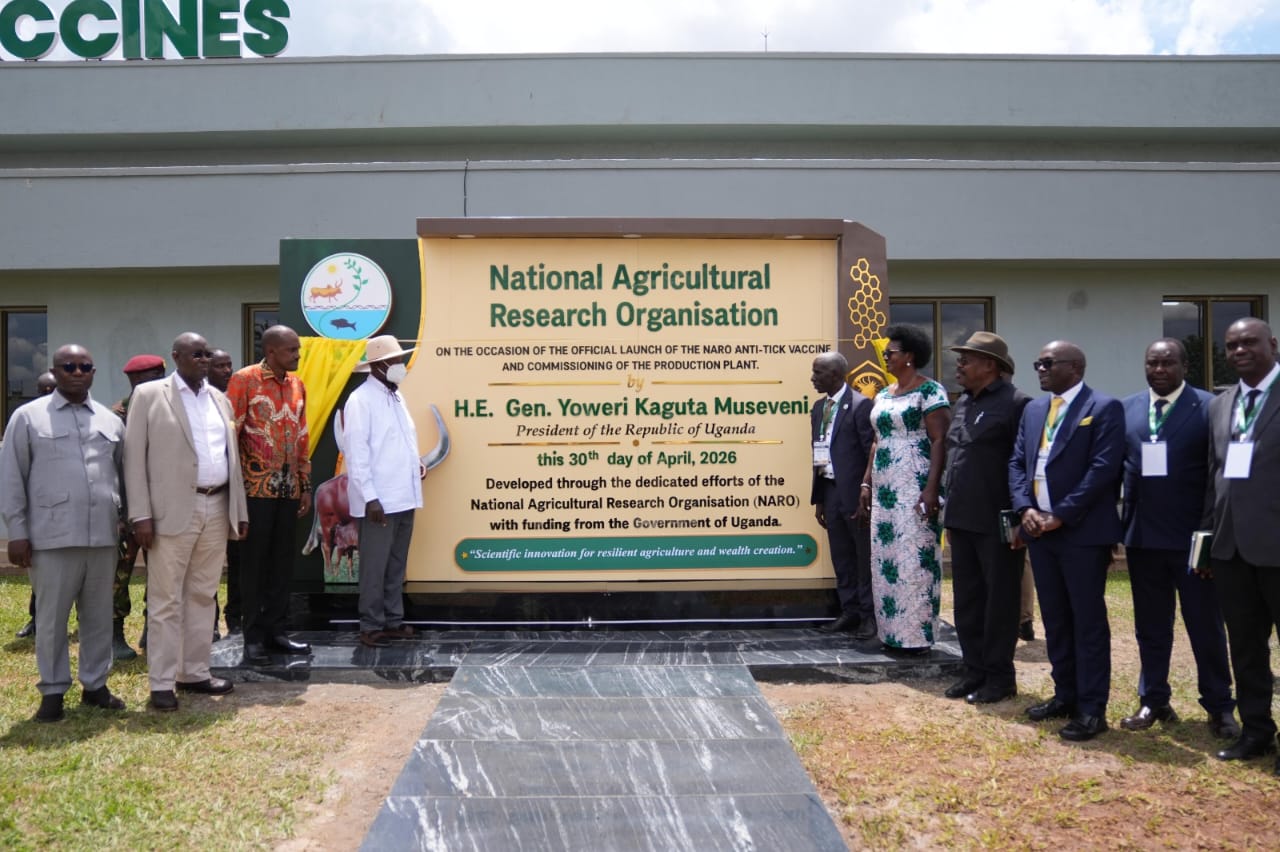
President Yoweri Kaguta Museveni on April 30, 2026 officially unveiled the vaccine, branded NAROVAC®-ATV1, and commissioned a modern production facility at the National Agricultural Research Organisation (NARO)-National Livestock Resources Research Institute (NaLIRRI) in Nakyesasa village, Wakiso District.
The launch marks a turning point for Uganda’s livestock sector, where ticks and tick-borne diseases have for decades caused heavy losses through reduced milk production, poor weight gain and livestock deaths.

In his remarks during the launch, President Museveni described the innovation as proof of Uganda’s growing scientific capacity, summarizing the breakthrough in a memorable statement: “The cow now kills the tick.”

Scientists behind the vaccine explained that it was developed using recombinant technology based on antigens derived from local tick species, specifically the Subolesin protein.
Dr. Swidiq Mugerwa, NARO Deputy Director General for Research and one of the lead scientists on the project, explained that once the vaccine is injected into cattle, the animal’s immune system produces antibodies that attack ticks during feeding.
“When a tick feeds on the cow’s blood, it ingests the antibodies, which then act to kill the tick,” Dr. Mugerwa said.

The vaccine is administered in three initial doses given on day 0, day 30 and day 180, providing protection for up to one year, with booster doses recommended every six months to maintain immunity.
The development is expected to reduce reliance on acaricides, chemical tick-control products that have increasingly become ineffective due to growing tick resistance, while also raising concerns over environmental safety and food quality.
President Museveni linked the vaccine to Uganda’s broader economic transformation agenda, describing it as part of the country’s transition into a science-led economy driven by innovation and technology.
He said Uganda’s economic journey has evolved from post-conflict recovery and diversification to value addition and now scientific innovation, adding that the anti-tick vaccine joins other locally developed technologies in positioning Uganda as a producer of homegrown solutions.
“This is why Uganda is unstoppable,” the President said while reaffirming government support for science and innovation.
He also proposed enhanced incentives for scientists, including tax waivers on salaries, to sustain research and development efforts.
NARO Director General Dr. Yona Baguma revealed that the vaccine, described as the first of its kind in Africa and the second in the world, is the result of more than a decade of research that started in 2013.
Scientists developed four candidate vaccines using ticks collected from ten agro-ecological zones across Uganda before conducting laboratory studies, station trials and field trials in areas including Mbarara, Maruzi, Nabuin and Uganda Prisons farms.
According to Dr. Baguma, the vaccine demonstrated 93.2 percent effectiveness against major tick species including the Brown ear tick, Blue tick and Bont-legged tick, which are among the most economically destructive parasites affecting livestock in Uganda.
Government invested approximately UGX 170 billion in research, infrastructure development, trials and recruitment of skilled personnel to support the project.
The newly commissioned production facility has capacity to manufacture 36 million doses annually, equivalent to about three million doses every month.
Before official approval, the vaccine underwent extensive field testing involving 60 farmers across 30 districts and more than 12,600 cattle, 3,388 goats and 367 sheep.
Researchers reported major reductions in tick populations and tick-borne diseases during the trials, outcomes expected to translate into lower production costs, improved animal health and increased farmer incomes.
Uganda currently has an estimated cattle population of 16 million, with ticks affecting nearly all production systems across the country.
Dr. Baguma further explained that the vaccine development and production process was supervised by several regulatory agencies including the Uganda National Council for Science and Technology (UNCST) and the National Drug Authority (NDA).
UNCST cleared the vaccine as safe and effective, while NDA inspected the facility and issued the necessary manufacturing licenses and pre-market authorization.
NDA Executive Director Dr. David Nahamya described the facility as ultra-modern and capable of supporting regional and international vaccine production.
“We have inspected several production facilities on the continent but this is ultra-modern. It is value for money,” Dr. Nahamya said.
He added that the project reflects President Museveni’s vision of using science, innovation and collaboration to address Uganda’s agricultural and socioeconomic challenges.
NARO is now planning to establish a larger Vaccines and Pharmaceutical City estimated to cost UGX 600 billion over three years.
The proposed facility would expand production to include vaccines for Foot and Mouth Disease, East Coast Fever, Newcastle Disease, Gumboro Disease, Lumpy Skin Disease and African Swine Fever.
According to Dr. Baguma, Uganda also intends to export the vaccine across Africa, an important development considering the continent currently imports about 99 percent of its livestock vaccines.
To support regional access, NARO is pursuing registration through the East African Community Mutual Recognition Procedure and engaging the African Union’s Pan African Veterinary Vaccine Centre for broader continental approval.
“With a scalable production system already in place, Uganda is well positioned to become a regional hub for veterinary vaccines,” Dr. Baguma said.
Agriculture Minister Frank Tumwebaze described the vaccine as evidence that Uganda’s agricultural research institutions are delivering practical and market-ready solutions.
He said government had disbursed approximately UGX 170 billion since 2022 to support vaccine research, certification, infrastructure and trials.
Tumwebaze also praised NARO scientists for their professionalism and patriotism, saying they had resisted efforts to compromise the project.
He stressed the importance of continued investment in agricultural research to strengthen food systems and transform Uganda’s agri-food sector.
In addition to the anti-tick vaccine, he highlighted other NARO innovations including improved crop varieties, irrigation technologies, forage choppers, maize shellers, bio-stimulants and Aflasafe solutions for controlling aflatoxin contamination.
“I therefore have no doubt that any further investment in NARO is and will be worthwhile,” Tumwebaze said.
State Minister for Animal Industry Bright Rwamirama said Uganda’s livestock sector has recorded major improvements in genetics, nutrition and animal health due to sustained government interventions.
He cited growth in annual milk production from 700 million litres in 1990 to 5.3 billion litres today.
Rwamirama noted that although farmers urgently need the vaccine due to rising resistance to acaricides, successful nationwide rollout will require substantial investment and collaboration.
NARO has proposed a partnership-driven distribution system combining government structures and private sector networks to ensure nationwide access.
Beyond its direct benefits to farmers, the launch of the anti-tick vaccine signals a broader message that African countries can develop and scale their own scientific solutions to local challenges.
With the unveiling of NAROVAC®-ATV1, Uganda has positioned itself at the forefront of Africa’s emerging science-led agricultural transformation.