






By Mulengera Reporters
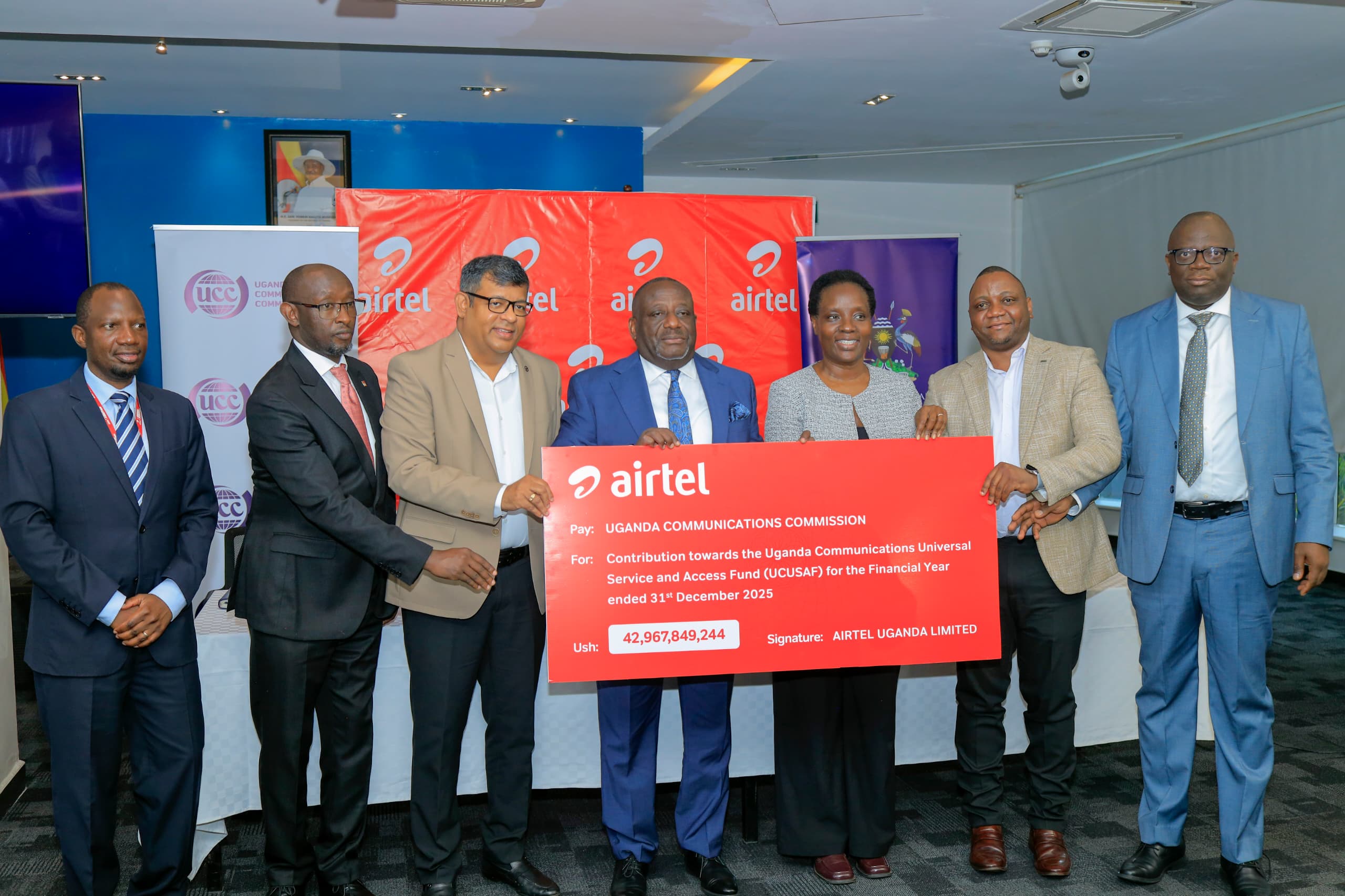
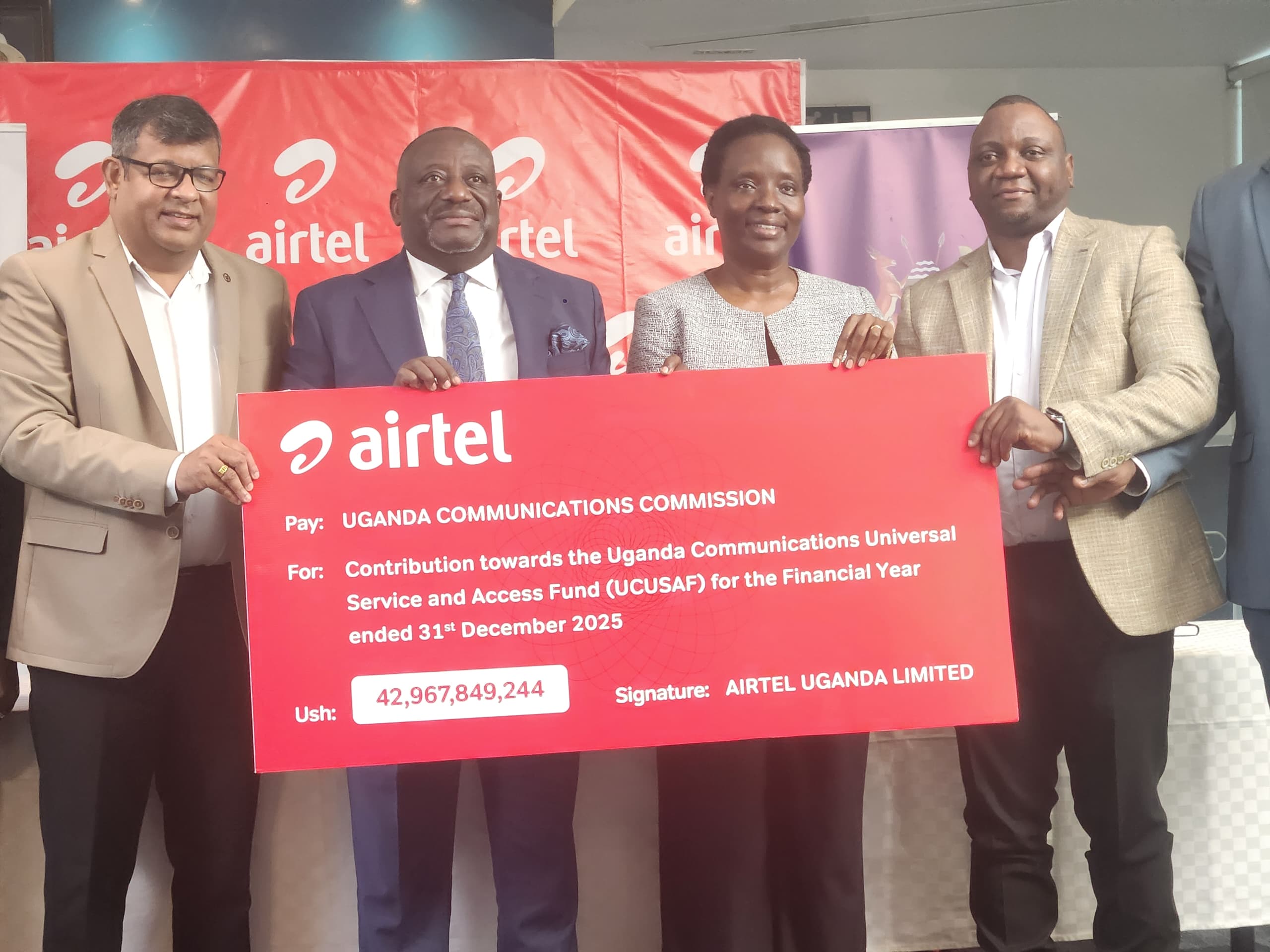
The Uganda Communications Commission (UCC) has received UGX 42.9 billion from Airtel Uganda as part of the telecom company’s mandatory contribution toward expanding digital connectivity and communication services in underserved communities across the country.
The contribution, channeled through the Uganda Communications Universal Service and Access Fund (UCUSAF), represents 2 percent of Airtel Uganda’s gross annual revenue for the financial year ending December 31, 2025, in line with the Communications Act and the company’s national telecommunications license obligations.
The payment marks an increase from the UGX 37.9 billion Airtel Uganda contributed last year, reflecting the telecom operator’s continued growth and expansion in Uganda’s communications sector.

Speaking during the official handover ceremony at the UCC headquarters in Kampala, UCC Executive Director Nyombi Thembo described the contribution as a significant boost to Uganda’s digital inclusion agenda and a demonstration of the telecom sector’s commitment to national development.

“The 42.9 billion from Airtel is more than just a cheque. It is a strong signal that Uganda’s telecom sector is flourishing and ready to give back to the communities that have made this growth possible,” Nyombi said.
He explained that while telecom operators are required by law to contribute 2 percent of their gross annual revenues to the Commission, the funds play a critical role in financing programmes aimed at bridging the digital divide across Uganda.
“Whereas businesses must think about profit and shareholder value, government must think about inclusion, ensuring that no citizen is left behind in this digital age,” he said.

According to UCC, half of the funds collected from operators are remitted to the Consolidated Fund, while the remaining portion is retained by the Commission to support the Universal Service and Access Fund. The money finances the expansion of ICT infrastructure to unserved and underserved areas, supports ICT programmes in schools and health centers, promotes digital literacy and innovation, and improves access to communication services for marginalized communities and persons with disabilities.
Nyombi said the increasing value of annual contributions from telecom operators reflects the growth of Uganda’s digital economy and the effectiveness of government policies aimed at strengthening the communications sector.
“The fact that the contribution itself has grown from last year’s UGX 37.9 billion is a testament to the enabling environment fostered by government through sound policy, legislation and regulation,” he said.
He added that the Commission remains committed to partnering with telecom companies to deliver a fully connected Uganda by 2030 in line with the National Development Plan IV and Uganda Vision 2040.
During the event, Airtel Uganda Chief Executive Officer and Managing Director Soumendra Sahu reaffirmed the company’s commitment to supporting Uganda’s digital transformation through continued investment in network infrastructure and connectivity solutions.
Sahu said Airtel Uganda had significantly expanded its network coverage over the past year as part of efforts to improve service delivery and drive digital inclusion.
“Last year, Airtel Uganda made two important commitments in the digital inclusion agenda. One was to accelerate our investment in the network across the country and deliver a brilliant experience for all those we connect with,” he said.
According to Sahu, Airtel Uganda rolled out 258 new 4G sites by December 2025 before increasing the figure to 448 sites by the end of the first quarter of 2026 after adding another 190 sites in three months.
“This is the biggest site rollout in the last seven to eight years. We have never done 448 sites in 12 months,” he noted.
The telecom company also expanded its 5G network to 365 sites including Kampala, Wakiso, Jinja, Mbale, Mityana, Masaka Lira, Fort Portal, Gulu and Mbarara among others across the country and expects the number to rise to nearly 590 sites by the end of May following the addition of 225 more sites.
Sahu said the company’s investment strategy was aimed at unlocking opportunities for individuals and businesses while supporting Uganda’s ambition of growing its economy tenfold by 2040.
The ceremony also highlighted Uganda’s push toward emerging communication technologies, with Nyombi revealing that UCC had approved a pilot project by Airtel Uganda to operationalize Direct-to-Cell satellite services in Uganda.
The pilot project is currently being undertaken in Murchison Falls National Park and other underserved areas, with UCC expressing optimism that Uganda could become one of the first countries in Africa to commercially launch satellite-to-smartphone connectivity services.
“With satellite services, connectivity is going to be everywhere, all the time in Uganda,” Nyombi said.
The development follows the recent licensing of Starlink Internet Services Limited to begin operating satellite internet services in Uganda, a move expected to strengthen connectivity in remote areas where conventional terrestrial networks remain limited.
Sahu said Airtel Uganda had already entered the testing phase of the Direct-to-Cell system through its partnership with Starlink, describing the technology as a potential game changer for communication services in Uganda. (For comments on this story, get back to us on 0705579994 [WhatsApp line], 0779411734 & 041 4674611 or email us at mulengeranews@gmail.com).