








By Ben Musanje
Uganda’s labour market is largely driven by the services sector and informal employment arrangements, with the Uganda Bureau of Statistics (UBOS) Labour Market Survey Report 2025 revealing that the country has millions of people engaged in work across both informal and formal settings, though most remain in insecure jobs.
The findings, presented by Elizabeth Nyirantwari, Senior Statistician at UBOS, show that the total number of employees in informal establishments stands at 7,350,199 people, making this the largest segment of the workforce captured in the survey. Of these, 3,951,752 are males, while 3,398,447 are females, indicating a relatively balanced but male-dominated informal labour market.
In addition, formal establishments employ a total of 2,373,109 workers across the country. This brings the combined total number of employees in both formal and informal establishments to approximately 9,723,308 workers, highlighting the scale of Uganda’s labour force engagement in wage and self-employment activities.

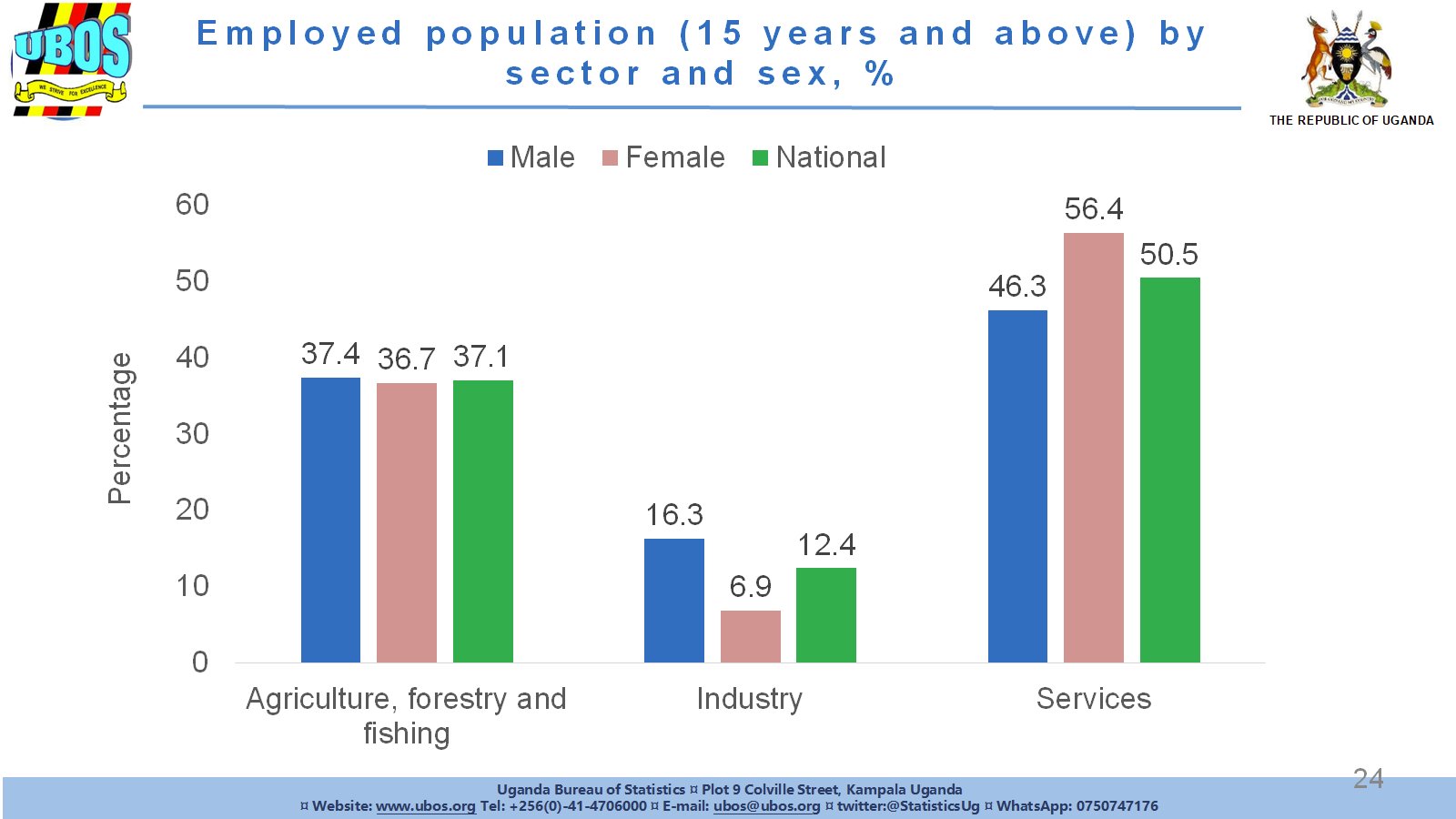
Despite the presence of formal institutions, the survey shows that the services sector dominates employment across the economy. In informal establishments alone, 6,121,260 employees are engaged in services, making it the leading employer compared to industry and agriculture. Industry and agriculture account for significantly smaller shares, reflecting the limited structural transformation of the economy.

Within formal establishments, services also remain the largest employer with 1,985,054 employees, followed by agriculture with 806,269 employees, while industry accounts for only 301,787 employees. This reinforces the pattern of a service-led economy with weak industrial absorption capacity.
The report further reveals that many workers in formal establishments are not formally employed. Out of the 2,373,109 employees in formal establishments, a majority are engaged under informal arrangements despite working in registered institutions. This means that a significant portion of Uganda’s workforce lacks contracts, social security coverage, and employment benefits even within formal workplaces.
Nyirantwari noted that informal employees within formal establishments are heavily concentrated in the services sector, accounting for 1,191,379 workers, further emphasizing the widespread nature of precarious employment conditions.

The labour market survey also recorded 305,364 job vacancies across the economy during the period of data collection. Of these, 223,106 vacancies were in the services sector, while 80,100 were in industry, showing that most new job opportunities continue to emerge in services rather than manufacturing or agriculture.
Expansion of businesses was identified as the leading driver of new vacancies, accounting for 107,078 jobs, while resignations also contributed significantly to labour turnover across sectors.
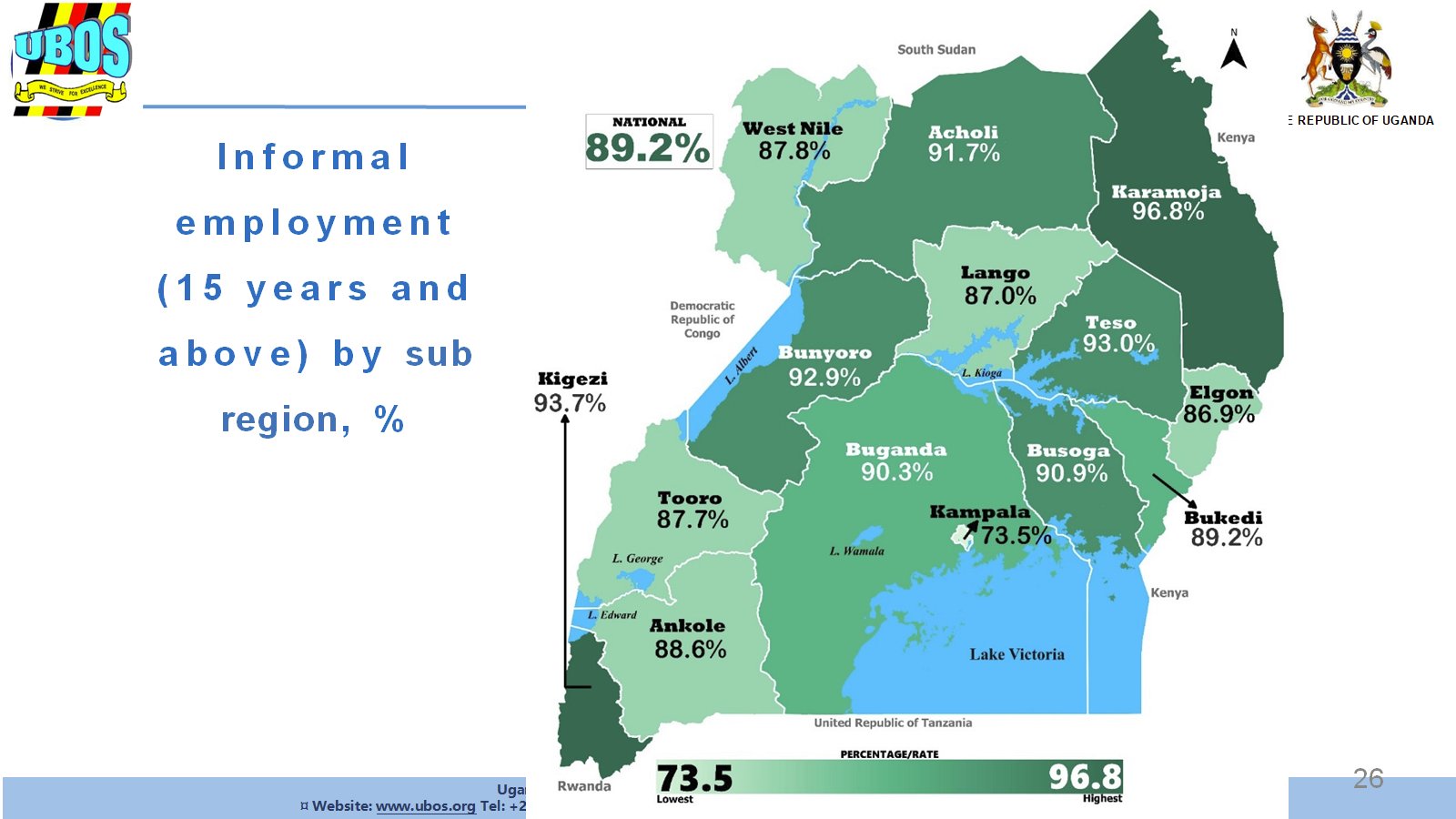
Regionally, employment remains unevenly distributed, with Kampala hosting a smaller share of informal employment at around 73–74%, compared to higher levels in Karamoja and other rural sub-regions, reflecting differences in economic structure and access to formal jobs.
The survey also highlighted concentration of formal employment in a few industrial zones, with the Kampala Industrial and Business Park in Namanve employing 15,099 workers, followed by Mbale Industrial and Business Park with 3,813 workers, while Buikwe Industrial Park employs only 155 workers.
Overall, the findings paint a picture of a labour market that is large and active, but still heavily informal and service-oriented. With more than 9.7 million workers engaged in employment nationwide, Uganda continues to face the challenge of improving job quality, expanding industrial employment, and transitioning workers from informal to formal employment arrangements. (For comments on this story, get back to us on 0705579994 [WhatsApp line], 0779411734 & 041 4674611 or email us at mulengeranews@gmail.com).