






By Ben Musanje
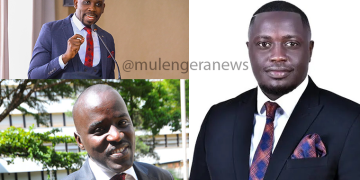
Kampala has been shaken by a political and legal firestorm after Ivan Bwowe, the candidate for the Peoples Front for Freedom (PFF), escalated his bitter dispute with the Electoral Commission (EC) to the High Court.
Bwowe has unleashed renowned Kampala lawyer Frank Kanduho in a high-stakes legal battle that could potentially disqualify National Unity Platform (NUP) stalwart Joel Ssenyonyi from the Nakawa Division West parliamentary race.
What began as a technical disagreement over constituency names has snowballed into one of the most dramatic pre-election legal confrontations in Uganda’s recent political history, pitting Bwowe’s determined legal team against a powerful electoral body and a crowded field of political heavyweights.

At the heart of the dispute is a single explosive claim: that Joel Ssenyonyi and six other candidates were never legally nominated. Bwowe’s appeal, filed under Pre-Election Appeal No. HCT-00-CV-EP-0008-2025, accuses the EC of creating a phantom constituency “Nakawa West” that he argues does not exist in law.

According to Bwowe, the candidates, including Ssenyonyi, were nominated using forms for a constituency that was never legally recognized or gazetted under Uganda’s electoral laws.
In court filings, Bwowe challenges the EC’s actions, insisting that “Nakawa West” is a politically convenient invention, not an officially demarcated constituency. Armed with legal documents, gazette notices, sworn affidavits, and a fierce legal strategy orchestrated by Kanduho & Co. Advocates, Bwowe argues that the EC’s attempt to treat “Nakawa West” as equivalent to the constitutionally recognized Nakawa Division West violates the law.
Bwowe’s appeal alleges that the EC improperly amended nomination papers after the fact, retroactively correcting what he terms an “ab initio” illegality.

According to his legal team, the proposers, seconders, and supporters on the disputed nomination forms all listed themselves as voters from “Nakawa West,” a place Bwowe insists is entirely imaginary. Should the court agree, seven candidates could be disqualified, leaving Bwowe as the only validly nominated candidate, effectively handing him the seat unopposed.
Ssenyonyi, a high-profile opposition legislator and media-savvy politician, now finds himself named as the sixth respondent in a case that could end his Nakawa Division West bid before voters ever head to the polls.
However, on December 1, 2025, the Electoral Commission dismissed Bwowe’s petition, which had called for his rivals’ nominations to be invalidated on the grounds of the alleged “Nakawa West” error.
Bwowe’s petition argued that the EC should declare “Nakawa West” a nonexistent constituency and nullify the nominations of all candidates who had used forms bearing the incorrect name. He requested the EC to declare him the only validly nominated candidate, effectively making him unopposed for the seat.
In response, the EC convened a hearing with all stakeholders, including the candidates, to consider the complaint. The Commission ruled that while some nomination forms listed “Nakawa West,” the legally binding Control Form—signed by all candidates, including Bwowe, correctly indicated “Nakawa Division West.” The EC concluded that the discrepancy was purely clerical and did not invalidate the nominations of any candidate. The Commission found Bwowe’s petition to be without merit and dismissed it.
Senior Legal Officer Hamidu Lugoloobi, representing the Electoral Commission, hit back strongly against Bwowe’s claims. He argued that the appeal was frivolous and amounted to an abuse of court process.
According to Lugoloobi, all candidates, including Bwowe, had been fully aware of the constituency they were contesting, and the errors on the nomination forms were nothing more than clerical mistakes that had been corrected before the campaign period began.
He maintained that these minor discrepancies did not invalidate the nomination process, and there was no legal basis for Bwowe’s petition to succeed.
With the ruling, all eight candidates, including Bwowe, remain duly nominated to contest for the Nakawa Division West parliamentary seat in the 2026 general elections.
Despite this setback, Bwowe and his legal team have vowed to continue their fight, now taking the case to the High Court. The legal battle, still ongoing, has drawn attention for its potential to shake up Uganda’s electoral processes and challenge the Commission’s handling of nomination procedures.
Behind the scenes, political insiders suggest that Bwowe’s decision to engage Frank Kanduho signals a serious escalation. Known for his aggressive courtroom style and deep expertise in constitutional litigation, Kanduho has positioned the case as a fundamental test of the rule of law.
In his legal filings, Kanduho accuses the EC of “intuitively amending the Constitution” and manufacturing a non-existent constituency to protect high-profile candidates from electoral embarrassment.
The High Court hearing, set for December 18, 2025, is being closely watched as a potential political earthquake. If Bwowe succeeds, it would not only derail Ssenyonyi’s campaign but could also expose significant flaws in Uganda’s electoral processes, sparking wider debates on nomination practices nationwide.
The Nakawa Division West race has quickly become ground zero in a battle that blends law, politics, and personal ambition in equal measure. As the legal drama unfolds, Kampala holds its breath, waiting to see whether the court will side with Bwowe’s legal purity or the EC’s pragmatic interpretation of the nomination process. (For comments on this story, get back to us on 0705579994 [WhatsApp line], 0779411734 & 041 4674611 or email us at mulengeranews@gmail.com).