







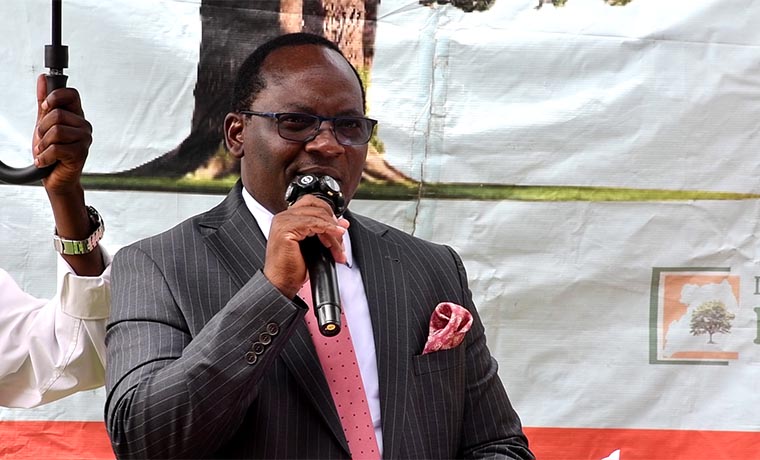
Democratic Front (DF) President Mathias Mpuuga, who has for years had a strained relationship with his former political allies in the Kavule-based National Unity Platform (NUP), has taken an indirect swipe at politicians and parties questioning Gen Salim Saleh’s proposed Consociational Dialogue, accusing them of applying double standards by setting conditions for national talks while pursuing other political arrangements that offer access to government funding and privileges.
Although he did not mention the National Unity Platform (NUP) by name, Mpuuga’s remarks come against the backdrop of renewed opposition demands for conditions to be met before participating in the proposed dialogue promoted by Gen Saleh and his personal secretary Prof Ogenga Otunnu.
NUP recently joined the People’s Front for Freedom (PFF) and Gen Mugisha Muntu’s Alliance for National Transformation (ANT) in outlining conditions for meaningful engagement, including the unconditional release of political prisoners, the return of exiled political leaders, including NUP leader Robert Kyagulanyi Ssentamu, restoration of constitutional order, accountability for missing people and an end to military involvement in partisan politics.
The demands have become part of the wider disagreement over how opposition parties should engage with the proposed Consociational framework and whether the government should first address longstanding political grievances before discussions can proceed.
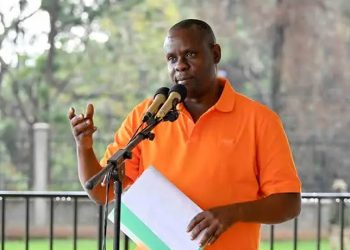
Speaking on Monday at the Democratic Front headquarters, Kampala, Mpuuga questioned what he called the selective participation by political parties, arguing that some of them appeared willing to engage in arrangements involving political benefits but reluctant to participate in broader discussions about the country’s future.
He specifically questioned parties seeking admission into the Inter-Party Organization for Dialogue (IPOD), arguing that their pursuit of the organization’s financial facilitation, allowances and other benefits sat uneasily with their positions on wider national discussions.
“The same party is negotiating for admission in IPOD to access IPOD money, facilitation, allowance and benefits. For us, that is double standard,” Mpuuga said.
His criticism appeared to touch on a broader question facing opposition politics, of whether political parties can insist on conditions for one dialogue process while remaining open to other political engagements that serve the interests of their parties.
“You cannot sit in one room, discuss IPOD money, and say you are not part of another meeting discussing the future of Uganda and where every citizen has interest,” he said.
Mpuuga, a former vice president for NUP and Leader of Opposition in Parliament (LoP) before breaking away to establish the Democratic Front, argued that opposition political leaders needed to demonstrate consistency in the positions they take on national issues.
He maintained that legitimate concerns about political prisoners, abductions, torture, human rights violations and the conduct of security operatives should not be overlooked, but warned that such demands should not become instruments for indefinitely blocking dialogue.
“Conditional therefore must not be an excuse for delay or disruption,” he said.
The former Nyendo-Mukungwe MP argued that conditions should instead be tabled and addressed within a properly constituted national dialogue framework, allowing political leaders to agree on the issues requiring immediate attention and the reforms necessary to resolve them.
His words offer a different perspective on the debate surrounding Gen Saleh’s proposed Consociational Democracy Agreement, which seeks to bring political parties and other national stakeholders into an arrangement for addressing political exclusion, governance disagreements and questions of national cohesion.
The proposal has attracted differing reactions from opposition formations, with some demanding guarantees on the neutrality of the convener, venue, agenda and implementation of any resolutions, while others have questioned whether the proposed arrangement adequately addresses the current political and constitutional problems.
Mathias Mpuuga insisted that Uganda needs a dialogue process that goes beyond political bargaining and the distribution of positions among party leaders, where party leaders sit and agree on how they personally benefit from it, leaving out the real people meant to be considered.
He said discussions should address the Constitution, elections, security, justice, human rights, equitable distribution of national resources and the country’s political future.
He also maintained that ordinary Ugandans should not be excluded from conversations that could determine the direction of the country.
The DF leader said his party was ready to participate in a credible national dialogue, arguing that political disagreements should be resolved through consensus rather than competing political interests and closed-door arrangements. (For comments on this story, get back to us on 0705579994 [WhatsApp line], 0779411734 & 041 4674611 or email us at mulengeranews@gmail.com).