











By Ben Musanje
A heated public storm has erupted online after UNAIDS Executive Director Winnie Byanyima, wife to detained opposition politician Dr Kizza Besigye, openly confronted Centenary Bank over the freezing of activist and lawyer Agatha Atuhaire’s account, turning what began as a routine compliance issue into a highly charged national controversy involving politics, religion, banking law and accusations of state overreach.
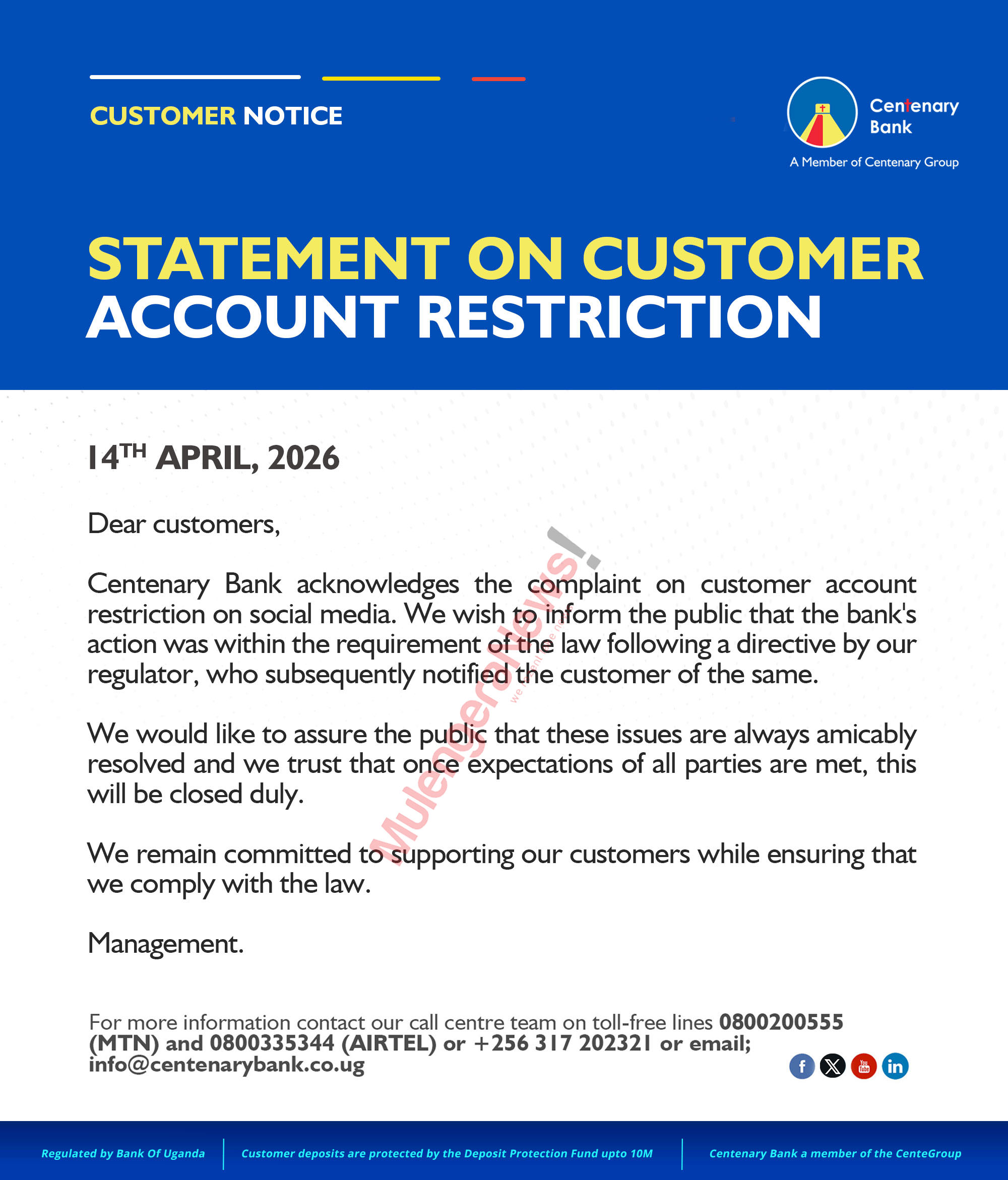
The controversy intensified on April 14, 2026, when Centenary Bank, a Catholic-founded financial institution, issued a public customer notice confirming that it had restricted a customer’s account. In its statement, the bank insisted that the action was taken strictly within the requirements of the law following instructions from a regulator. The bank added that the customer had been notified through official channels and assured the public that such matters are usually resolved through established procedures once all compliance conditions are met.
But the explanation quickly triggered outrage online.

Agatha Atuhaire, a former journalist at The Observer Newspaper who is now a lawyer and activist, pushed back strongly against the bank’s claim. She insisted she had not been directly notified and accused the institution of misleading the public about proper communication. She said it was unacceptable for a bank to act as though everything had been handled correctly while she was left stranded without access to her funds.

Atuhaire went further, describing a painful personal consequence of the account freeze. She said she had traveled and left her bank card behind for use in supporting her children, only to discover later that the account had been blocked. She claimed she was forced to urgently seek help from relatives and friends to ensure her children did not suffer, accusing the bank of failing in its basic duty to protect customer welfare.
It was at this point that Winnie Byanyima entered the dispute forcefully. Writing on social media platform X, she directly called out Centenary Bank, urging it to “do the right thing” and unfreeze Atuhaire’s account so she could feed her children and meet basic obligations. She warned the bank against blindly following what she described as unlawful instructions from security-linked authorities, stressing that moral responsibility must guide its decisions. In a striking appeal, she reminded the institution of its Catholic foundation and urged it to act “religiously,” suggesting it should stand on principles of justice rather than compliance alone. She further identified herself as a “concerned Catholic,” intensifying the moral weight of her message.
Her intervention immediately escalated the debate, drawing both support and criticism across political and professional circles.

Centenary Bank responded again, maintaining its position that it had acted lawfully and under directive from a regulator who had also communicated the restriction to the customer. The bank insisted it remained committed to customer service and compliance with legal frameworks, expressing confidence that the matter would be resolved once all regulatory expectations were met.
The situation became even more complex as prominent public figures weighed in.
Former Makerere University Vice Chancellor Prof Venansius Baryamureeba defended the bank, arguing that Centenary Bank is a regulated financial institution under the Bank of Uganda and must comply with lawful instructions issued by regulators. He warned against blaming the bank for actions it is legally bound to execute, adding that in regulated financial systems, account restrictions can occur when compliance checks or directives are issued. He emphasized that banks risk serious consequences, including license issues, if they disregard regulatory orders.
However, not everyone agreed with that position.
City lawyer Eron Kiiza raised sharp questions about procedure and transparency, asking why Centenary Bank did not directly notify its customer before or at the time of freezing the account. He questioned why the bank appeared to rely on a regulator to communicate sensitive financial restrictions instead of informing the customer itself. He argued that the situation created confusion and risked eroding trust in banking communication systems.
Veteran journalist Angelo Izama added another layer of controversy, suggesting that the regulatory reference made by the bank might not only involve the central bank but also the Financial Intelligence Authority, which handles anti-money laundering oversight. His remarks added further uncertainty about which agency actually triggered the restriction, fueling speculation and debate online.
On social media, Agatha Atuhaire continued to express anger, stating that the freeze was part of a wider pattern of pressure on activists and civil society actors. She claimed that both state and private institutions were being used to restrict dissenting voices, and she criticized Centenary Bank for failing to take responsibility for proper communication. She also thanked Winnie Byanyima for her public solidarity, saying she was deeply disappointed by the bank’s handling of the situation.
The controversy has also revived attention on Atuhaire’s previous activism, including her 2025 detention in Tanzania alongside Kenyan activist Boniface Mwangi, an incident that ended with the pair being found at the border after what they described as being dumped following their detention. That episode is now being widely referenced by supporters who argue that she is repeatedly targeted for her activism.
As the debate continues to grow, Centenary Bank finds itself under intense scrutiny from activists, lawyers, academics, and political figures. What began as a regulatory compliance issue has now transformed into a symbolic national argument about justice, transparency, financial freedom, and the limits of institutional power, with Winnie Byanyima’s intervention ensuring the saga remains firmly in the public spotlight. (For comments on this story, get back to us on 0705579994 [WhatsApp line], 0779411734 & 041 4674611 or email us at mulengeranews@gmail.com).