









By Ben Musanje
The Uganda Law Society (ULS) has instituted legal action against the government following an incident in which its representatives were blocked from accessing the presiding judge during a High Court criminal session at Ggaba, raising fresh concerns over the protection of constitutional rights and the independence of legal processes.
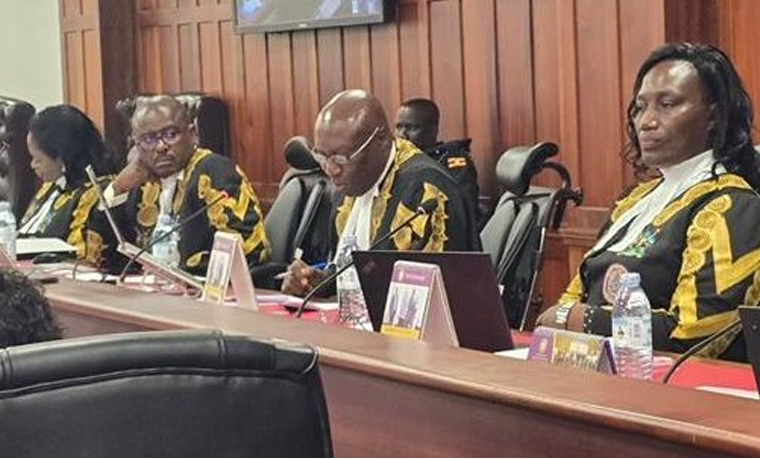
The dispute stems from Criminal Session Case No. 132 of 2026, Uganda versus Christopher Okello Onyium, currently before the High Court Criminal Division sitting at Ggaba Community Church in Makindye division. In response to developments in the trial, the Uganda Law Society on Wednesday filed a human rights enforcement application—Miscellaneous Application No. 170 of 2026—against the Attorney General, citing alleged violations of multiple constitutional provisions, including the right to a fair hearing and the principle of judicial independence.
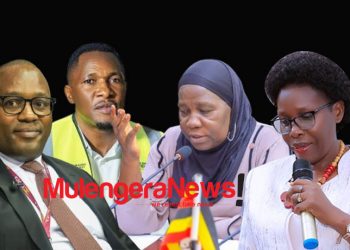
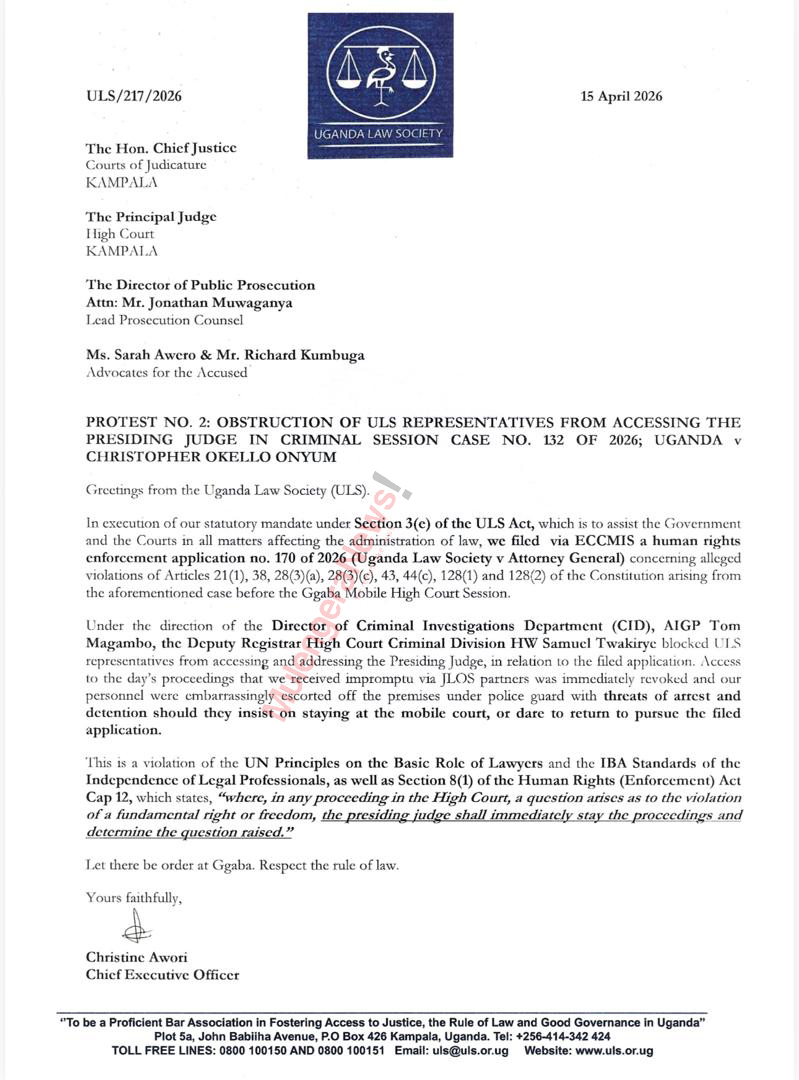
In a letter dated April 15, 2026, addressed to the Chief Justice, the Principal Judge, and the Director of Public Prosecutions, the Chief Executive Officer of the Uganda Law Society, Christine Awori, detailed how the Society’s representatives were denied access to the court and prevented from addressing the presiding judge regarding the application.

According to the Society, the obstruction was carried out by the Deputy Registrar of the High Court Criminal Division, HW Samuel Twakirye, reportedly acting under the direction of the Police Director of the Criminal Investigations Department, AIGP Tom Magambo. The ULS stated that although its representatives had initially accessed the court proceedings through coordination with Justice Law and Order Sector partners, that access was abruptly revoked.
The representatives were subsequently escorted off the premises under police guard and warned against returning, with threats of arrest and detention if they attempted to pursue the matter further at the mobile court.
Awori maintains that the actions taken against its representatives contravene both national law and international standards governing the legal profession. It specifically points to Section 8(1) of the Human Rights (Enforcement) Act, 2019, which requires that where a question arises concerning the violation of a fundamental right or freedom, the presiding judge must immediately stay proceedings and determine the issue.
A day earlier, on April 14, 2026, the Vice President of the Uganda Law Society, Anthony Asiimwe, had formally written to the presiding judge, Hon Lady Justice Alice Komuhangi Khauka, requesting an urgent hearing of the application and a stay of the criminal proceedings pending its determination.

The Human Rights (Enforcement) Act allows individuals and organisations to seek redress where constitutional rights are alleged to have been infringed and obliges courts to address such matters without undue reliance on procedural technicalities.
The Uganda Law Society argues that the refusal to grant audience to its representatives undermines these provisions and risks eroding confidence in the administration of justice. Awori has also cited international legal standards, including principles on the role of lawyers, in condemning the incident.
By filing suit against the Attorney General, the Uganda Law Society now seeks judicial intervention to address the alleged violations and to reaffirm the obligation of courts to uphold constitutional safeguards during ongoing proceedings.
The Judiciary and the Criminal Investigations Directorate had not issued official responses to the allegations by the time of publication. (For comments on this story, get back to us on 0705579994 [WhatsApp line], 0779411734 & 041 4674611 or email us at mulengeranews@gmail.com).