






By Ben Musanje
Uganda’s road network is facing a growing financing challenge, with the government acknowledging that the money required to maintain existing roads is more than double what has been allocated for the 2026/27 financial year.
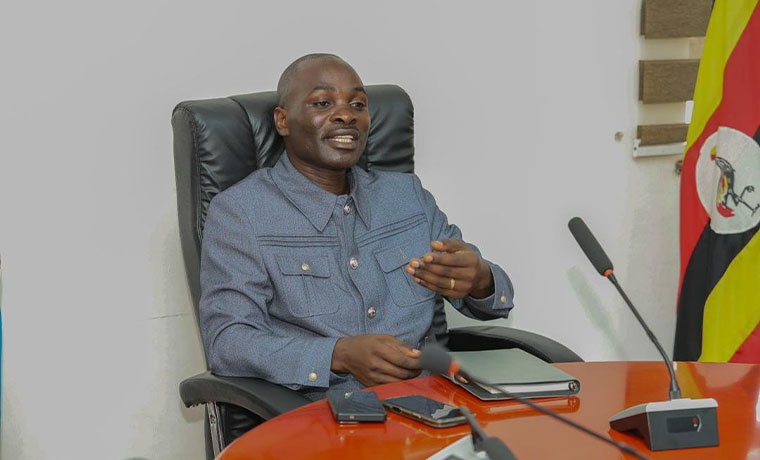
In a statement to Parliament, the Minister of Works and Transport, Hon. Fred Byamukama, revealed that maintaining the national road asset requires about UGX 807 billion annually, but government has allocated only UGX 326 billion—leaving a funding gap of about UGX 481 billion.
The ministry estimates the country’s national road asset is worth approximately UGX 26.9 trillion, raising questions about whether current spending levels are sufficient to protect public infrastructure investments already made.

The funding shortfall comes at a time when Uganda’s road network remains largely unpaved. Of the estimated 159,561 kilometres of roads countrywide, only 5.57 percent is paved, while about 94.43 percent remains unpaved.

The government says road transport accounts for more than 90 percent of passenger and cargo movement in the country, making road infrastructure a key driver of trade and economic activity.
However, several ongoing projects highlighted in the ministry’s report show delays linked to financing challenges, contractor payments, land acquisition, and procurement processes.
Billions committed, projects still incomplete

The ministry reported that it is implementing multiple national road projects, including 23 upgrading projects covering 1,274.8 kilometres, 11 rehabilitation projects covering 854.6 kilometres, and several bridge construction projects.
Some projects have progressed significantly, but others remain behind schedule despite substantial financial commitments.
For example, the Busega-Mpigi Expressway, funded by the African Development Bank and the Government of Uganda, has reached 47.15 percent physical progress and 49.44 percent financial progress. The ministry cites delays in processing additional works as one of the challenges affecting implementation.
The Kampala-Jinja Road rehabilitation project, which was initially planned as periodic maintenance, has reportedly expanded into full rehabilitation because of changing project requirements. The project has reached 75 percent physical progress, but the ministry says completion has been delayed by funding challenges.
On the Katonga Bridge, Lwera Swamp and Kalandazi Swamp reconstruction project, physical progress stands at 82 percent, but the ministry reports delays caused by failure to pay the contractor, with outstanding obligations amounting to about UGX 4.6 billion.
Maintenance spending remains below requirement
The ministry argues that preventive maintenance is cheaper than waiting for roads to deteriorate and require full reconstruction.
The allocated UGX 326 billion will support routine maintenance, periodic repairs of paved roads, bridge maintenance, emergency responses to floods and landslides, and drainage improvements.
But the difference between the annual requirement and available funding means many roads risk deterioration before they receive necessary interventions.
The ministry has also identified inadequate maintenance funding as one of the major challenges affecting transport infrastructure.
Other challenges listed include high costs of acquiring land for road projects, climate change impacts, limited capacity among local contractors, lengthy procurement processes, and delays in releasing counterpart funding for externally financed projects.
Road equipment: expensive assets, limited availability
Questions over value for money also extend to road construction equipment owned by government.
According to the ministry, Uganda procured 1,151 units of road equipment from Japan in 2017 and previously acquired 1,405 units from China in 2012. The combined value of the equipment is estimated at more than USD 250 million.
Despite this investment, availability remains low.
The ministry reported that only:
- 50 percent of district road equipment is currently available;
- 40 percent of zonal heavy equipment is operational;
- 40 percent of force account equipment is available; and
- equipment received from China in 2012 has availability of only 0–3 percent.
The ministry attributed improvements in equipment availability to supplementary funding used for major repairs and purchase of tyres, but it also identified additional funding gaps.
For example, district road equipment requires UGX 45 billion, but only UGX 22 billion has been approved, leaving a UGX 23 billion gap.
The accountability question
While government continues to announce new road projects, the financing challenges raise questions about whether available resources are being spread too thinly across too many commitments.
The ministry’s own report shows that some projects are progressing well, while others face delays due to unpaid contractors, land acquisition problems, or inadequate funding.
With billions of shillings committed to road construction and equipment procurement, the key accountability issue remains whether spending decisions are matching maintenance needs and whether completed infrastructure is being protected from rapid deterioration.
The Ministry of Works and Transport has assured Parliament that it will continue working with the Ministry of Finance, development partners and other stakeholders to mobilize resources and complete planned interventions.
However, without a clear solution to the maintenance funding gap, Uganda risks losing value from past investments as roads require increasingly expensive rehabilitation instead of timely repairs. (For comments on this story, get back to us on 0705579994 [WhatsApp line], 0779411734 & 041 4674611 or email us at mulengeranews@gmail.com).