







By Aggrey Baba
Uganda is expected to start earning from its oil in 2026, following steady progress in the construction of infrastructure needed to support oil production in the Albertine Graben region.
Government officials and project implementers say the major works are now more than halfway complete, bringing the country closer to realising oil revenues for the first time.
The Albertine Graben, located in western Uganda, is home to the country’s commercial oil reserves discovered nearly twenty years ago. To unlock this resource, the government, together with international oil companies, has been building facilities to extract, process, and transport crude oil.
Among the most important projects is the East African Crude Oil Pipeline (EACOP), a 1,443-kilometre pipeline that will carry Uganda’s crude oil from Hoima to the port of Tanga in Tanzania.

The pipeline, being implemented by EACOP Ltd, a company jointly owned by Uganda, Tanzania, TotalEnergies, and CNOOC, is now reported to be about halfway complete.
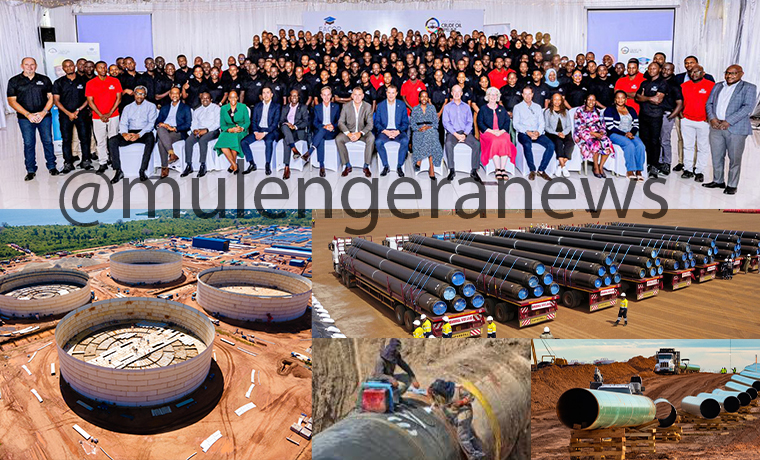
According to the Petroleum Authority of Uganda (PAU), over 1,000 kilometres of pipeline sections have already been delivered from China and are currently being insulated and coated in preparation for installation.
The pipeline will be buried underground and will serve as the main route for exporting Uganda’s oil to international markets.
In addition to the pipeline, other critical components are also progressing. These include central processing facilities, pump stations, access roads, and the drilling of production wells at two major oil fields of Tilenga in Buliisa District and Kingfisher in Kikuube District.


At the Kingfisher site, which is being developed by CNOOC, 18 out of the planned 31 wells have already been drilled. Meanwhile, TotalEnergies is overseeing the Tilenga project, where similar progress is being made, and both fields will feed oil into the pipeline through central processing stations that are currently under construction.
One of the structures under construction is Pump Station One (PS1) in Rwenkunyu, Hoima District, a facility which will collect and measure oil from surrounding fields before it is sent to either the refinery or into the pipeline for export. The foundation for PS1 is already in place, and equipment deliveries have started.
During a recent site visit by officials from PAU and Tanzania’s Energy and Water Utilities Regulatory Authority (EWURA), it was noted that Tanzania’s section of the pipeline may be slightly ahead due to early mobilization. However, both sides are working within the same timeline to ensure completion by 2025, in time for first oil in 2026.
Uganda plans to use part of its oil domestically through a refinery that will produce fuel products like petrol and diesel, while the rest will be exported to earn foreign exchange. Government revenues from the oil will come through taxes, royalties, and dividends from Uganda’s shareholding in the joint oil ventures.
Officials have also promised that systems are in place to guard against corruption and ensure that oil revenues benefit the public. The Petroleum Authority and Uganda National Oil Company are among the agencies tasked with oversight and accountability. (For comments on this story, get back to us on 0705579994 [WhatsApp line], 0779411734 & 041 4674611 or email us at mulengeranews@gmail.com).