












By Ben Musanje
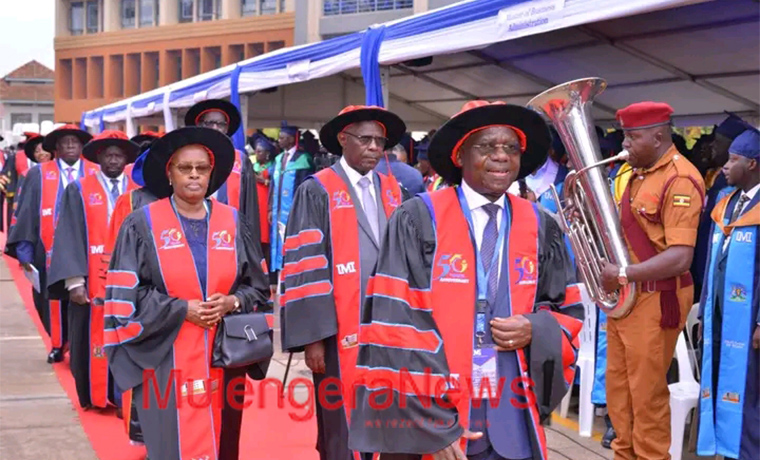
It began as a quiet exchange between old colleagues, but it quickly turned into one of the most memorable moments at Uganda Management Institute’s (UMI) graduation ceremony.
As the tents settled and dignitaries prepared for formal speeches, former Chief Justice Bart Katureebe leaned into reflection, recalling a conversation from years earlier with then Principal Judge Justice Francis Zeija, who was seated in the VIP tent as Guest of Honour.
In a light, almost teasing tone, Justice Bart Katureebe reminded the audience that during his final days in office, he had once advised Justice Francis Zeija not to pressure for an extension of his own judicial leadership transition. At the time, Katureebe was concluding his tenure as Uganda’s Chief Justice, a role he held from 5 March 2015 to 20 June 2020.

He noted that leadership, in his view, is never about holding on, but about allowing institutions to renew themselves through new stewardship. Then came the moment that drew laughter across the tents.

With a relaxed smile, Justice Bart Katureebe remarked that he had since moved on from the judiciary and was “striving,” before adding that there is always life after being Chief Justice. The comment, directed partly at the current CJ now in the tent, blended humour with a quiet lesson on transitions in public service.
Justice Francis Zeija, who has since risen to become Uganda’s Chief Justice in March 2026 after serving as Principal Judge and later acting head of the judiciary, listened attentively as the exchange unfolded in front of grandaunts, faculty and senior government officials.
Beyond the humour, Justice Bart Katureebe used his role as UMI Chancellor to deliver a deeper message about the role of universities in shaping public life. He urged institutions of higher learning to move beyond classrooms and research papers and engage directly with society’s most pressing challenges.

He framed his address around three responsibilities: community engagement, knowledge dissemination and public accountability.
According to him, universities only fulfill their mission when knowledge is applied to real-life problems and used to improve governance, services and livelihoods.
Katureebe emphasized that community engagement should not be symbolic but practical, insisting that universities must co-create solutions with citizens, local leaders, civil society and public institutions.
He further argued that communities should not be treated as passive recipients of knowledge, but as partners who help define research priorities and validate solutions.
On knowledge dissemination, he stressed that academic research must be translated into accessible formats such as policy briefs, radio programmes, training manuals and digital learning tools to ensure it reaches decision-makers and ordinary citizens alike.
He also placed strong emphasis on accountability, arguing that universities have a duty not only to generate knowledge but to empower society to use it in demanding better governance.
In his view, accountability is not confrontation but a mechanism for building trust between citizens and institutions.
To strengthen this vision at UMI, Justice Bart Katureebe proposed structural reforms, including the integration of community engagement into academic performance assessments, expansion of outreach programmes, and the establishment of a Centre for Public Accountability and Knowledge Exchange.
He also called for stronger partnerships with Parliament, local governments, oversight bodies and civil society organizations to ensure research findings influence policy and public service delivery.
Throughout his address, he reminded graduates that they represent a generation of public managers, policy advisors and civic leaders who must balance technical competence with ethical leadership.
Katureebe urged them to act with integrity, serve with humility, and use knowledge to strengthen rather than weaken institutions.
The graduation ceremony itself saw 4,087 graduands receive qualifications, including 11 PhDs, 801 master’s degrees, 3,266 postgraduate diplomas and nine ordinary diplomas.
The event also highlighted UMI’s growing role in public sector capacity building and research-driven education, reinforcing its position as a key institution in Uganda’s governance and leadership development landscape.
In closing, Justice Bart Katureebe returned to his opening reflection, gently reinforcing his message that leadership transitions are natural and necessary.
As he looked toward Justice Francis Zeija seated among the guests, his words carried both humour and mentorship: leadership roles may end, he implied, but service, relevance and purpose continue well beyond office.
The audience responded with warm applause, capturing a moment where institutional memory, personal friendship and national leadership quietly converged on one stage. (For comments on this story, get back to us on 0705579994 [WhatsApp line], 0779411734 & 041 4674611 or email us at mulengeranews@gmail.com).