









By Ben Musanje
Government’s push to expand home ownership in Uganda has received a major boost after Diamond Trust Bank (DTB) unveiled a new mortgage finance solution aimed at widening access to long-term housing loans amid a market where fewer than 40,000 active mortgages serve a population of about 45 million people.
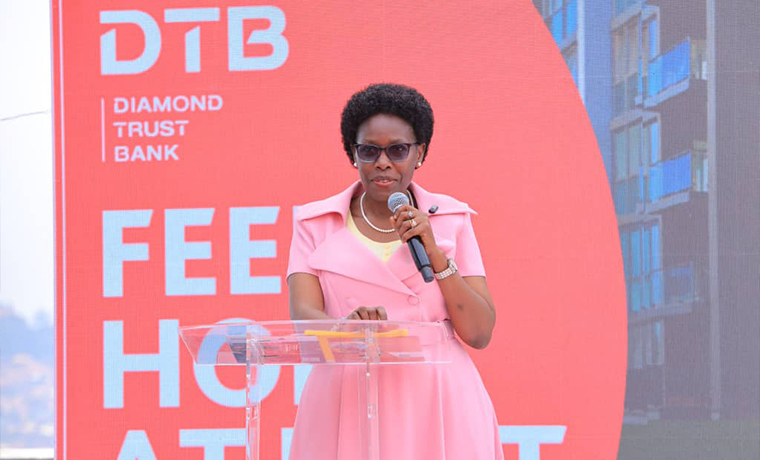
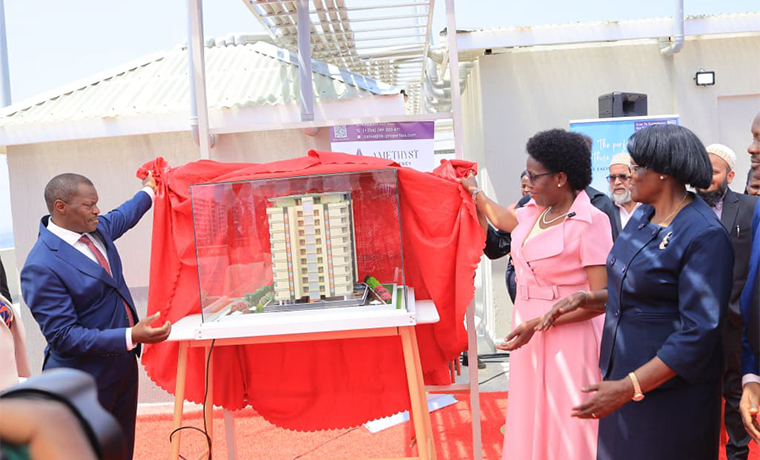
Launching the product at Emerald Residence in Mutungo on Wednesday, Lands, Housing and Urban Development Minister Judith Nabakooba said Uganda’s mortgage penetration remains extremely low, accounting for less than one percent of the country’s Gross Domestic Product (GDP), despite the growing demand for decent housing.
She said the limited access to mortgage financing has contributed to the country’s housing challenges, with about 60 percent of Ugandans living in inadequate or informal housing.

“Mortgage penetration in Uganda is extremely low, accounting for less than one percent of our GDP nationwide. There are fewer than 40,000 active mortgages for a population of 45 million people,” Nabakooba said.

The minister said the situation has worsened the country’s housing deficit, currently estimated at 2.4 million units, as urban areas continue to expand rapidly.
Nabakooba commended DTB for entering the mortgage space, saying the bank’s intervention goes beyond launching a commercial product and represents a partnership with government in addressing one of the country’s biggest socio-economic challenges.
“You are not merely launching a commercial service; you are actively answering a national call. You are choosing to partner with government and the private sector to solve one of the most critical challenges of our generation — providing dignified and accessible housing for our citizens,” she said.

She noted that access to long-term and affordable capital remains the foundation for growing Uganda’s housing sector, urging more financial institutions to invest in mortgage financing.
High costs, land challenges limiting mortgage growth
Nabakooba identified high interest rates, complex land ownership structures, informal employment and limited availability of patient capital as major barriers restricting many Ugandans from accessing mortgages.
She said mortgage rates, which typically range between 17 and expensive for average income earners 24 percent annually, have made long-term borrowing expensive for many households.
“High interest rates make long-term borrowing prohibitively expensive for average income earners,” she said.
The minister also cited challenges associated with land tenure systems, saying disputed ownership structures and difficulties in proving secure ownership often prevent many potential homeowners from using land as collateral.
She added that Uganda’s informal economy presents another challenge because many workers lack conventional payslips and documented monthly incomes required by financial institutions.
“Providing a stated, verifiable monthly income to secure a mortgage loan is still a hurdle for many Ugandans working in the informal sector,” Nabakooba said.
Government reforms to transform housing finance
The minister said government is implementing reforms intended to make mortgage financing more affordable and accessible.
She highlighted the Mortgage Refinance Institution Act as one of the key interventions expected to change the housing finance landscape by enabling access to long-term capital.
According to Nabakooba, mortgage refinance institutions will allow lenders to access deeper pools of funding through instruments such as corporate bonds, helping address the mismatch where banks use short-term deposits to finance long-term housing loans.
“This creates an avenue to pull mortgage rates down towards single digits,” she said.
She also pointed to reforms in property valuation through the Valuation Act, which she said would bring transparency and predictability to the real estate market by addressing inflated property valuations.
The minister said her ministry is accelerating land digitisation through the Land Information System to simplify land searches, reduce fraud and speed up mortgage processing.
“We are working to eliminate fraud practices like multiple titling and create systems where banks can directly access information on parcels they are handling during mortgage processing,” she said.
DTB targets affordable and accessible home financing
DTB Uganda Chief Executive Officer Godfrey Ssebaana said the bank’s decision to launch the mortgage solution was driven by the need to provide patient capital required for Ugandans to acquire homes.
He said DTB had recognized housing as one of the sectors requiring urgent financial intervention because of its role in creating family stability, wealth creation and economic growth.
“We realised there is a very big challenge in the housing sector. Solving this problem required thinking around the product, the price, but most importantly the capital we are going to inject,” Ssebaana said.
He said owning a home represents more than acquiring a building, describing it as a symbol of security, dignity and generational wealth.
“To build a nation, you have to build homes and families,” he said.
Ssebaana announced that DTB’s mortgage solution allows customers to access financing for periods of up to 20 years, with interest rates ranging from 15 to 20 percent depending on the borrower’s risk profile.
He said the bank had focused on ensuring the product remains competitive within Uganda’s lending environment.
“For us to provide financing for a period of 20 years, we have to ensure that the capital we are availing is affordable and does not make it difficult for Ugandans to achieve their dreams,” he said.
Call for housing solutions beyond Kampala
Ssebaana challenged developers to focus on affordable housing projects that cater for different income groups, saying the market should not only target high-end buyers.
He said Uganda needs housing solutions that accommodate ordinary workers, including those earning daily incomes.
“There are people who can afford high-end structures, but we must also provide products that serve the informal sector, including traders, women and young people who contribute significantly to the homes for a Ugandan whose job contributes to his earnings on a daily basis,” he said.
Nabakooba similarly urged DTB to design products that serve the informal sector, including traders, women and young people who contribute significantly to the economy but may not have traditional employment records.
“Do not look only at the top five percent of the formal sector. Design products that recognise cash flows from our informal sector,” she said.
She also encouraged the bank to extend mortgage financing support to emerging cities such as Lira, Gulu, Mbarara, Mbale, Jinja and Arua, where demand for structured housing is increasing.
Partnership key to closing housing gap
Both government and DTB said solving Uganda’s housing shortage will require cooperation among banks, developers, policymakers and citizens.
Ssebaana said DTB will continue working with developers by providing financing to support construction of more housing units.
“We are not only here to launch a mortgage product; we are here to solve a housing problem,” he said.
Nabakooba said government remains committed to providing infrastructure support, including roads, water, electricity and sewerage systems, to enable private developers to focus on affordable housing.
With Uganda’s urban population growing rapidly, the minister said expanding access to mortgage finance will be critical in ensuring more citizens can own decent homes.
“Government cannot do this alone. Through partnerships with institutions like DTB, we can create a future where home ownership becomes achievable for more Ugandans,” she said. (For comments on this story, get back to us on 0705579994 [WhatsApp line], 0779411734 & 041 4674611 or email us at mulengeranews@gmail.com).