







By BM
Kampala is set to become a showcase for Uganda’s green transport revolution, as the government announced plans to replace all fuel-powered boda bodas in the city with electric motorcycles by 2026.
The move reflects Uganda’s commitment to clean energy, reduced carbon emissions, and urban sustainability.
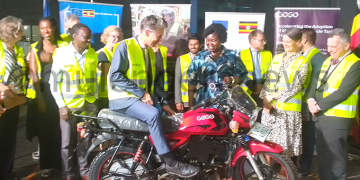
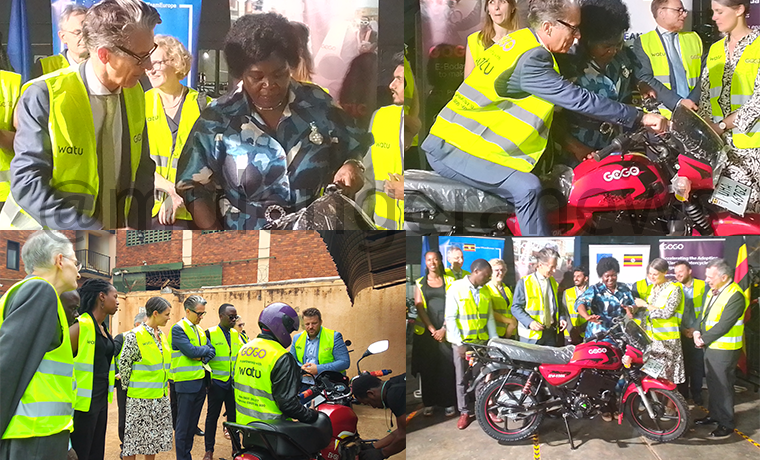
During a visit to Gogo Electric, a Kampala-based electric motorcycle assembly company, Hon. Ruth Nankabirwa, Minister of Energy and Mineral Development, emphasized that Kampala must set the example for the rest of the country.

“All the boda bodas in Kampala must be electric by next year, 2026. There is no reason why we should not. Kampala, the capital city, must serve as a model in reducing smoke and CO₂ emissions,” she said.

The announcement came during Green Diplomacy Week 2025, hosted by the European Union (EU) Delegation in Uganda, and attended by EU Ambassador Jan Sadek, EDFI representatives, and executives from Gogo Electric.
The visit highlighted Uganda’s collaboration with the EU under the Global Gateway and ElectriFI initiatives, which support climate-smart investments and energy access projects.
In 2024, the EU invested USD 1.5 million in Gogo Electric through its ElectriFI impact investment facility, helping the company locally produce electric motorcycles and batteries.


During the visit, a follow-on investment of USD 1 million was announced to expand Gogo’s battery-swapping network and scale production to an estimated 27,000 electric motorcycles and 43,000 batteries.
Ambassador Sadek praised the initiative as a model of sustainable urban transformation. “The EU’s investment in Gogo Electric demonstrates our shared vision for a climate-neutral, job-creating, and sustainable economy. Thousands of electric motorcycles, supported by battery-swapping stations, will clean the air and provide new livelihoods for Ugandans,” he said.
Gogo Electric currently employs around 250 Ugandans, with expansion expected to create hundreds more jobs.
Much of the battery and bike assembly is done locally, using Ugandan resources, while other components are imported.
The company’s battery-as-a-service model allows riders to swap depleted batteries for charged ones at convenient stations, ensuring reliability even in hard-to-reach areas.
Minister Nankabirwa highlighted a suite of incentives to encourage the adoption of electric motorcycles, particularly those manufactured locally, including tax waivers, support for innovative “use and pay” financing models, and the expansion of electricity access to ensure battery swap stations operate efficiently.
The government is collaborating with the Electricity Regulatory Authority to introduce special tariffs for e-mobility, ensuring electricity costs do not discourage adoption.
Over 240,000 new electricity connections have been made recently, and an amnesty program has provided free connections to former power users who had been illegally connected, further improving access for e-mobility infrastructure.
While Kampala will serve as the pilot city, the government plans to extend the rollout to other urban centres including Jinja, Gulu, Masaka, Mbarara, and Lira by 2040.
Focusing on Kampala will allow authorities to measure impacts, optimize battery swap stations, and demonstrate the benefits of e-mobility before scaling nationwide.
Minister Nankabirwa also called on riders and passengers to embrace the transition responsibly, prioritizing safety measures such as helmets and proper attire. She emphasized the holistic approach to e-mobility, which combines environmental sustainability with public health, job creation, and urban modernization.
The transition to electric motorcycles is expected to significantly reduce CO₂ emissions in Kampala, with projections of 148,000 tonnes cut annually.
By replacing polluting fuel motorcycles with clean electric alternatives, the city aims to improve air quality, reduce health risks, and demonstrate a scalable model for other African cities.
The EU reiterated its commitment to Uganda’s green transition. The ElectriFI facility is part of a broader EU strategy that has mobilized over €300 billion in sustainable investments globally, demonstrating how public investment can catalyze private sector engagement in renewable energy, climate resilience, and sustainable transport.
“This initiative is more than a green policy. It’s about jobs, cleaner streets, and prosperity for all Ugandans. Kampala will lead the way, and the rest of the country will follow,” Minister Nankabirwa said. (For comments on this story, get back to us on 0705579994 [WhatsApp line], 0779411734 & 041 4674611 or email us at mulengeranews@gmail.com).