






By Mulengera Reporters
Uganda’s struggle to manage Kampala’s growing waste crisis is less about a shortage of garbage trucks and more about how land is organized, owned and managed, senior government officials and sanitation experts have argued.
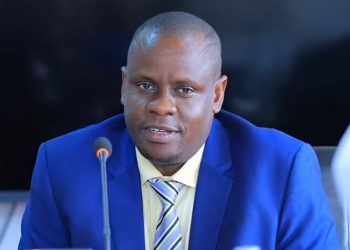
Gen. Salim Saleh, senior presidential adviser and coordinator of Operation Wealth Creation (OWC), and Dr. Eng. Silver Mugisha, Managing Director of the National Water and Sewerage Corporation (NWSC), said sustainable solutions to the capital’s waste challenges require stronger coordination among land-owning institutions and a deliberate approach to making land available for sanitation infrastructure.
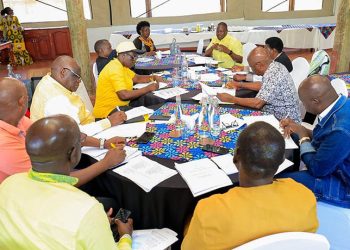
The remarks were made Tuesday in Kapeeka, Nakaseke District, during a high-level meeting convened by Gen. Saleh to review progress of a joint sanitation initiative aimed at addressing Kampala’s mounting solid waste problem.

The meeting brought together key stakeholders involved in the Organic Dark Matter initiative, a partnership between Kampala’s city authorities, Operation Wealth Creation and NWSC launched earlier this year to tackle the city’s sanitation emergency.
Kampala produces an estimated 2,500 to 3,000 metric tonnes of waste every day, yet the city collects less than half of what it generates. The shortfall has been blamed on limited collection infrastructure, illegal dumping, inadequate disposal capacity and rapid urban growth.
A major challenge is the nature of the waste itself. About 80 percent of Kampala’s waste is organic material, making it heavy, bulky and expensive to transport and dispose of. Officials say managing this type of waste requires properly planned land for treatment, recycling and disposal facilities.
During the meeting, participants observed that Uganda’s complex land ownership structures, fragmented ownership arrangements and weak coordination between institutions have slowed efforts to establish effective waste management systems.

They argued that resolving land ownership and access challenges must come before long-term sanitation investments can succeed.
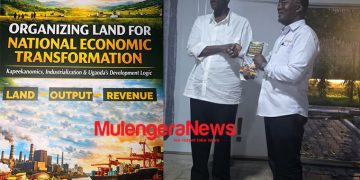
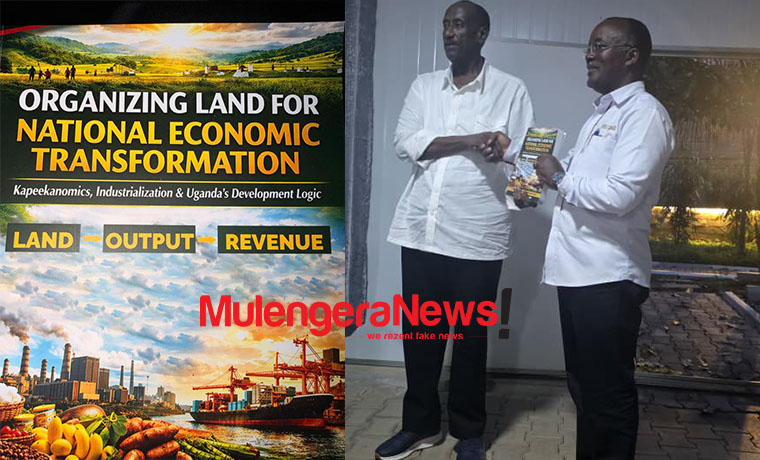
Gen. Saleh has consistently advanced the idea that Uganda’s development challenges are linked not to a shortage of land but to poor organization and coordination of land resources. His argument extends beyond sanitation and forms the basis of his recent book, Organizing Land for National Economic Transformation: Kapeekanomics, Industrialization and Uganda’s Development Logic, co-authored with development scholar Dr. Pascal Odoch.
The book presents land as a resource whose value can be unlocked through better planning, organization and investment rather than through ownership alone.
On the sidelines of the meeting, Gen. Saleh presented a copy of the book to Dr. Mugisha, highlighting the connection between organized land use, industrial development and improved public services.
Kapeeka itself was cited as an example of how coordinated land management can transform economic activity. The area hosts the China-Uganda Liao Shen Industrial Park, a 5.2-square-kilometre manufacturing hub that has developed from former agricultural land into a growing industrial centre with dozens of factories.
Gen. Saleh praised Dr. Mugisha and NWSC for supporting infrastructure development in the wider Namunkekera industrial area, where the corporation upgraded water supply systems using water drawn from River Mayanja to serve industries and surrounding communities.
The NWSC chief also emphasized the need for stronger partnerships between government agencies, private sector players and development partners to address sanitation challenges.
NWSC currently manages Kampala’s sewerage and faecal sludge treatment systems, operating three major treatment facilities — Bugolobi, Lubigi and Nalukolongo — as well as the Kinawataka sewage pre-treatment facility where private cesspool operators discharge waste.
The upgraded Bugolobi treatment plant has a design capacity of 45,000 cubic metres per day and uses treated waste to generate biogas electricity, while dried sludge is processed for agricultural use.
However, officials acknowledge that sewer coverage remains limited in Kampala, forcing many households and businesses to rely on septic tanks and pit latrines that require regular emptying by cesspool trucks.
Dr. Mugisha said NWSC remains committed to improving cooperation among institutions and supporting solutions that promote public health, environmental protection and sustainable waste management.
“The challenge requires collective action and better coordination among stakeholders,” officials noted during the meeting, emphasizing that no single institution can resolve Kampala’s sanitation problems alone.
The proposed reforms, however, face the challenge of changing a system where agencies and land-owning bodies have historically operated separately.
Kampala’s waste management system has repeatedly struggled under increasing pressure. The challenge became particularly visible after Uganda’s first National Cleaning Day, when the volume of collected waste overwhelmed existing collection networks and caused congestion at the Buyala disposal facility for several days.
Stakeholders now believe that organizing land for sanitation infrastructure could provide the foundation for a more permanent solution — one that transforms Kampala’s waste from an urban burden into a managed resource capable of supporting environmental protection, energy production and economic development. (For comments on this story, get back to us on 0705579994 [WhatsApp line], 0779411734 & 041 4674611 or email us at mulengeranews@gmail.com).