





By Mulengera News
Karamoja is no longer being whispered about in humanitarian briefings, it is being repositioned as Africa’s next strategic frontier.
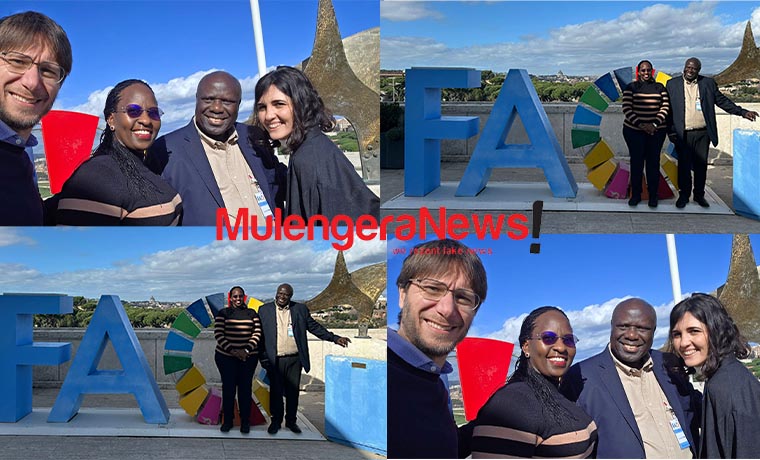
In a high-stakes brainstorming session that could redefine the future of Uganda’s north-east, the Food and Agriculture Organization (FAO) of the United Nations sat down with the ambitious Karamoja Peace and Technology University (KAPATU) project to explore a partnership insiders say could transform not only Karamoja, but the wider Ateker region and Africa’s vast drylands.

This was not a donor pledge meeting held in February this year (2026). No funds were exchanged. No ceremonial agreements were signed. Instead, what unfolded was something far more strategic: a recalibration of how Karamoja is seen and how it will shape its own destiny.
For decades, the region has been framed as fragile, peripheral, and aid-dependent. But in that room, Karamoja was reframed as a strategic Arid and Semi-Arid Lands (ASAL) context, a living laboratory whose climate realities mirror those across Africa’s drylands. The message was unmistakable: this is not a space for endless emergency response. It is a frontier for innovation, resilience, and systems transformation.
At the centre of this shift stands KAPATU, a purpose-built public university conceived in 2014 and actualised on 29 April 2023 in a colourful ceremony presided over by Uganda’s Vice President, Jessica Rose Epel Alupo, representing President Yoweri Kaguta Museveni. The institution operates under a powerful Strategic Leadership Committee chaired by President Museveni himself, alongside Vice President Alupo and First Lady Janet Kataha Museveni. With a government allocation of Shs180 billion in FY2025/26 following a special Cabinet sitting chaired by the President, the political backing behind the university is unmistakable.

Far from being a symbolic institution, KAPATU has been positioned as the intellectual engine of Karamoja’s transformation. Its multi-faculty structure, spanning agriculture, health sciences, engineering and technology, education, peace and diplomacy, and law is designed not merely to graduate students, but to institutionalize development gains through research, innovation, and community engagement. It represents a deliberate shift from fragmented, short-term projects to systems anchored in knowledge and local capacity.
During the session, discussions ventured into areas that go beyond routine agricultural support. Livestock disease surveillance under the One Health framework, nutrition-sensitive food systems, digital agriculture and market integration, biodiversity and the emerging bio-economy, sustainable wildlife management, gender and youth inclusion, resilience in fragile contexts, and the catalytic role of legal reform were all placed on the table. The convergence aligns tightly with FAO’s global vision of Better Production, Better Nutrition, Better Environment, and Better Life but the ambition here is regional reinvention.
Perhaps the most telling outcome of the engagement was the formal referral of KAPATU by the FAO Uganda Country Office for deeper technical discussions on collaboration pathways and partnership modalities. In development diplomacy, such a referral signals more than polite interest; it suggests institutional recognition and the possibility of long-term engagement.
KAPATU itself is a unique coalition, jointly established by the Roman Catholic Dioceses of Kotido and Moroto, supported by the Catholic Lawyers Society International under Counsel Severino Twinobusingye, and backed by the Government of Uganda. Its main campus at Losilang in Kotido Municipality stands not just as a construction project, but as a political and intellectual statement: Karamoja will build its own experts, craft its own policies, and anchor its own peace and development agenda.
If this alliance crystallizes, the implications could ripple far beyond Uganda. Africa’s drylands are home to millions who face similar climate volatility, food insecurity, and governance challenges. What is being quietly shaped in Karamoja could become a continental template — a model proving that resilience is not delivered by rotating projects, but engineered through institutions.
What was officially described as a “non-financial exploratory dialogue” may, in time, be remembered as the moment Karamoja stopped being treated as a humanitarian footnote — and started positioning itself as Africa’s dryland power house in the making.