






By Arthur Nuwagaba
The recent anti-corruption operations led by the Minister of Local Government, Hon. Balaam Barugahara Ateenyi, and the Minister of State for Local Government, Hon. Justine Nameere, have captured national attention. Their inspection tours have uncovered alleged cases of ghost workers, procurement irregularities, abandoned government projects, misuse of public funds, and poor service delivery in several local governments. These efforts deserve recognition because they demonstrate government’s commitment to promoting accountability and exposing corruption.
However, they also reveal a fundamental weakness in Uganda’s anti-corruption strategy. Most interventions are postmortems; they occur after public resources have already been stolen or wasted, contracts have been manipulated, projects have stalled, and taxpayers have suffered the consequences. By the time investigators arrive, the damage has already been done. While arrests and prosecutions are necessary, they do not always translate into the recovery of stolen public resources. This raises a more fundamental question: Why do we continue waiting for corruption to occur before taking action, instead of preventing it in the first place?
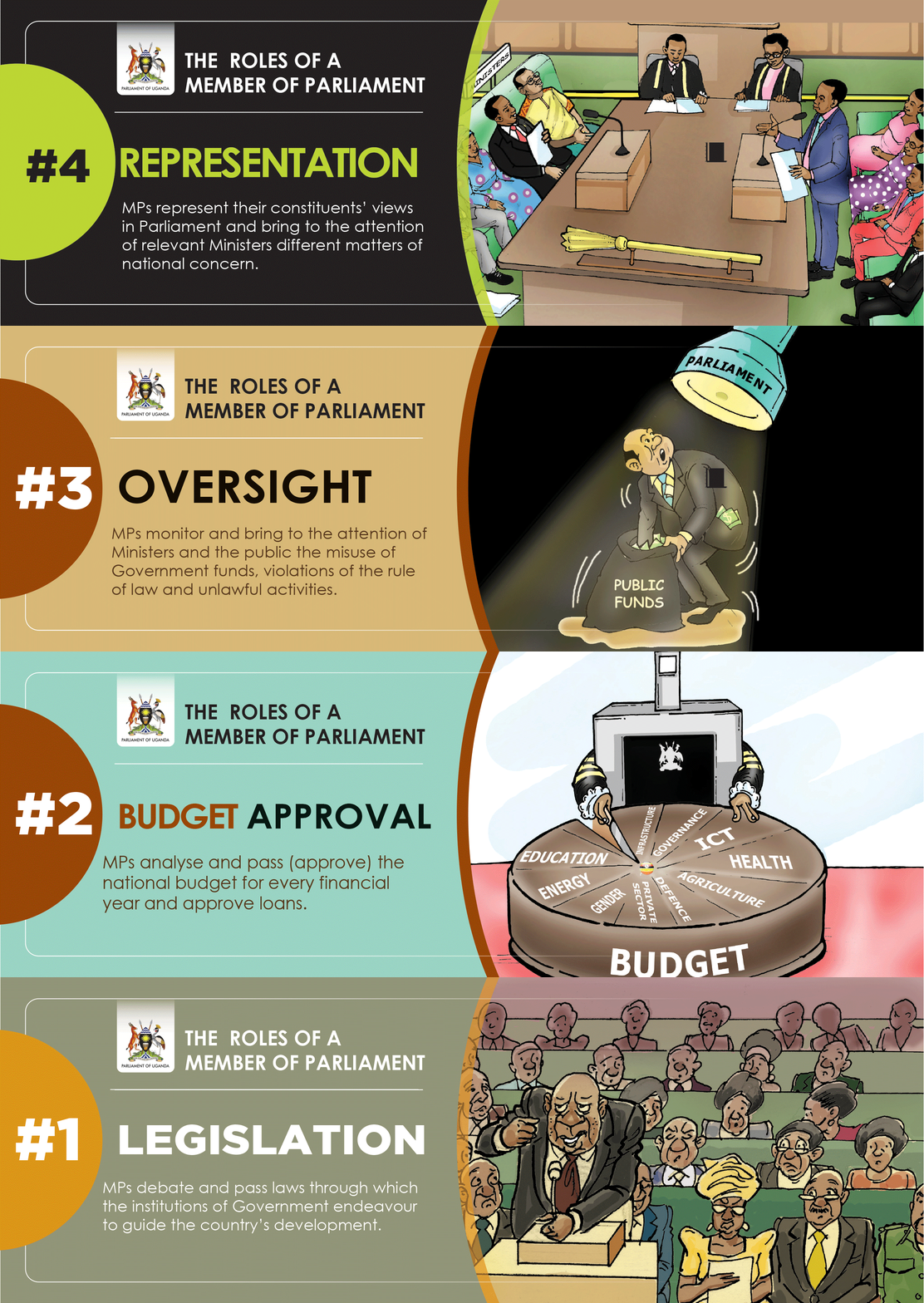
Uganda has no shortage of anti-corruption institutions. The Inspectorate of Government (IGG), State House Anti-Corruption Unit, Criminal Investigations Directorate (CID), Office of the Director of Public Prosecutions (DPP), Office of the Auditor General (OAG), Public Procurement and Disposal of Public Assets Authority (PPDA), Financial Intelligence Authority (FIA), the Anti-Corruption Court, and Parliament’s oversight committees all play critical roles. Yet corruption continues to undermine national development.

According to the Inspectorate of Government, Uganda loses approximately UGX 9.144 trillion annually to corruption. Auditor General reports consistently reveal procurement irregularities, inflated contracts, unsupported expenditures, abandoned projects, delayed implementation and poor-quality public works. These recurring findings suggest that Uganda has become effective at detecting corruption after it occurs, but less effective at preventing it.

Corruption does not begin when money leaves the Treasury. It begins when procurement processes are influenced by hidden interests instead of competition, contract terms create loopholes for inflated claims and unjustified variations, and weak supervision allows substandard work to be certified. By the time payments are made, corruption has already passed through several stages involving procurement, contract management, project supervision and financial approval. The consequences are evident across many public projects. Cost overruns, delayed completion, frequent contract variations and infrastructure that fails to meet expected standards have become recurring challenges.
There is also a social contradiction. While many Ugandans condemn corruption, they often defend individuals accused of it because of political, ethnic or personal loyalties. Accountability becomes secondary to affiliation, weakening public confidence in the fight against corruption. Uganda must therefore complement enforcement with prevention. Investigations, arrests and prosecutions remain necessary, but they should be the last line of defence, not the first.
Government should establish a National Project Monitoring Unit supported by integrated digital systems that monitor procurement and project implementation in real time. Such a system should generate automatic red flags whenever project costs exceed approved budgets, timelines are unnecessarily extended, payments are made without corresponding physical progress, or quality standards are compromised. Technologies such as electronic procurement, artificial intelligence, geotagged inspections and integrated financial management systems can detect risks before billions of shillings are lost.

The true measure of success in fighting corruption should not be the number of arrests or prosecutions. It should be the amount of public money protected before it is stolen. Uganda does not simply need stronger investigations; it needs stronger preventive systems. The future of the anti-corruption agenda lies in preventing corruption before it happens, not conducting postmortems after the damage is already done. The writer is a Senior M&E Practitioner and a PhD Candidate in Business. Administration. (For comments on this story, get back to us on 0705579994 [WhatsApp line], 0779411734 & 041 4674611 or email us at mulengeranews@gmail.com).