






By Nabimanya Ronald
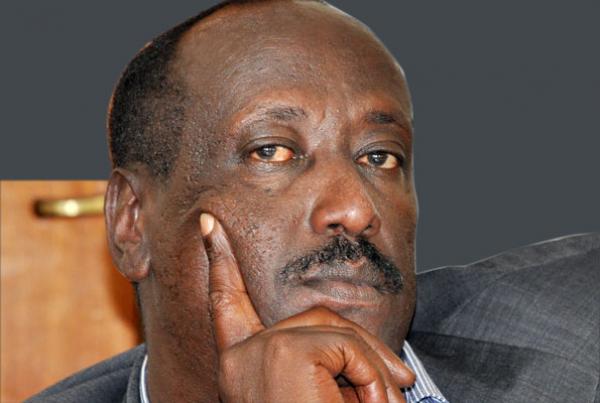
The recent diplomatic tensions between Uganda’s Chief of Defense Forces and European Union envoys have drawn public attention to the evolving dynamics within the country’s security and foreign relations landscape. At the center of this unfolding story is Gen. Salim Saleh, a revered veteran of Uganda’s liberation struggle who continues to play a pivotal role in mediating transitions between old and new paradigms of leadership.
Saleh: The Stabilizer Uganda Needs
In a time when swift reactions often eclipse strategic thinking, Gen. Saleh’s response to the EU delegation exemplified Uganda’s capacity for self-regulation. Without dismissing concerns, he reassured allies that Uganda understands the value of diplomatic engagement, even when internal voices differ in tone or style.
Throughout his public life, Saleh has cultivated the role of stabilizer. His quiet yet deliberate influence has often brought balance during moments of tension. He commands respect across generations from his fellow NRA veterans to the rising generation of digital-age commanders. In every high-stakes moment, Saleh has acted not as an enforcer, but as a steward of national interest. His recent remarks reflected not only political wisdom but a deep sense of institutional maturity. Uganda, he seemed to remind the world, is not adrift.
Saleh represents a model of leadership that is both historically grounded and forward-looking. His message to Uganda’s European partners was calm, assuring, and rooted in mutual respect reminding all stakeholders that Uganda has internal mechanisms of balance and that such mechanisms are alive and active.
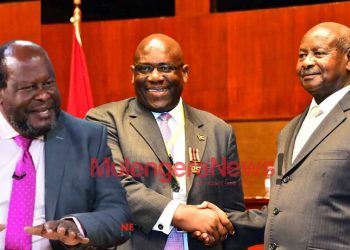
Gen. Salim Saleh and his team with EU Ambassadors at his home in Gulu.
Muhoozi: The New Breed, Not Without Value
It is no secret that Gen. Muhoozi Kainerugaba’s public statements often delivered through social media have sparked spirited debate, both at home and abroad. His style, forthright and sometimes confrontational, marks a notable departure from the traditional script of military diplomacy. Yet, to focus solely on form risks missing the deeper context of his emergence.
Muhoozi belongs to a generation shaped not by the bush war but by its aftermath. He is a product of the post-liberation Uganda professionally trained abroad, versed in regional geopolitics, and unafraid to assert Uganda’s interests on digital platforms that have become central to modern political discourse. In this light, his rise reflects more than personality; it signals a generational shift in how power, patriotism, and public voice are expressed.
While his methods may contrast with those of his predecessors, Muhoozi’s motivations stem from a desire to see Uganda recognized and respected on its own terms. His sense of urgency resonates with many young Ugandans especially those who feel that traditional diplomacy often moves too slowly to reflect their frustrations or aspirations. His voice, though controversial at times, is anchored in the same national pride that drove the liberation generation before him.
Critically, Muhoozi’s statements do not define Uganda’s state policy. The country remains governed by collective leadership, constitutional frameworks, and institutional oversight. His role symbolic to some, strategic to others adds texture to Uganda’s evolving political identity but does not unilaterally shape it.
This is why Gen. Salim Saleh’s presence is so essential not to stifle the rising generation, but to guide it. Saleh’s stabilizing influence does not compete with Muhoozi’s energy; it channels it. Together, they embody a necessary dialogue between experience and ambition, tradition and transformation.
Rather than dismissing Muhoozi, Uganda must harness his voice, temper it with wisdom, and integrate it into a broader framework of national development. That is how resilient systems are built not by erasing new voices, but by cultivating them with care and conscience.
On the EU: Room for Reflection
Uganda has long enjoyed fruitful relations with the European Union, and this partnership continues to be important for trade, development, and diplomacy. The concerns raised by the EU are noted, but they must be weighed against the context in which Uganda operates.
Diplomacy is not only about reacting to speech, but also about interpreting intent and appreciating local realities. Uganda, like any nation, has multiple voices; some traditional, others new, some restrained, others passionate. To judge a nation solely on one expression is to miss the symphony.
Gen. Saleh’s intervention was an invitation to dialogue, not a dismissal of criticism. It reflected Uganda’s willingness to self-reflect and self-correct, without external imposition. For diplomacy to be meaningful, it must be mutual. And mutual respect begins with contextual understanding.
Conclusion: Unity, Understanding, and Forward Motion
Uganda’s strength has never come from uniformity, but from the ability to harmonize its differences. Gen. Saleh’s recent remarks, and his broader posture in national affairs, reaffirm that leadership is not about silencing rising voices, but guiding them.
He is, in many ways, the stabilizing force ensuring that Uganda’s journey from its liberation roots to its modern-day ambitions remains on course. As regional dynamics shift and younger voices grow louder, it is men like Saleh who ensure that the past and future walk hand in hand.
The world would do well to see beyond the noise to understand Uganda as a sovereign nation with internal resilience, generational depth, and leaders capable of navigating both continuity and change with dignity.
Nabimanya Ronald is an Author, Publisher and Ugandan Concerned Citizen & can be reached via bishanga.ronald@gmail.com. (For comments on this story, get back to us on 0705579994 [WhatsApp line], 0779411734 & 041 4674611 or email us at mulengeranews@gmail.com).