






By Aggrey Baba
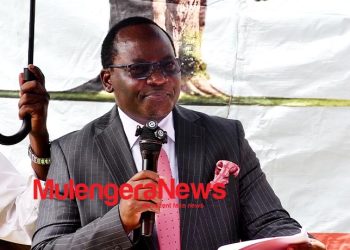
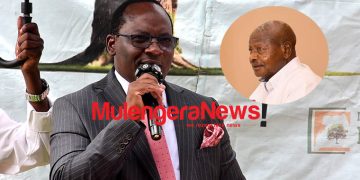
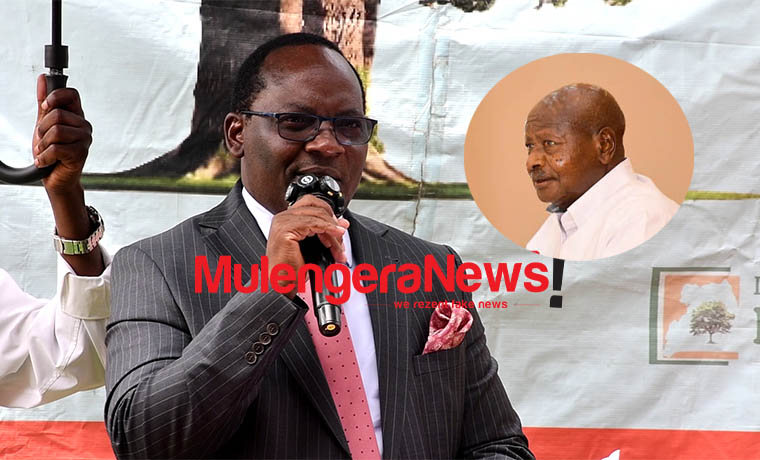
Democratic Front (DF) President Mathias Mpuuga has warned President YK Museveni against turning Uganda’s long-awaited political transition into an internal NRM succession arrangement, arguing that the country’s future cannot be determined by NRM alone.
Mpuuga said the question of what happens after Museveni’s forty years in power is a national matter involving all Ugandans, not simply an issue of identifying who should take over the presidency within the NRM.
He argued that Uganda does not need another change of guard in which one individual replaces another while the same political and governance arrangements remain in place.
The DF leader made the remarks on Monday in Lungujja, where he outlined the party’s position on national dialogue, constitutional reforms and the need for an orderly transfer of power.
His remarks come against the backdrop of recent NRM Central Executive Committee (CEC) meetings, where Museveni is reportedly said to have endorsed his son, Gen Muhoozi Kainerugaba, as his preferred successor, further drawing attention to questions about the country’s political future and the possibility of an NRM-led succession arrangement.
Mpuuga said reports and political discussions suggesting that Museveni could be preparing to step aside after 40 years in power had generated considerable public interest, but warned against allowing the succession question to be handled as an NRM internal affair.
“Uganda’s transition is not an NRM internal matter, but a national question for which Ugandans have waited, wished, prayed, fasted and struggled for decades,” he said.
He argued that after 40 years in power, Museveni should use the opportunity to facilitate a national process that prepares the country for a new political and constitutional order rather than impose another successor.
“Uganda does not need succession, a simple change of guard. Having had enough of the same since independence, we need a change of system,” Mpuuga said.
He said the country needed a transition from a system characterized by impunity and rule by force to one grounded in the rule of law, democratic consent and functioning institutions.
Mpuuga argued that NRM had a responsibility to help oversee an orderly transition because of its long period in government and its influence over the country’s political and security structures.
According to Mpuuga, an imposed succession arrangement risked creating instability, regardless of who eventually occupied State House.
The DF president outlined several issues he believes must form part of the transition discussions, including restoring presidential term limits, strengthening constitutional institutions, protecting fundamental rights and freedoms, reforming the electoral system and addressing the role of the military in politics.
He also called for a framework that would allow a retiring president to leave office with dignity, safety and immunity, while ensuring that state institutions are no longer controlled by the interests of individuals or political factions.
Mpuuga said the country needs a constitutional settlement that could not be easily altered by one individual for personal or political convenience.
He further argued that a credible transition must include an agreed framework for transferring power, rather than leaving the country to uncertainty or an informal succession arrangement like the one NRM is reportedly pursuing.
DF wants the process to be anchored in structured national dialogue involving political parties, civil society, religious and cultural institutions and other stakeholders.
Mpuuga said such a process should have an agreed agenda, clear rules, a trusted convener, a defined timeframe and a mechanism for monitoring implementation of the resulting agreements.
He also called on Museveni and the NRM to demonstrate goodwill by allowing discussions on Uganda’s future to begin immediately.
The DF leader said his party is prepared to engage other political parties and participate in efforts to build consensus around reforms, reconciliation and an orderly transition.
He warned that the choice facing Uganda was between continuing with political division and uncertainty or pursuing dialogue and reforms that could give the country a new constitutional direction.