







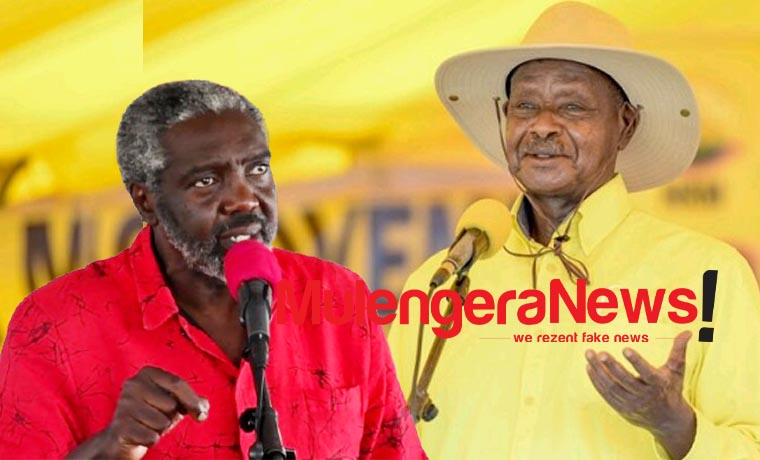
The political dialogue between President Yoweri Museveni’s NRM and opposition parties suffered what UPC president Jimmy Akena describes as deliberate sabotage after negotiations had already produced agreements on increased political-party funding.
Akena has now lifted the lid on what he says was a breakdown of trust inside the dialogue process, accusing individuals within the ruling establishment of turning against agreements they had participated in making once it became clear that opposition parties stood to benefit.
The UPC president says he was among the opposition leaders who pushed hardest for engagement with Museveni, even publicly declaring that he was willing to meet the President over something as simple as a cup of tea if that was what it took to get political dialogue moving.
And according to Akena, the engagement was not a waste of time.
“We got some progress made. We got funding increased across the board, agreed all the budgets,” he revealed.
But he says the atmosphere changed when some individuals within Museveni’s government became uncomfortable with money going to one political party.
Akena described the subsequent conduct as treachery, arguing that the ruling party cannot invite opposition leaders to negotiations and then undermine the commitments reached when it comes to implementation.
He also reminded the NRM that its own historical predecessor, the National Resistance Army, received direct government funding while operating as a department of government.
For years, Akena said, the NRA was financed through government structures, including the period leading up to the return to multiparty politics.
He questioned the moral authority of ruling-party figures who now appear uncomfortable with public financing of political parties when their own political history includes benefiting from such arrangements.
This comes at the backdrop of some opposition political parties being denied entry into the IPOD, following recent reforms which were initiated by DP’s Norbert Mao, who is also the minister of Justice and Constitutional Affairs in Museveni’s government.
Akena also defended his record in the Inter-Party Organisation for Dialogue, saying he was instrumental in securing the first summit and pushing political-party funding onto the summit agenda.
He went ahead and challenged the NRM to demonstrate what it had achieved in advancing the dialogue process.
“NRM record: zero. Jimmy Akena’s record: I got the first summit,” he declared.
But the UPC boss warned that dialogue cannot be reduced to a public-relations exercise in which opposition leaders are expected to sit with government, smile for photos and pretend that political disagreements and abuses have disappeared.
He accused the government of mistreating, threatening, jailing and killing political opponents while still expecting them to participate in negotiations as though nothing is wrong.
“You’ve mistreated us, you’ve cheated us, you’re abusing us, you’re threatening us, you’re jailing us, and you’re killing us. And you still want dialogue, and we’re still talking,” he said.
Akena maintained that he remains willing to negotiate with the NRM, but insisted that genuine dialogue requires honesty, respect and the implementation of agreed commitments.
He said he would not allow his willingness to engage Museveni to be exploited as evidence that the opposition has accepted political mistreatment.
His account raises uncomfortable questions about the credibility of the IPOD framework and whether agreements reached between the NRM and opposition can survive resistance from powerful individuals within the NRM. (For comments on this story, get back to us on 0705579994 [WhatsApp line], 0779411734 & 041 4674611 or email us at mulengeranews@gmail.com).